What Happens When Consignment Stock Comes Back
Most conversations about consignment stock focus on the outbound side. You pack it, you send it, you eventually find out how much sold. That's the story everyone tells, because it's the story that generates revenue. But every consignment relationship has a second half that gets far less attention: the stock that comes back.
Sometimes it's a full pallet a retail partner decided not to carry anymore. Sometimes it's a handful of units that didn't move after a season. Sometimes it's damaged goods a partner is sending back rather than trying to sell. Whatever the reason, that stock has to go somewhere, both physically and in your records, and how well that second half is handled says just as much about the health of your consignment operation as how well the first half is.
Why a return is trickier than it sounds
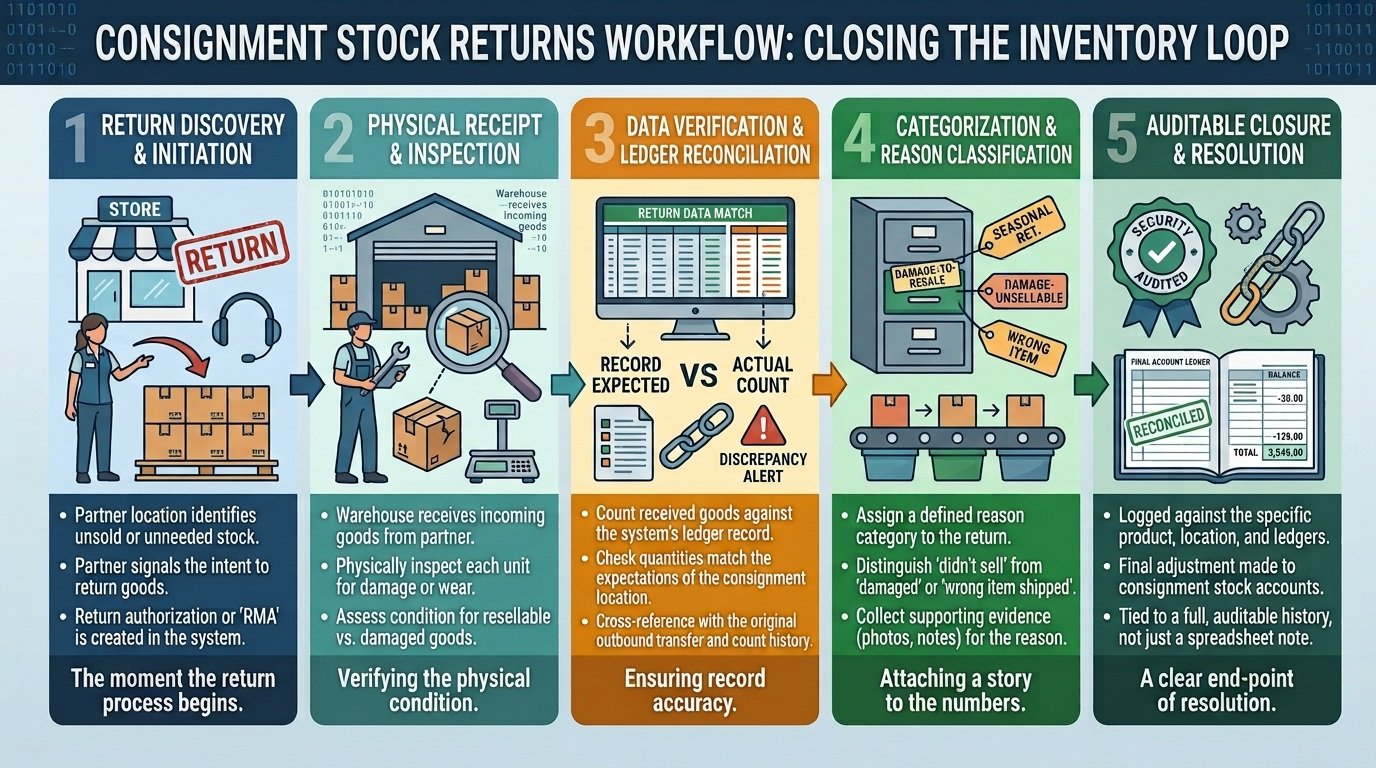
On paper, a return sounds simple. Stock comes back, you note it down, done. In practice, a return raises questions the outbound side never had to answer. Is what's physically coming back the same quantity your records say should be there? Is it in sellable condition, or was it returned specifically because it isn't? Is this a genuine return of unsold stock, or is it actually covering for a shortfall that was never properly investigated as a loss?
That last question matters more than it might seem. If a partner sends back fewer units than your records expected, and that gap simply gets folded into “well, that's the return,” a real discrepancy, whether it's a counting error, damage nobody flagged, or something more concerning, can quietly disappear into a number that looks perfectly normal on paper.
What a proper return process actually needs to capture
A return that's handled well isn't just a quantity going back into inventory. It needs to record what's actually coming back, matched against what was expected to be there, at that specific location, for that specific product. It needs a reason attached, drawn from a real, defined list rather than a vague note, so that “didn't sell,” “damaged,” and “wrong item shipped” are all distinguishable from each other instead of blurring into one catch-all category.
This is exactly the gap APES is built to close for consignment businesses. Inside APES, a stock return isn't a standalone note in a spreadsheet, it's logged against the same product, the same location, and the same ongoing ledger that already tracked that stock's transfer out and every count taken while it sat with the partner. A return with a reason category attached, tied to a real record instead of a rough note, gives you something a spreadsheet never can: a full, connected history for that stock, from the day it left your hands to the day it's fully accounted for again.
The trust question, from the other direction
An earlier piece on this topic talked about how consignment stock tracking is really a trust problem as much as a logistics one. Returns are where that trust gets tested from the opposite direction. Sending stock out and later finding a shortfall is one kind of uncomfortable conversation. Receiving stock back and finding it doesn't match what was expected, in quantity, in condition, or in the reason given, is another kind entirely, and often a more sensitive one, because it can feel like it's questioning whether the partner is being straightforward with you.
A structured return process defuses a lot of that tension before it starts. When every return carries a clear record, a defined reason, and a count that either matches expectations or is flagged when it doesn't, the conversation stops being “I think something's off” and becomes “here's exactly what the numbers show, let's figure out why.” That's a much easier conversation to have, for both sides.
What happens without this structure
Picture the alternative. A partner calls to say they're sending back three boxes of unsold stock. Someone receives it, gives it a quick visual check, and updates a spreadsheet with a rough number. Nobody records why it's coming back specifically, whether it was counted against what the ledger expected, or whether the condition matches what a saleable return should look like. Three months later, when the year-end reconciliation happens, that return is just a number with no story behind it, indistinguishable from every other adjustment made that quarter.
Now picture needing to answer a real question about it. Did that return actually match what was owed, or was some of it quietly short? Was any of it damaged, and if so, was that ever followed up with the partner? Without a proper record made at the time, those questions don't have answers, only guesses.
Why this matters more as you scale
A single retail partner sending back the occasional item is manageable even without much structure, because there's little volume to lose track of. The problem grows fast once there are ten, twenty, or fifty partner locations, each with their own rhythm of transfers, sales, and returns. At that scale, an unstructured return process doesn't just create the occasional awkward gap, it becomes a genuine blind spot across the entire operation, one that's almost impossible to audit properly after the fact because there was never a consistent record to audit in the first place.
This is exactly why APES treats returns as their own tracked workflow inside its Consignment Stock module, not an afterthought bolted onto the transfer process. Every return carries the same rigor as a transfer or a count: tied to the right location and product, backed by a defined reason, and reconciled against what the ledger already expected to be there. Whether you're managing three partner locations or fifty, the same structure applies consistently, without needing someone to remember to apply it by hand each time.
Closing the loop properly
Consignment stock only tells a complete, trustworthy story when every stage of its life is recorded with the same care, from the moment it leaves your hands to the moment it's confirmed sold, or the moment it comes back. Treating returns as a minor bookkeeping afterthought is how small discrepancies quietly become large, unexplainable gaps by the time anyone goes looking for them.
If your current return process is “someone counts what comes back and updates a spreadsheet,” that's worth a closer look, not because it's necessarily wrong today, but because it's exactly the kind of gap that only becomes visible once it's already cost you something.
This is the kind of gap Appnicorn works with consignment businesses to close, using APES to give every transfer, count, and return a single, connected record instead of a scattered one. If your consignment stock still moves through spreadsheets and best guesses on the way back in, reach out to Appnicorn to see what it looks like when the whole cycle, out and back, lives in one system instead.