Consignment Stock Tracking, Finally Visible
If you run a consignment business, you already know the strange discomfort of not really knowing where your own stock is. You packed the boxes yourself. You dropped them off at your retail partner's shelf. And from that moment, the stock enters a kind of fog. You know roughly how much you sent. You don't really know how much is left, how much sold, or whether the numbers your partner reports back to you match what's actually sitting on their shelf.
This isn't a trust problem in the personal sense. Most retail partners aren't trying to shortchange anyone. It's a tracking problem. Stock that lives outside your own four walls is naturally harder to see, and when you can't see it clearly, every number becomes a small negotiation. Was it 40 units sold or 38? Did two go missing, or were they just miscounted during a busy Saturday? Without a shared, reliable record, both sides end up guessing, and guessing is exhausting when it happens every single month.
Why consignment stock breaks most inventory systems
Most inventory tools are built with one assumption baked in: the stock lives in a place you control. A warehouse. A single shop. A backroom you can walk into and count yourself. Consignment breaks that assumption immediately. Your stock might sit across a dozen different partner locations, each with its own staff, its own rhythm, and its own way of writing things down, if they write things down at all.
On top of that, consignment stock moves in more directions than a normal sale. It gets transferred out to a partner. Some of it sells, though nobody actually watches it sell. Some of it gets returned. Occasionally a physical count reveals a difference between what the system expects and what's actually there, and someone has to decide whether that difference is a genuine sale, a loss, a counting mistake, or a transfer that was never properly recorded. Each of these movements needs its own record, and if any one of them is missing, the whole picture stops making sense.
The result is what a lot of consignment businesses quietly live with: a spreadsheet that's always a little bit behind, a WhatsApp message asking “how many do we have left at that outlet,” and a monthly reconciliation that takes longer than it should because nobody's really sure which number to trust.
What actually needs to happen for consignment stock to be visible
Here's the part worth being honest about, because it shapes everything else: nobody, not APES, not any system, knows the moment a consignment item sells. There's no cash register plugged into the stockroom. The only way to find out what sold is to count what's left and compare it against what should be there. That gap between expected and actual is the real signal, and it only shows up when someone counts.
So the question isn't “how do we know about a sale the instant it happens,” because nothing outside a proper point-of-sale integration can honestly answer that. The real question is narrower and more useful: when someone does count, does that count turn into a clear, shared, trustworthy number, or does it turn into another entry in a notebook that only one person ever looks at?
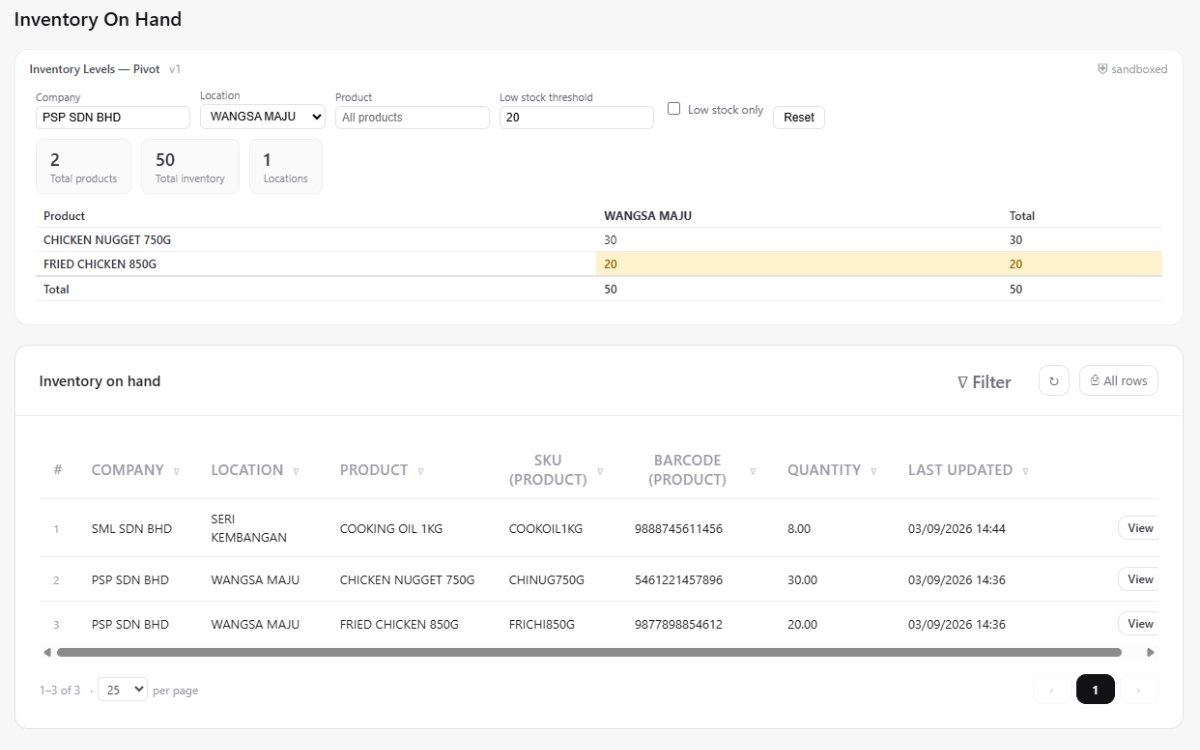
This is where APES comes in, and it's worth being precise about what it actually does. APES doesn't count your stock for you, and it doesn't know a sale happened the moment it happens. What it does is take the count, the moment someone at a partner location opens the mobile app and counts what's physically in front of them, and turn it into a structured, timestamped, attributed record, and then work out the shortfall against what the ledger expected to be there.
How it works, in practice
Picture a normal cycle for a consignment business using APES. Stock gets packed and sent out to a retail partner. That transfer is logged as a stock transfer record, tied to the specific company and location it's going to, with the product and quantity recorded against the unit of measure it was sent in. From this point, both sides have the same starting number, and the ledger knows exactly how much should be sitting at that location.
Nothing more happens automatically after that. The stock sits there, some of it selling, some of it not, and the system has no way of knowing which is which until the next count. That's not a limitation someone forgot to build around. It's simply how consignment works in the real world, and pretending otherwise would only give you a false sense of certainty.
When it's time to check stock, whether that's a scheduled stock take or just someone confirming numbers before restocking, the person at the partner location opens the mobile app and counts what's physically there. That count becomes the new reference point, and it's recorded the moment it's entered. If the count matches what the ledger expected, nothing more needs to happen, and that quiet, uneventful match is exactly what a healthy consignment relationship should look like.
When the count comes in lower than expected, that shortfall is what gets treated as the likely sales for that period, and this is where most systems fall apart and where APES is built to hold together. Instead of the shortfall just silently updating the numbers, it triggers a stock adjustment, and that adjustment goes through an approval step. The person responsible for approving adjustments, defined by role rather than by guesswork, reviews the shortfall and decides whether it looks like ordinary sales, a loss, or a miscount, and approves or rejects it accordingly. Every adjustment carries a reason, drawn from a defined list rather than a vague note, so that over time you can actually see patterns. Are shortfalls clustering at one location? Is one particular product consistently harder to reconcile? Those are the kinds of questions you can only ask once your data is structured enough to answer them.
Why the mobile app matters more than it seems
It's tempting to think of the mobile app as a small convenience, a nicer way to type in numbers instead of writing them on paper. But the real value is in what happens to the count once it's entered, not in some claim about knowing what's happening on the shelf in real time. Nobody knows that, and any system that implies otherwise is overselling itself.
What the app actually removes is the delay and the mess that usually happens between a count being taken and it becoming something useful. No transcribing a paper tally into a spreadsheet later, introducing errors along the way. No ambiguity about who counted what and when, because every count is attributed to a person, a place, and a time the moment it's submitted. The count itself is what's instant. What it tells you about sales is only ever as recent as your last count, and how recent that is depends entirely on how often you choose to count.
None of this requires your retail partner to learn a complicated system. Counting stock and tapping numbers into a phone is not a large ask, and it's usually less work than whatever paper or spreadsheet process they were doing before. The difference is what happens to that count afterward. Instead of sitting in a notebook until someone remembers to look at it, it becomes part of a structured, shared record the moment it's submitted, ready to be compared against the ledger and turned into a real number.
What this changes for the business owner
The practical effect of all this is fewer surprises and fewer arguments, even though the underlying rhythm, count, compare, reconcile, hasn't fundamentally changed. When a shortfall shows up, you're not starting from zero, trying to reconstruct what happened from memory or scattered messages. You have a record of every transfer, every count, and every adjustment, each with a timestamp, a reason, and a person attached to it. Reconciliation stops being a monthly ordeal and starts being a quick check against numbers that were already mostly sorted out.
There's also a quieter benefit that's easy to underestimate: the relationship with your retail partners gets simpler. A lot of tension in consignment relationships comes from disagreements over numbers nobody can fully verify. When both sides are looking at the same system, built from counts either side can perform and see, disagreements become something you can actually resolve instead of something you have to negotiate.
Consignment stock doesn't have to stay a mystery
The honest truth about consignment inventory is that nobody will ever know a sale happened the instant it happens, not with paper, not with a spreadsheet, and not with APES. What changes is everything that happens once someone finally does count: how quickly that count is recorded, how clearly the shortfall is shown, and how fairly it gets reconciled into a real answer.
That's the gap APES is built to close. Not by promising to know what it can't, but by making sure that every time someone does count, that count actually means something, to you, to your partner, and to the numbers you both rely on.
If your consignment stock currently lives in a mix of spreadsheets, messages, and best guesses, it might be worth seeing what it looks like when it lives in one place instead. Feel free to contact us to know more about APES.