How APES Helps a Business Stay Compliant Without Extra Paperwork
Ask most business owners what compliance actually feels like day to day, and the answer is rarely about the rules themselves. It is about the paperwork those rules create. A retention schedule someone has to remember to check. A register of who can see personal information that nobody has updated in months. A folder of evidence assembled in a panic right before an audit, because keeping it up to date the whole year felt like a job nobody had time for.
APES takes a different position. Instead of treating compliance as a separate layer of forms bolted onto the real work, it builds the record keeping directly into how the platform already operates. The evidence is not assembled after the fact. It already exists, because it was captured the moment the underlying action happened.
Every Collection Declares How Long It Keeps Its Data
A common compliance requirement is simple to state and surprisingly hard to actually follow. Do not keep personal or financial data longer than you are allowed to, or longer than you actually need it. In practice, this usually depends on someone remembering to go back through old records and manually check what has aged past its limit, which is exactly the kind of task that gets pushed to next quarter indefinitely.
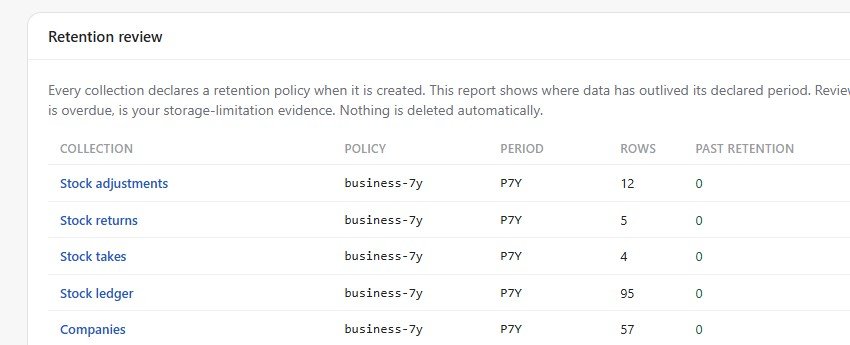
In APES, every collection declares a retention policy the moment it is created, such as keeping statutory business records for seven years or operational data for one. This is not a note in a document somewhere. It is a property of the collection itself, checked against automatically. A business can review, at any time, exactly which records have outlived their declared period, without needing to reconstruct that answer by hand.
Personal and Sensitive Data Is Marked, Not Assumed
A lot of compliance risk comes from a very ordinary mistake, treating a field like a name, a phone number, or an identification number the same way as any other piece of text. Nobody decides to be careless with it. It simply never gets flagged as different from anything else in the same table.
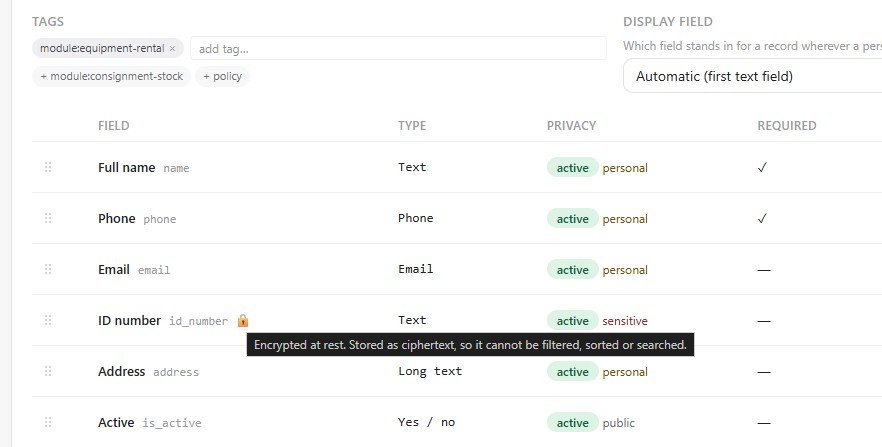
APES asks for that distinction to be made once, at the moment a field is created, rather than leaving it to be remembered later. A field can be marked as personal data, or further marked as sensitive, which masks it automatically for anyone without specific permission to see it, and in some cases stores it encrypted so it cannot even be searched or filtered by someone who should not have access to it in the first place. This is not a setting a business has to re apply every time that field shows up somewhere new. It is set once, and it holds everywhere the field appears afterward.
Who Can See What Is Never Left to Memory
A regulator asking who has access to a certain category of data deserves a precise answer, not a best guess based on who someone thinks still has an old login. APES ties every permission to a role, and a role's grants are visible as a complete matrix rather than scattered across individual user settings that would each need to be checked one by one.
This turns a question that would otherwise take a meeting and some guesswork into something that can be answered by simply looking at the screen. A business does not need to interview its own staff to find out who can export a customer list. The answer is already sitting in the roles and permissions page, current and accurate, because it is the same configuration actually enforcing access in the first place, not a separate description of it.
Evidence That Was Never Assembled After the Fact
The most common failure in a compliance review is not that something went wrong. It is that nobody can prove what actually happened, even when everything was done correctly, because the proof was never captured in a form anyone can produce later.
APES keeps a tamper evident audit trail on every record automatically, recording who did what and when, whether the change came from a person or from a workflow running on its own. When a business needs to demonstrate that a data access rule was actually followed, or that a sensitive record was only viewed by people with the right permission, that evidence is not reconstructed under pressure before an audit. It was written down the moment it happened, and it can be exported as a single evidence bundle covering the chain state, the access matrix, and the policy history together.
Rules That Do Not Depend on Everyone Remembering Them
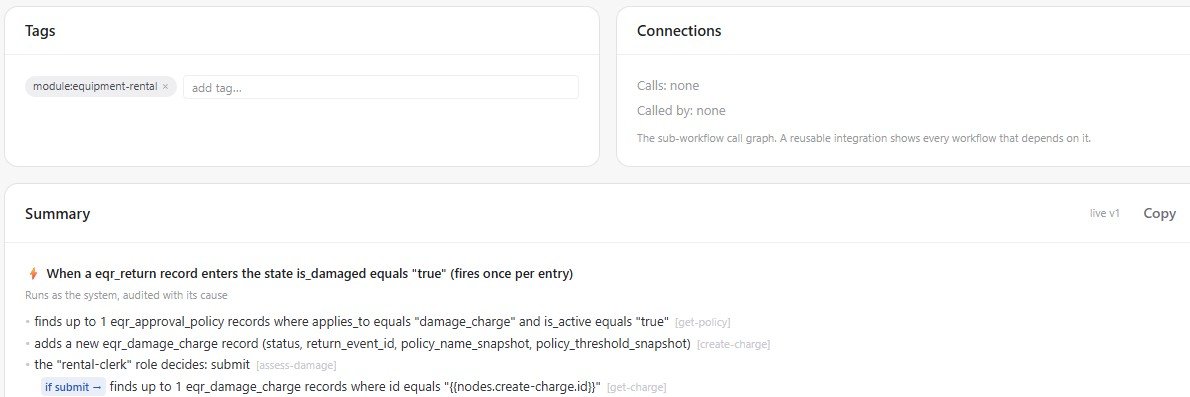
A business can write down a rule such as a manager must approve any customer data export over a certain size, and that rule will hold for exactly as long as everyone remembers it exists. APES lets rules like this be enforced directly, as part of a workflow or a record rule, so the outcome does not depend on whether the right person happened to be paying attention that day.
This is the same underlying idea covered elsewhere in this series about approvals and permissions, applied specifically to the kind of rule a compliance function actually cares about. A policy that lives only in a handbook is a policy that gets forgotten under pressure. A policy that lives in the system itself gets followed every time, because there was never a manual step where it could quietly get skipped.
Compliance as a Byproduct, Not a Separate Project
None of this requires a business to run a compliance project alongside its actual work. Retention periods, data classification, access control, and a provable history of every change are not extra tasks layered on top of using APES. They are simply what the platform is already doing while a business gets on with its real work, stock, sales, approvals, whatever the business actually runs on.
That is really the point. A business should not have to choose between moving quickly and being able to prove, later, exactly what it did and why. APES is built so that the second one is just what happens automatically while the business does the first.