Business Process Software: Why Modern Organizations Need More Than Just Workflow Automation
Every business relies on processes to function. Whether it involves approving purchases, onboarding employees, managing inventory, processing customer requests, or handling financial transactions, processes are the mechanisms that keep organizations moving. In smaller businesses, these processes often develop organically. Employees communicate through emails, spreadsheets, phone calls, and messaging applications, and work gets completed because everyone understands what needs to be done.
As organizations grow, however, this informal approach becomes increasingly difficult to sustain. More people become involved in decision-making, more systems are introduced, and more exceptions need to be managed. What once seemed like a simple workflow can quickly become a source of delays, confusion, operational risk, and compliance issues. This is where business process software becomes essential.
Business process software provides organizations with the ability to standardize, automate, monitor, and improve the way work is performed. Rather than relying on manual coordination and individual knowledge, businesses can establish structured workflows that ensure activities are executed consistently and efficiently. As a result, organizations gain better visibility, stronger control, and greater confidence in their operations.
What Is Business Process Software?
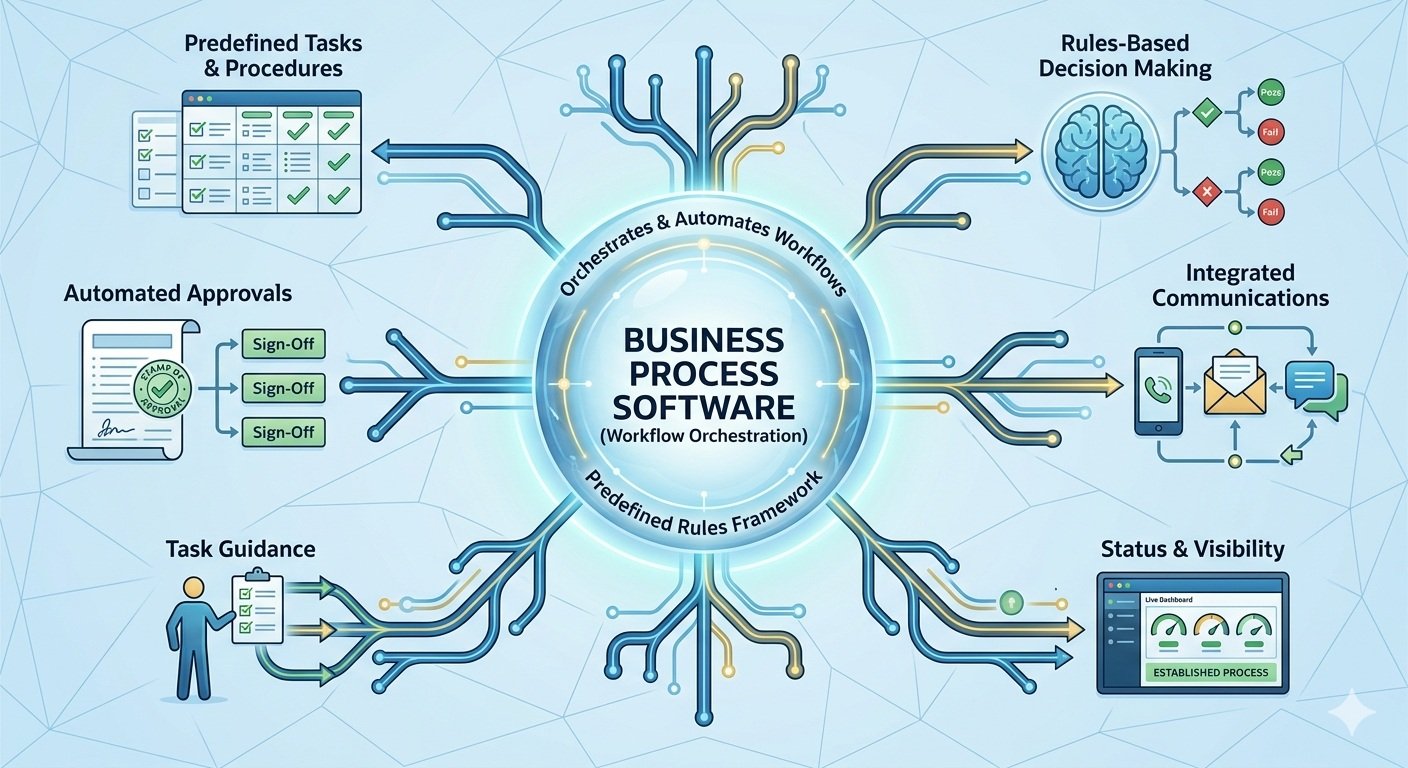
Business process software refers to technology designed to manage and automate business workflows. It serves as a framework that guides tasks, approvals, decisions, and communications according to predefined rules and procedures. Instead of employees manually determining what should happen next, the software orchestrates the flow of work and ensures that each step follows an established process.
Organizations use business process software across a wide range of functions, including procurement, finance, human resources, customer service, operations, quality management, and compliance. The primary objective is not simply to digitize paperwork but to create repeatable and scalable processes that improve consistency throughout the organization.
By transforming manual workflows into structured digital processes, businesses reduce uncertainty and gain greater control over how work is executed. This becomes particularly important when organizations operate across multiple departments, locations, or business units where consistency can be difficult to maintain.
The Growing Need for Business Process Software
Many operational challenges arise not because employees lack skill or commitment, but because processes are poorly defined, inconsistently followed, or difficult to monitor. In many organizations, approvals occur through email chains, requests are submitted through spreadsheets, and critical decisions are communicated through messaging applications. While these methods may appear efficient in the short term, they often create significant problems as business complexity increases.
Without a structured process framework, employees may follow different approaches for the same task. Approval requirements may vary depending on who is involved, and important information can become scattered across multiple systems and communication channels. Managers may struggle to determine the status of requests, identify bottlenecks, or understand why delays occur.
As organizations expand, these issues become more pronounced. More transactions, more stakeholders, and more exceptions create an environment where manual process management becomes increasingly difficult. Business process software addresses these challenges by introducing structure, transparency, and accountability into everyday operations.
The Benefits of Implementing Business Process Software
One of the most significant benefits of business process software is improved operational efficiency. Many business activities involve repetitive administrative work such as routing requests, sending notifications, collecting approvals, and updating records. Automating these activities reduces manual effort and allows employees to focus on higher-value responsibilities.
Another important advantage is process standardization. When workflows are managed through software, organizations can ensure that the same business rules are applied consistently across departments and locations. This reduces variability, improves quality, and creates a more predictable operating environment.
Business process software also strengthens accountability. Every action performed within a workflow can be recorded, creating a complete history of who initiated a request, who approved it, and when each action occurred. This level of visibility helps organizations investigate issues, improve performance, and maintain compliance with internal policies and regulatory requirements.
In addition, business process software enhances collaboration by connecting employees, departments, and systems through a unified workflow. Instead of relying on fragmented communication channels, stakeholders can work within a structured process that provides clear visibility into responsibilities, status updates, and next steps.
Key Capabilities of Modern Business Process Software
Modern business process software has evolved significantly beyond simple workflow routing. Today's platforms offer a wide range of capabilities designed to support complex business operations.
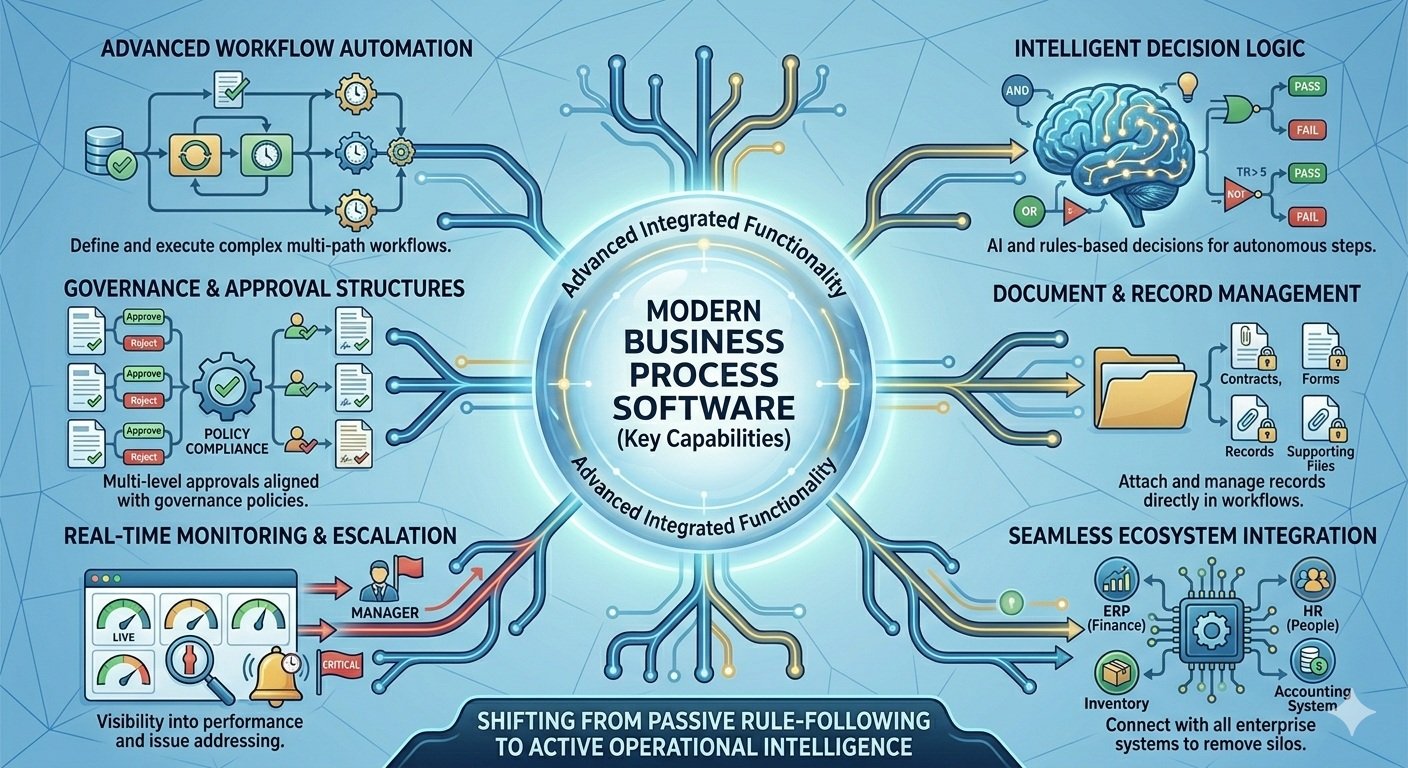
Workflow automation remains a core feature, allowing organizations to define how work moves through the business. Approval management capabilities enable organizations to create multi-level approval structures that reflect their operational requirements and governance policies. Process monitoring tools provide visibility into workflow performance, helping managers identify bottlenecks and opportunities for improvement.
Many solutions also include document management capabilities that allow supporting files, contracts, forms, and records to be attached directly to workflow activities. Notification and escalation mechanisms ensure that tasks are not overlooked and that delays are addressed before they impact operations.
Integration capabilities have become increasingly important as businesses adopt multiple enterprise systems. Modern business process software can often connect with ERP, CRM, finance, inventory, and HR systems, allowing information to move seamlessly across the organization. This integration reduces duplication, improves data accuracy, and creates a more connected operational environment.
How Business Process Software Supports Business Growth
Growth creates opportunities, but it also introduces complexity. As organizations expand, they typically experience increased transaction volumes, larger teams, more stakeholders, and greater regulatory requirements. Processes that once worked effectively through informal communication often become difficult to manage at scale.
Business process software helps organizations maintain operational consistency during periods of growth. By embedding workflows within a structured system, businesses reduce their dependence on individual employees and ensure that processes remain consistent regardless of organizational size.
This capability becomes especially valuable when onboarding new employees, entering new markets, managing multiple locations, or handling increasing volumes of customer and supplier interactions. Instead of relying on tribal knowledge, organizations can institutionalize best practices within their process framework.
As a result, businesses gain the ability to scale operations while maintaining visibility, accountability, and control.
Why Automation Alone Is No Longer Enough
While workflow automation delivers significant benefits, many organizations eventually discover that automation alone does not solve all operational challenges. A process can be automated and still lack governance. Employees may still bypass controls, exceptions may be handled inconsistently, and approvals may occur without sufficient oversight.
This is particularly common in environments where multiple systems operate independently. An organization may have an ERP system, procurement platform, inventory system, customer management solution, and finance application, yet still struggle to enforce consistent business rules across these systems.
As businesses become more complex, the focus shifts from simply automating activities to ensuring that processes are governed, controlled, and enforceable. Organizations need confidence that policies are being followed, approvals are occurring correctly, and exceptions are managed appropriately. This is where many traditional business process software solutions reach their limitations.
Why APES Is More Than Business Process Software
APES (Automated Process Enforcement System) was designed to address a challenge that many organizations face after implementing traditional workflow solutions. While most business process software focuses on moving work from one stage to another, APES focuses on ensuring that business rules are actually enforced throughout the process.
Rather than serving solely as a workflow automation platform, APES acts as a governance and enforcement layer across business operations. It helps organizations ensure that approvals occur according to policy, segregation of duties is maintained, exceptions follow controlled pathways, and accountability is embedded into every decision.
This approach is particularly valuable for businesses operating in complex environments where compliance, risk management, auditability, and operational control are critical. APES can work alongside existing enterprise systems to strengthen governance without requiring organizations to replace their current technology investments.
By combining process automation with enforcement and governance capabilities, APES enables businesses to move beyond efficiency improvements and build operational frameworks that are both scalable and controlled. This helps organizations reduce risk, improve compliance, strengthen accountability, and create processes that can be trusted as the business continues to grow.
Conclusion
Business process software has become an essential component of modern business operations. As organizations face increasing complexity, the ability to standardize workflows, automate routine activities, and gain visibility into operational performance is no longer a competitive advantage—it is a necessity.
However, organizations should recognize that effective process management requires more than automation alone. Sustainable growth depends on the ability to enforce policies, maintain accountability, and ensure that business rules are consistently followed across the organization.
If you are evaluating the effectiveness of your current process controls, governance framework, or workflow environment, Appnicorn offers a free APES Governance Assessment to help identify potential gaps and opportunities for improvement. The assessment provides valuable insight into your organization's approval controls, process governance, auditability, enforcement capabilities, and operational risks.
Contact Appnicorn today to request your free assessment and discover how stronger process governance can help your organization build more efficient, accountable, and scalable business operations.