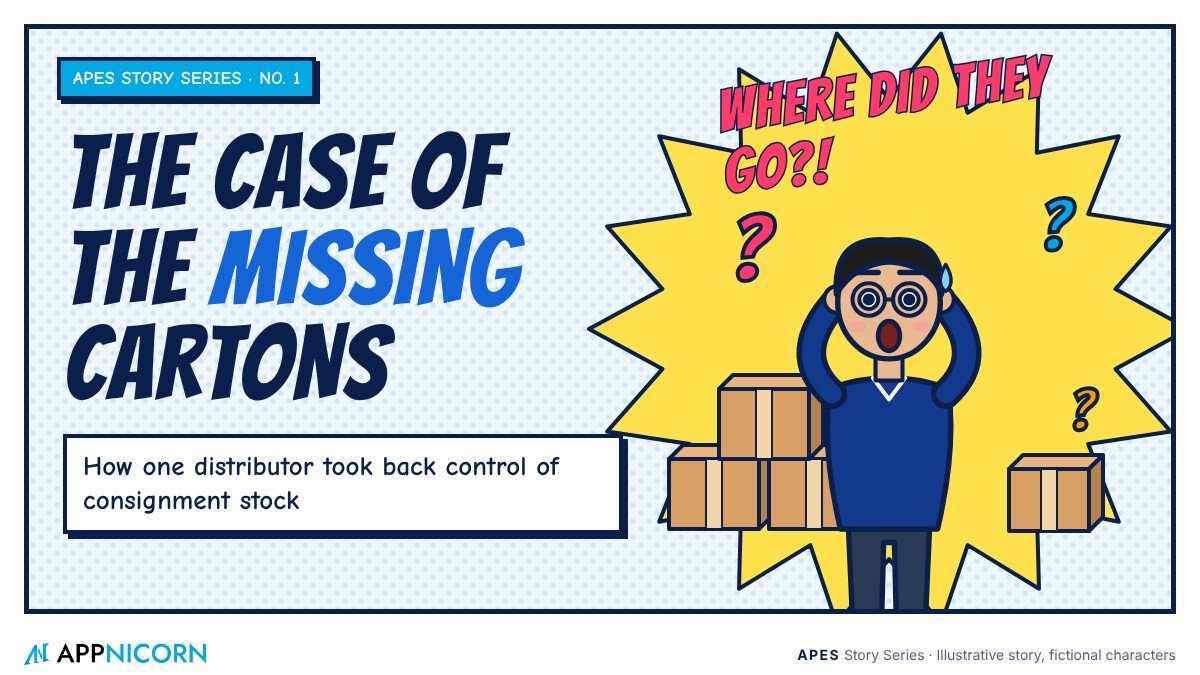
This is an illustrative story. The company, the people and the numbers are fictional, but the problem is one that many Malaysian distributors will recognise.
Meet Daniel and his very busy month-end
Daniel runs a distribution company that supplies household products to minimarkets, pharmacies and sundry shops across the Klang Valley. Like many distributors, he sells a large part of his range on consignment. His team places stock on the retailer's shelf, the retailer pays only for what they sell, and whatever is left stays on the shelf until the next visit.
It is a good arrangement for winning shelf space. Retailers love it because they carry no risk. Daniel likes it because it gets his products in front of shoppers in places a competitor cannot reach.
There is just one problem. The stock on those shelves is still Daniel's. And on the last working day of every month, he has no clear idea how much of it there is.
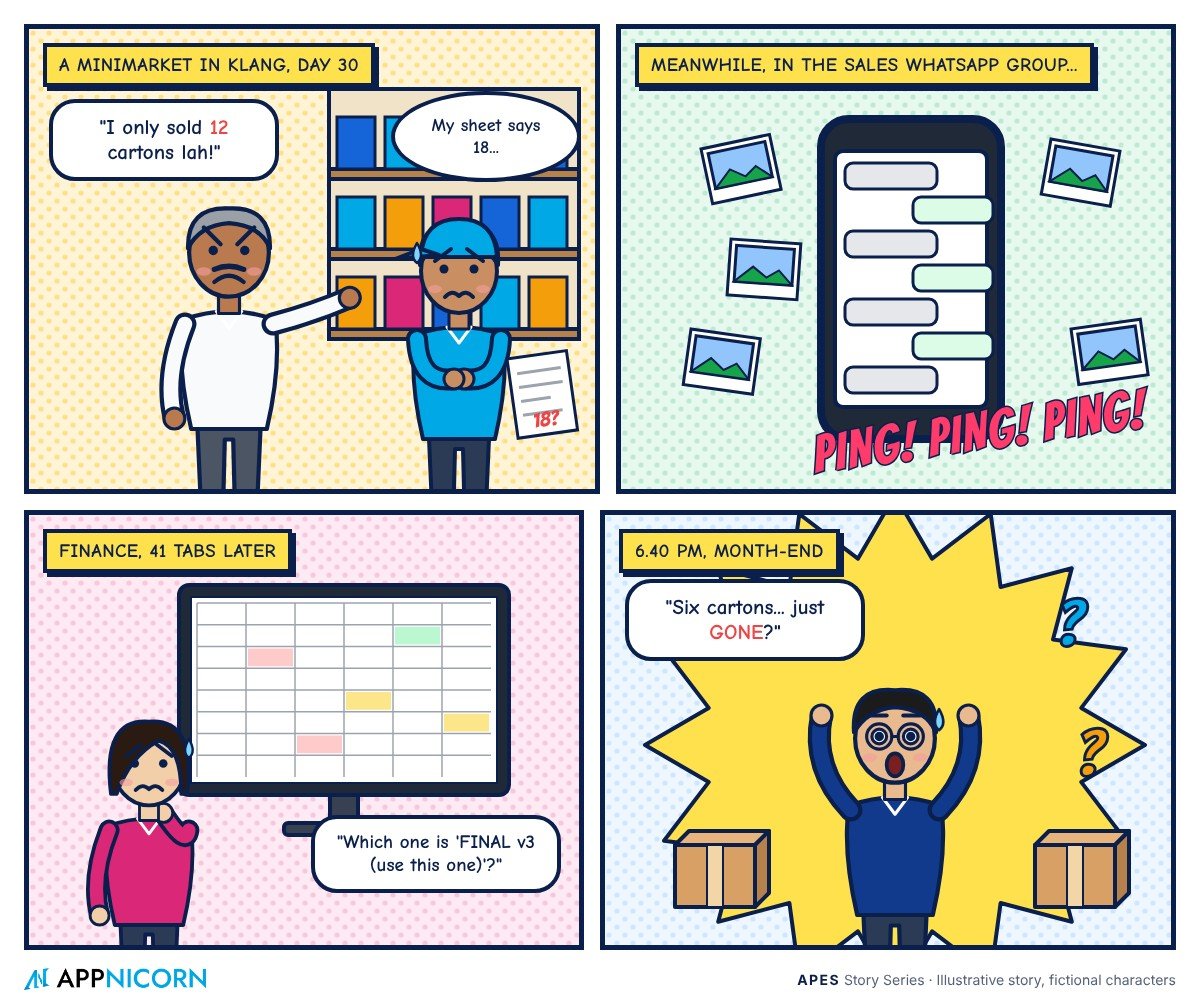
At 6.40 pm on this particular month-end, Daniel is sitting in front of a spreadsheet with forty-one tabs. His finance manager, Mei Ling, is on her third coffee. His most experienced sales rep, Arif, is on the phone from a minimarket in Klang, reading out numbers from a crumpled count sheet while the shop owner insists, politely but firmly, that he only sold twelve cartons, not eighteen.
Somewhere between eighteen and twelve, six cartons have gone missing. Nobody knows where. And this is only one outlet.
How the consignment process actually worked
On paper, Daniel's process was simple.
When Arif delivered stock to an outlet, he wrote a delivery note by hand and asked the shop owner to sign it. On his next visit, usually a few weeks later, he counted what was left on the shelf, wrote the figure on a count sheet, took a photo for good measure and sent it to the sales WhatsApp group.
Back at the office, Mei Ling worked out what each outlet had sold. The formula was easy enough: what was there last time, plus what was delivered, minus what was returned, minus what is there now. The difference was what the outlet had sold, and that was what Daniel billed.
In practice, every part of that formula had a weak spot.
The opening figure came from last month's spreadsheet, which might have been edited since. The delivery figure depended on a handwritten note that sometimes stayed in Arif's van for a week. Returns, such as damaged or near-expiry items, were often collected informally and recorded later, if at all. And the closing count depended on one person, on one visit, counting by hand on a crowded shelf.
When any of these figures was wrong, the bill was wrong. And when the bill was wrong, the outlet disputed it.
The pain points nobody had written down
If you had asked Daniel what his biggest problem was, he would have said "month-end". But the real problems ran deeper, and most of them never appeared in any report.
Stock he could not see. At any moment, a significant part of Daniel's inventory sat on other people's shelves. He could tell you what was in his own warehouse. He could not tell you, with confidence, what was in the market.
Billing that started arguments. Because the sold quantity was calculated from figures nobody fully trusted, invoices regularly turned into negotiations. Arif spent hours each month re-counting shelves and defending numbers instead of selling.
Cash that arrived late. Every dispute delayed an invoice, and every delayed invoice delayed payment. Mei Ling could not close the month until the arguments were settled, so the whole cash cycle stretched.
Expired and damaged stock that vanished from the books. Items close to expiry were sometimes pulled from the shelf and brought back to the warehouse without a proper return record. On paper they were still at the outlet. In reality they were in a bin.
Everything depended on Arif. He knew which shop owner kept stock in the back room, which one moved Daniel's products to a lower shelf, and which one always needed a second count. When Arif went on leave, the counts slipped and the disputes doubled.
No trail to follow. When the six cartons went missing, nobody could say whether they had been sold, returned, damaged, miscounted or never delivered in the first place. The information was spread across a handwritten note, a WhatsApp photo, a spreadsheet tab and Arif's memory.
What it was really costing
Daniel had always treated these issues as the price of doing consignment. When he finally sat down with Mei Ling to look at them properly, the picture was less comfortable.
Unexplained stock losses were being written off quietly at year-end, with no way to trace where they came from. Invoices were going out later than they should, which meant cash was arriving later too. His best sales rep was spending a large part of each month on counting and disputes rather than opening new outlets. And because nobody trusted the stock-in-market figure, purchasing ordered extra "just in case", tying up even more cash.
None of this showed up as a single line in the accounts. It was spread thinly across margin, cash flow and staff time. That is exactly what made it so easy to live with, and so expensive.
The fixes that did not work
Daniel was not a man who ignored problems. Over the years he had tried several fixes.
He made the spreadsheet bigger. It gained more columns, colour codes and a tab for every outlet. It also gained more formulas that only Mei Ling understood, and more versions saved with names like "FINAL v3 (use this one)".
He created more WhatsApp groups: one per region, then one for counts and another for returns. Photos arrived faster, but finding last month's count for a particular outlet meant scrolling through hundreds of messages.
He looked at the stock features in his accounting software. They were fine for his own warehouse, but they had no real idea of stock sitting at someone else's shop, still owned by Daniel, waiting to be sold. The add-on was simply too basic for the way his business actually worked.
Each fix helped a little. None of them changed the underlying problem: the process lived in people's heads and in disconnected tools, so nothing could check it as it happened.
How APES changed the story
Daniel came to Appnicorn with one request: "I just want to know what is on the shelves, and bill it without an argument."
Instead of asking Daniel to change how he sells, the team built a consignment module in APES around the way his business already worked. Here is how the same month looked afterwards.
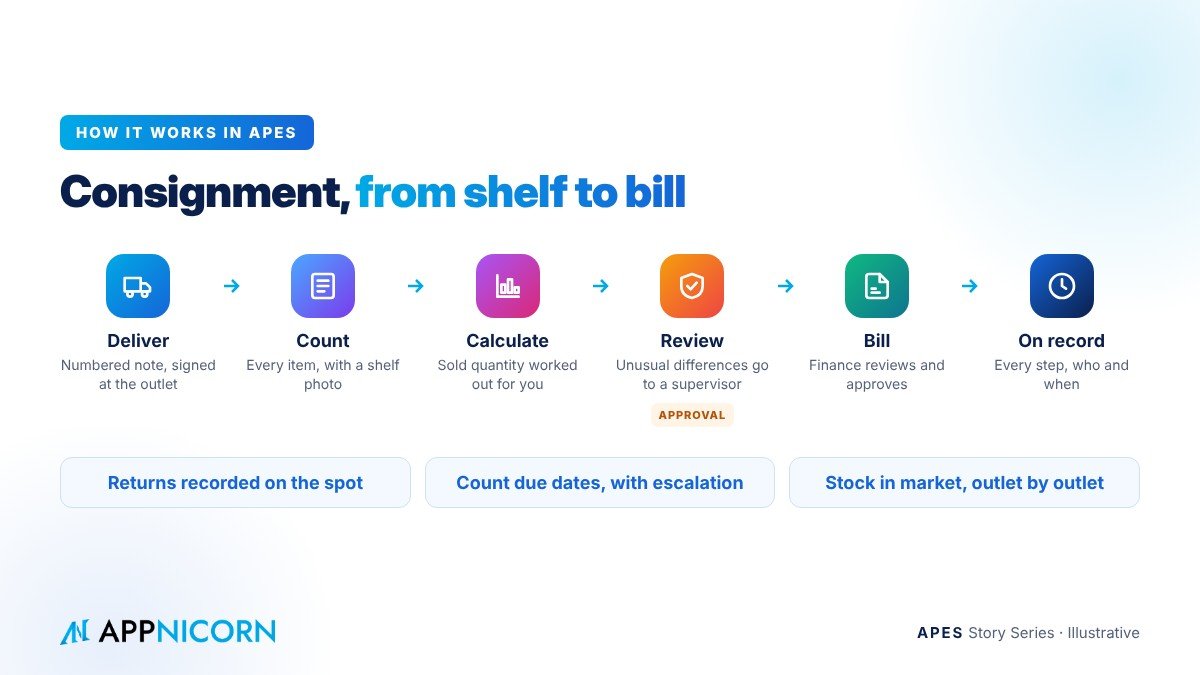
Every outlet became a location. Each shop Daniel supplies is set up in APES as its own stock location, owned by Daniel but sitting at the retailer. The stock in the market is no longer a guess. It is a live figure, outlet by outlet.
Deliveries are recorded at the shelf. When Arif delivers stock, he records it in APES on his phone against that outlet. The consignment delivery note is numbered under control and the shop owner signs on screen. The moment it is confirmed, the outlet's balance goes up. No paper sits in the van for a week.
Counts follow a standard form. On his next visit, Arif opens the outlet in APES and sees exactly what should be on the shelf. He enters what is actually there, item by item, and attaches a photo of the shelf. The form will not submit until every item is counted and the photo is attached.
The system does the arithmetic. APES calculates the sold quantity from the recorded opening balance, deliveries, returns and the new count. Nobody retypes figures from a WhatsApp photo, and nobody edits last month's numbers without leaving a record.
Differences are flagged, not argued about. If a count shows a variance that the business considers unusual, the count is held and sent to the sales supervisor for review before anything is billed. The supervisor can approve it, ask Arif to recount, or record a reason such as damage or theft.
Returns are recorded when they happen. Damaged or near-expiry items collected from an outlet are recorded as returns on the spot, with a reason. They come off the outlet's balance immediately and do not quietly disappear.
Billing follows the count. Once a count is confirmed, APES prepares the billing details for that outlet from the sold quantity and the agreed prices. Mei Ling reviews and approves them rather than building them from scratch, and sends them on for invoicing.
Nothing waits forgotten. Each outlet has a count due date. If a count has not been done on time, a reminder goes to the rep, and if it is still outstanding, it is escalated to the supervisor. Disputes have owners and deadlines too.
Every step leaves a trail. Every delivery, count, return, approval and change is kept in a tamper-evident audit trail, with who did it and when. When a shop owner questions a bill, Arif can show the delivery note they signed, the count with its photo and the return records, all in one place.
AI helps with the paperwork. At month-end, AI inside APES can summarise which outlets had unusual variances and draft replies to outlet queries for the team to review. It prepares. A person decides.
What changed for Daniel's team
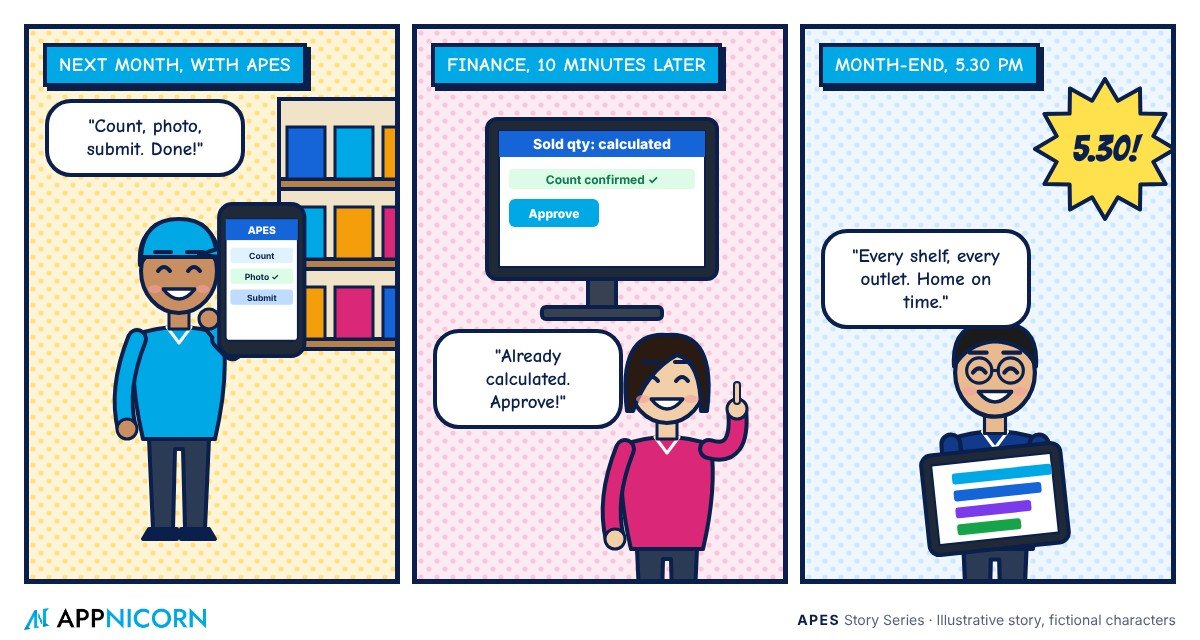
The next month-end looked very different. This part of the story is illustrative, but it shows the kind of change a business can expect.
Daniel opened APES and saw his stock in the market, outlet by outlet, without asking anyone. The few counts with unusual differences were already sitting with the supervisor, with photos attached. Mei Ling was approving billing details instead of building them from WhatsApp. Arif spent his month visiting outlets and opening new ones, not re-counting old ones.
The disputes did not disappear entirely. Shop owners still asked questions. But now each question had an answer on record, and most were settled in a single conversation. And when Arif took a week's leave, his colleague covered his outlets using the same forms and the same history, and nothing fell apart.
Most importantly, Daniel stopped discovering problems at year-end. When an outlet's figures started to look odd, he knew within days, not months.
Is this your business?
You do not have to be a consignment distributor to recognise this story. Ask yourself a few questions.
Do you have stock, equipment or assets sitting somewhere other than your own premises? Does billing depend on figures collected by hand and sent by WhatsApp? Do invoices regularly turn into negotiations? Does one experienced person hold the process together? And when something goes missing, can you trace exactly what happened?
If several of those answers are uncomfortable, the problem is probably not your people. It is that your process has outgrown the tools holding it together.
Bring us your version of the missing cartons
APES (said "A-pes") is a custom ERP made by Appnicorn, a Malaysian IT company with years of experience building business systems. Every module in APES is customised to your company's unique needs, and consignment distribution is one of the processes APES already runs in production.
Whether your challenge is consignment stock, purchasing, deliveries, claims or a process unique to your industry, APES gives you one workspace where every step follows your rules. Approvals go to the right people with deadlines and escalation, documents are numbered under control, and every action is kept in a tamper-evident audit trail. If the module you need does not exist yet, Appnicorn designs and builds it with you.
Pricing depends on the process being built, so the best first step is a conversation. Bring us your last month-end, the disputes you could not settle and the stock you could not find, and we will show you how it would run in APES.