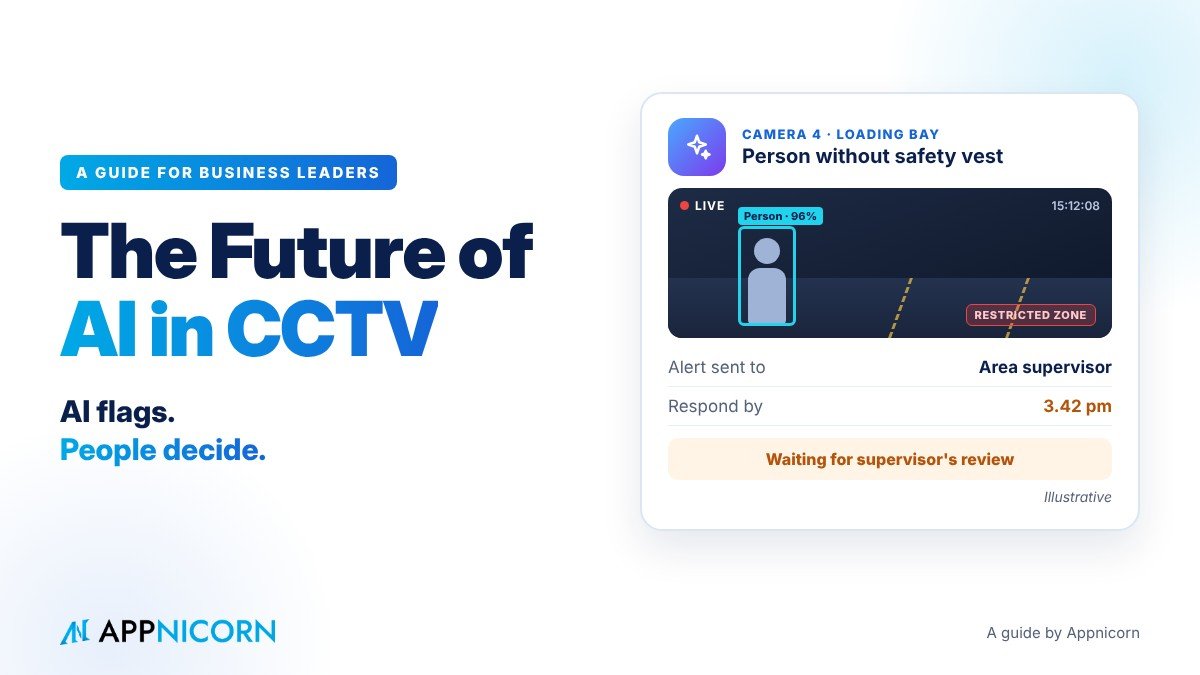
For most of its history, CCTV has been a recorder. Cameras capture everything, a screen in the guardhouse shows a grid of feeds that nobody can watch all at once, and the footage is only looked at after something has gone wrong. Someone spends an afternoon scrolling through hours of video to find the moment a pallet went missing or a lorry left without a ticket.
AI is changing that. Cameras are starting to understand what they see: a person in a restricted area, a vehicle at the gate, a worker without a helmet, a queue growing at the counter. Instead of storing hours of video for someone to search later, the system can point out the few seconds that matter, as they happen.
This guide is written for business owners, operations heads and security managers who want a clear, practical view. It explains how AI in CCTV works, what it can do today, where it is heading, what it should never decide on its own, the risks to take seriously, and how to adopt it without losing control.
From recording to understanding: how CCTV has changed
It helps to see AI in CCTV as the latest step in a longer journey.
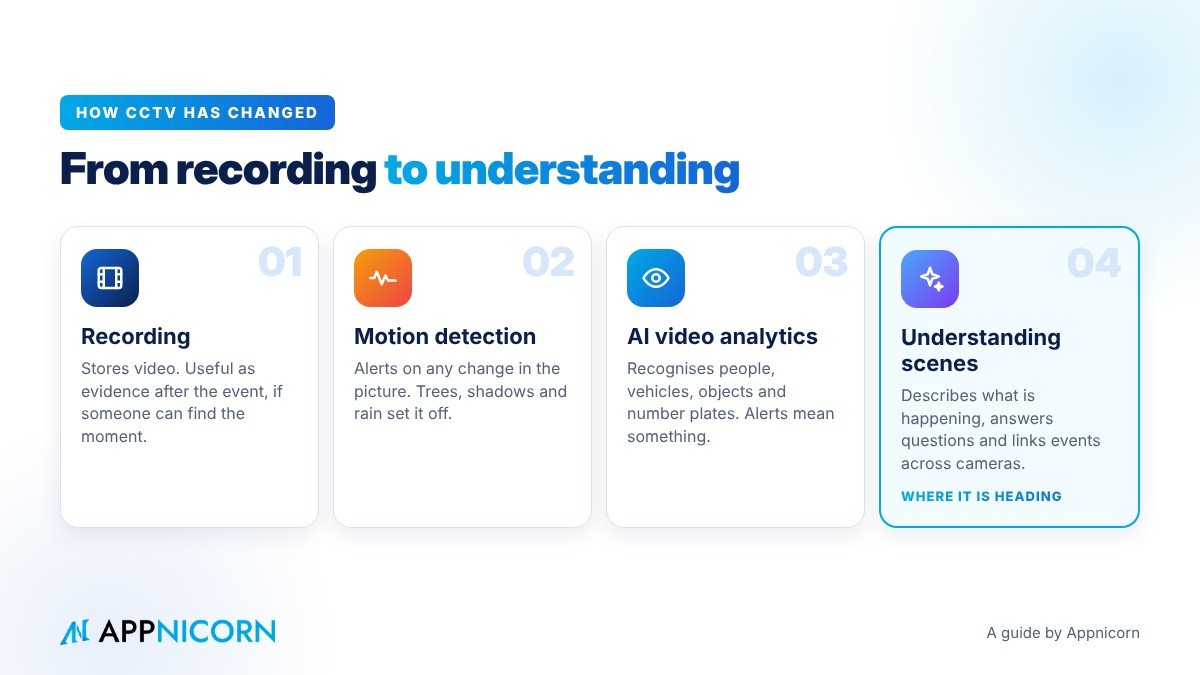
Recording. Analogue and early digital systems simply stored video. Their value was evidence after the event, if the footage was clear and someone could find the right moment.
Simple motion detection. The next step was software that noticed change in the picture and raised an alert. It sounded useful, but anything could trigger it: a swaying tree, a passing shadow, rain, headlights. Many sites switched the alerts off because there were too many of them.
AI video analytics. Today's systems use trained models that recognise what is in the picture: people, vehicles, objects, number plates. They can tell a person from a cat, a lorry from a car, and a delivery from a break-in. That makes alerts far more meaningful.
Understanding scenes. The newest models go further. They can describe what is happening in plain language, answer questions about footage, and connect events across several cameras. This is where much of the future lies.
What AI can already do with CCTV
AI is most useful where something specific needs to be noticed, where people cannot watch every screen, and where a person can quickly check what the system flags. These are the uses businesses are adopting today.
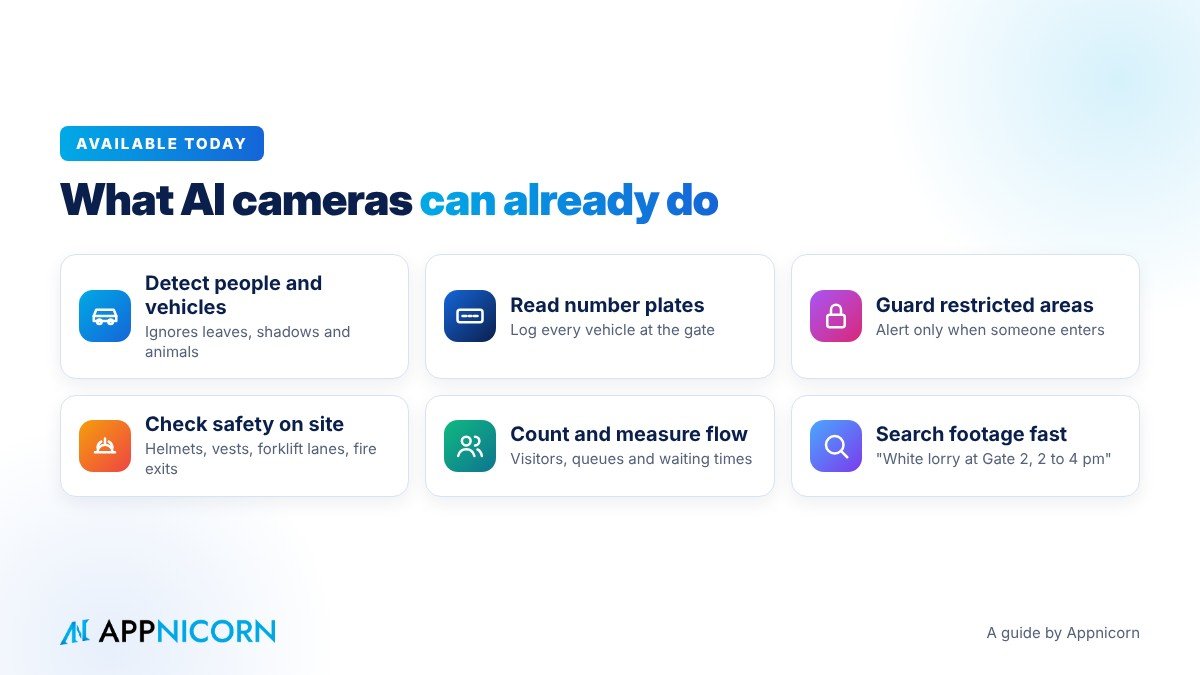
Detecting people and vehicles. The system recognises when a person or vehicle enters an area, crosses a line or appears outside working hours, and ignores the leaves, shadows and animals that confused older motion detection.
Reading number plates. Licence plate recognition reads plates at gates, car parks and loading bays. It can log every vehicle in and out, check plates against an approved list and note when a scheduled vehicle arrives.
Guarding perimeters and restricted areas. AI can watch a fence line, a store room or a server room and raise an alert only when someone actually enters, rather than every time the light changes.
Checking safety on site. In factories, warehouses and construction sites, AI can spot a worker without a helmet or safety vest, a person walking into a forklift lane, or a blocked fire exit.
Counting and measuring flow. In shops, branches and service counters, AI can count visitors, measure how long queues are and how long people wait, and show which areas are busy at which times, without needing to know who anyone is.
Spotting unusual situations. Some systems can flag a bag left behind, a person lingering in one spot for too long, a vehicle parked where it should not be, or smoke appearing in the frame. These alerts point to where a person should look; they do not prove that anything is wrong.
Searching footage quickly. Instead of scrolling through hours of video, investigators can search for "white lorry at Gate 2 between 2 pm and 4 pm" or "person in a red shirt near the loading bay" and jump straight to the matching clips.
Where AI in CCTV is heading
The technology is moving quickly. Several changes are already underway and are likely to shape the next few years.
Ask the cameras in plain language. Vision-language models, the camera equivalent of the AI chat tools many people now use, let a manager type a question such as "Did anyone open the store room after 10 pm last night?" and receive an answer with the relevant clips. Searching footage becomes as easy as searching email.
Summaries instead of screens. Rather than watching feeds, a supervisor may receive a short written summary at the end of a shift: what happened at each gate, which alerts were raised, which were checked and what was found. Video becomes something you read about first and watch only when needed.
AI inside the camera. More processing is moving into the camera itself or a small device on site, often called "edge AI". Footage can be analysed locally, so less video needs to be sent over the internet, alerts arrive faster and sites with weak connections can still work.
Following events across cameras. Instead of treating each camera separately, systems are learning to connect what several cameras see, such as a vehicle entering at the gate, stopping at the weighbridge, moving to the loading bay and leaving, as one journey.
Cameras as business sensors, not just security. The biggest shift may be in purpose. The same camera that guards the gate can confirm that a delivery arrived, measure how long a lorry waited, check that a loading bay is clear or count stock on a shelf. CCTV starts to serve operations, safety and customer service as well as security.
Fewer, better alerts. As models improve, the goal is fewer false alarms and more context with each alert: not just "motion at Camera 7", but "a person entered the chemical store without a vest at 3.12 pm; the area is restricted to trained staff".
Connected to business systems. Camera events will increasingly flow into the systems that run the business, such as gate passes, delivery records, safety reports and visitor logs, so that what a camera sees can start a proper process rather than just an alarm.
What AI should not decide on its own
AI makes cameras far more capable. That makes it even more important to be clear about what it must never do alone.
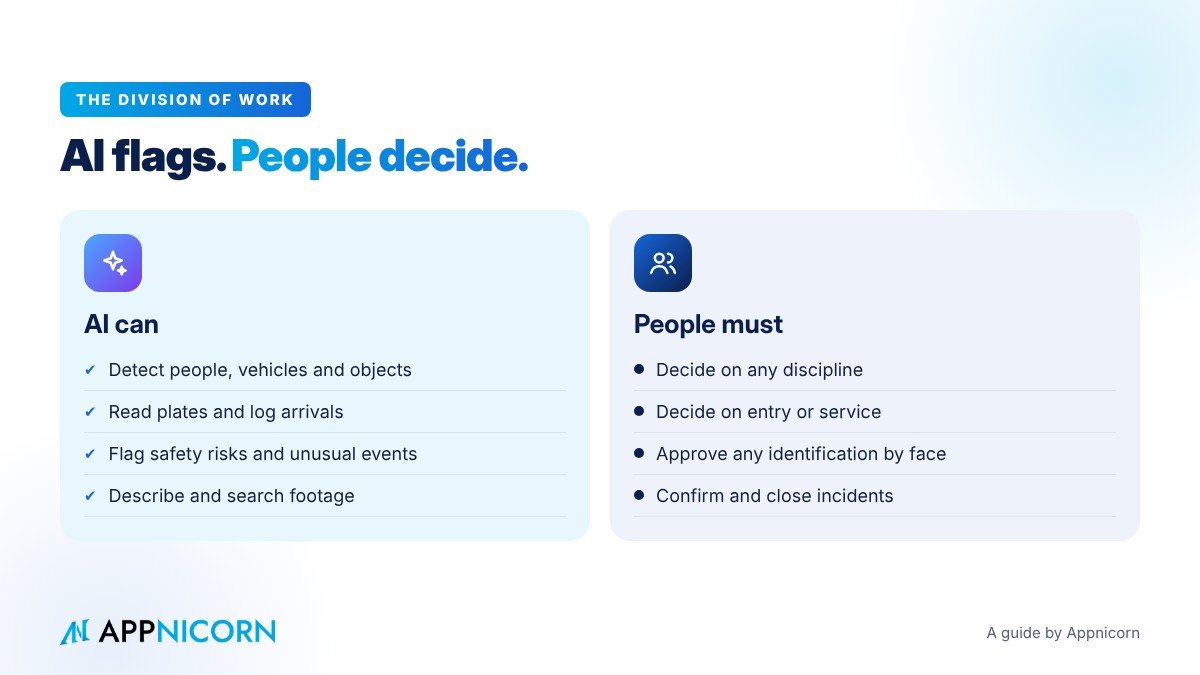
Accusing or disciplining anyone. An AI alert that a worker was in the wrong place, or that a customer may have taken something, is a reason to look, not proof. Any decision that affects a person's job, reputation or freedom must be made by a person who has reviewed the evidence.
Denying entry or service without review. If a system cannot match a plate or a face, a person should be able to check and decide. Nobody should be locked out, refused service or treated as a suspect only because a model was unsure.
Identifying people by face without a clear, lawful reason. Facial recognition is the most sensitive use of AI in CCTV. Many uses, such as counting visitors or detecting safety gear, need no identification at all. Where identification is truly needed, it should be justified, limited, recorded and reviewed.
Closing incidents. AI can raise and describe an incident. A named person should confirm what happened and close it.
A useful rule of thumb: let AI watch, flag and describe, and let people check, decide and act.
The risks businesses should take seriously
AI-powered CCTV brings real benefits, and it also brings risks that grow as the cameras become smarter.
Privacy and personal data. Footage that shows identifiable people is generally treated as personal data. In Malaysia, businesses need to handle it in line with the Personal Data Protection Act: tell people that cameras are in use and why, use footage only for the stated purpose, protect it, and keep it no longer than needed. The amended Act also treats biometric data as sensitive personal data, which matters for any use of facial recognition. The Commissioner's guideline on Data Protection Officers lists regular and systematic monitoring of personal data as one of the situations in which a company must appoint a DPO, so businesses running large or AI-driven camera networks should check whether that applies to them and take proper advice.
Mistakes and bias. AI models can be wrong, and they can be wrong more often for some groups of people or in some conditions, such as poor lighting, rain or unusual angles. An alert is a probability, not a fact.
Alert fatigue. A system that raises too many alerts trains people to ignore them. Badly tuned AI can recreate the very problem it was meant to solve.
Cameras as a security weakness. Connected cameras are computers on your network. Weak passwords, outdated firmware and cameras exposed to the internet can let attackers in, or let outsiders watch your premises.
No record of what happened next. If an alert was raised but nobody can show who saw it, what they did and when, the business has gained very little. In an audit, an insurance claim or a dispute, the record of the response matters as much as the footage.
Trust and culture. Staff who feel constantly watched and judged by software may lose trust in the company. Being open about what cameras are for, and what they are not used for, matters.
Data leaving the business. Some AI services send footage to outside servers to be processed. Businesses should know where their video goes, how it is protected and whether it is used to train anyone else's models.
The principles of responsible AI in CCTV
The businesses that use AI cameras well tend to follow a few simple principles.
AI flags, people decide. The system raises alerts and suggestions. A named person reviews them and decides what happens next.
Purpose first. Each camera and each AI feature has a clear, stated purpose, such as gate control, safety or queue management, and is not quietly used for something else.
Identify only when necessary. Use counting and detection without identifying anyone wherever that is enough. Treat facial recognition as the exception, not the default.
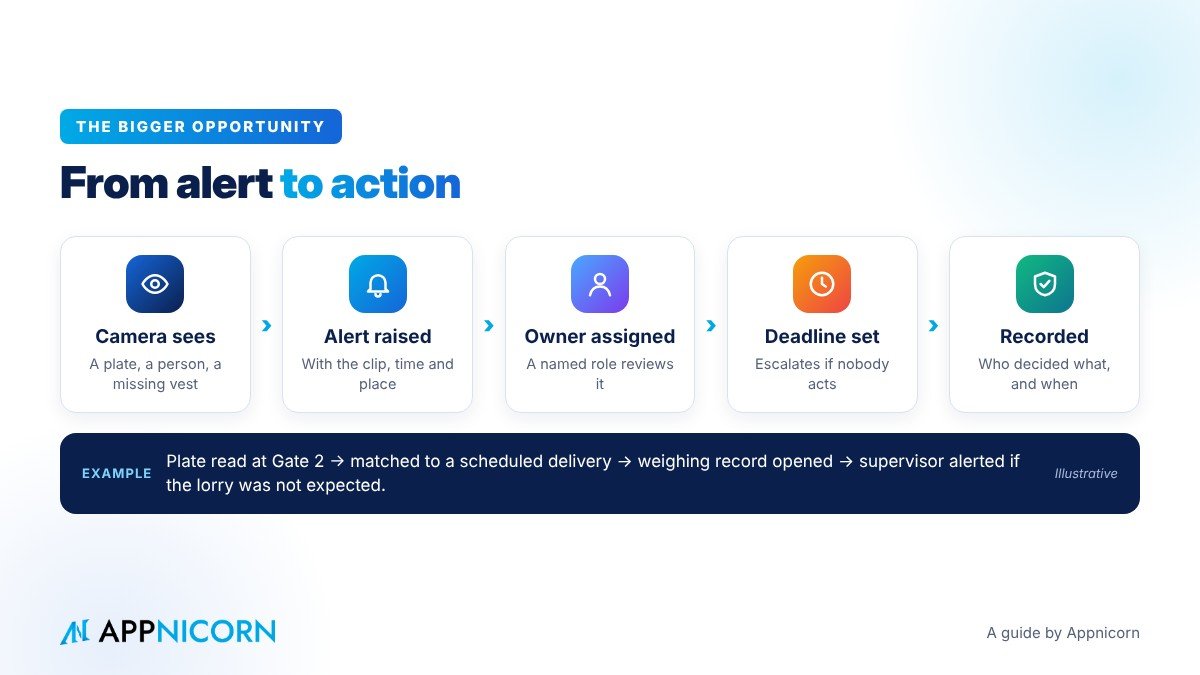
Every alert has an owner. Each type of alert goes to a named role, with a clear deadline for responding and an escalation if nobody does.
Every response is recorded. Who saw the alert, what they decided and when become part of a tamper-evident record, so the evidence exists when it is needed.
Footage is protected and kept only as long as needed. Access is limited to the people who need it, and retention periods are set and followed.
The bigger opportunity: from alert to action
Here is the part most discussions of AI cameras miss. An alert on its own changes nothing. Something only improves when the alert reaches the right person, they act on it, and the business can show what was done.
Consider a few everyday examples.
A camera reads the plate of a lorry at the gate. On its own, that is a line in a log. Connected to the business, it can match the lorry to a scheduled delivery, open the weighing record, and flag the supervisor if the lorry was not expected.
A camera spots a worker without a helmet in a restricted zone. On its own, that is a beep in the guardhouse. Connected to the business, it can create a safety observation, send it to the area supervisor, set a deadline for follow-up and escalate it if nobody responds.
A camera sees the queue at a service counter growing past a set length. On its own, that is a number on a dashboard. Connected to the business, it can alert the branch manager to open another counter and record how quickly that happened.
In each case, the camera is the eyes, but the value comes from the process that follows: routing, approvals, deadlines, escalation and a clear record. That is where AI in CCTV meets the systems that run the rest of the business, and where many companies will find the largest gains.
A practical roadmap for business leaders
1. Start with the problem, not the camera. List the incidents, losses, safety issues or delays that cost the business most. Decide which of them a camera could help you notice sooner.
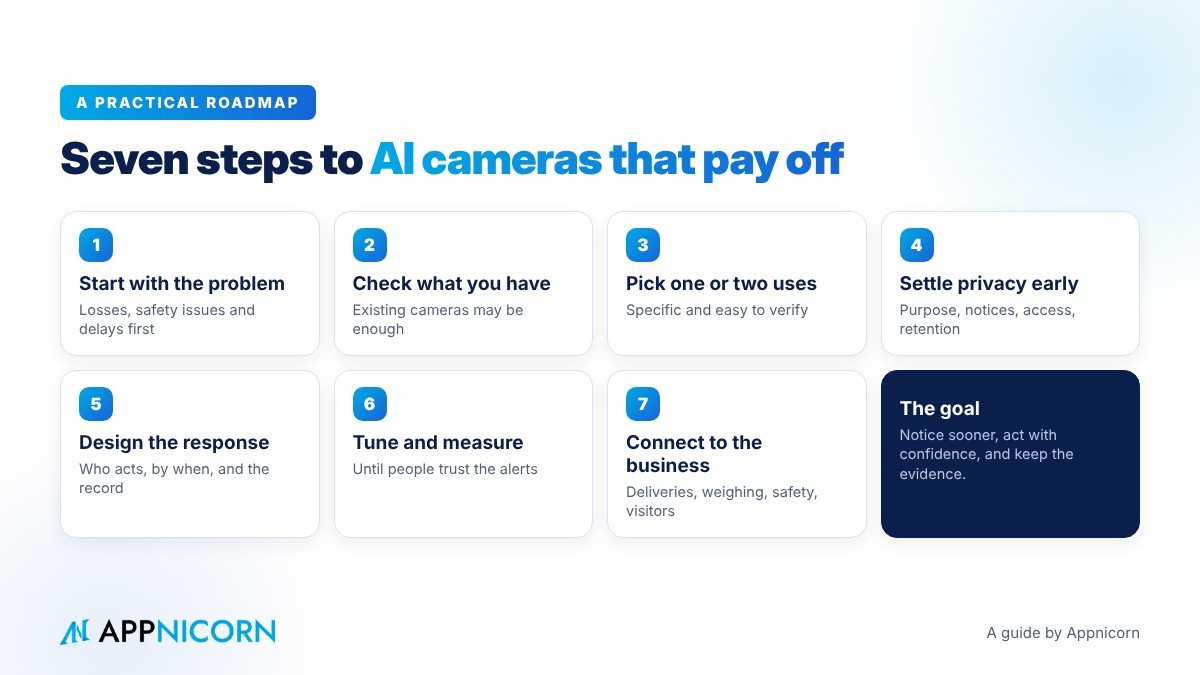
2. Check what you already have. Many existing cameras can support AI analytics with the right software or an added device on site. Replacing everything is not always necessary.
3. Pick one or two clear uses. Gate and vehicle logging, restricted-area alerts and safety checks are common first choices because they are specific and easy to verify.
4. Settle privacy and purpose early. Decide what each camera is for, what notices you will display, who can view footage, how long it is kept and whether any identification is involved. Take advice where needed.
5. Design the response, not just the alert. For each alert type, decide who receives it, what they must do, by when, and what happens if they do not. Make sure every response is recorded.
6. Tune and measure honestly. Track false alarms, response times and real incidents before and after. Adjust sensitivity until people trust the alerts.
7. Connect it to the business. Once the alerts are reliable, link them to the processes they affect, such as deliveries, weighing, safety reporting, visitors and security incidents.
Questions to ask before you choose an AI CCTV system
What exactly does the AI detect, and how often is it wrong in conditions like ours?
Does it need to identify people, or can it do the job without facial recognition?
Where is footage processed and stored, and is it ever used to train someone else's models?
Who can view footage and alerts, and is every view recorded?
How are alerts routed, and can we set owners, deadlines and escalation?
Can every alert be traced to the clip, the time and the person who responded?
How does it connect with our other systems, such as gate passes, weighing, deliveries and safety records?
How are the cameras and software kept secure and up to date?
What happens when the AI is unsure? Does it say so, or does it guess?
What changes for security and operations teams
When AI is introduced well, security and operations teams do not disappear. Their work changes. Less time goes on staring at screens and scrolling through footage. More time goes on responding to the alerts that matter, improving procedures and fixing the causes of repeated incidents. Investigations take minutes rather than afternoons. And because every alert and response is recorded, the evidence for managers, auditors and insurers is produced as the work happens, not pieced together afterwards.
That is the real future of AI in CCTV: not cameras that replace people, but cameras that help people notice sooner and act with confidence.
Let's talk about your site
Every site is different. The right mix of cameras, AI and human response depends on your premises, your risks and what you need to happen when something is spotted.
If you are thinking about how AI cameras could help your business, or about turning what your cameras see into proper follow-up, approvals and records, we would be glad to talk it through. Appnicorn is a Malaysian IT company with years of experience building business systems, and APES is the custom ERP we build with our clients, shaped around how each organisation actually works. Tell us what you need your cameras to catch, and we will explore the possibilities with you.
Talk to our team about the possibilities for your organisation.