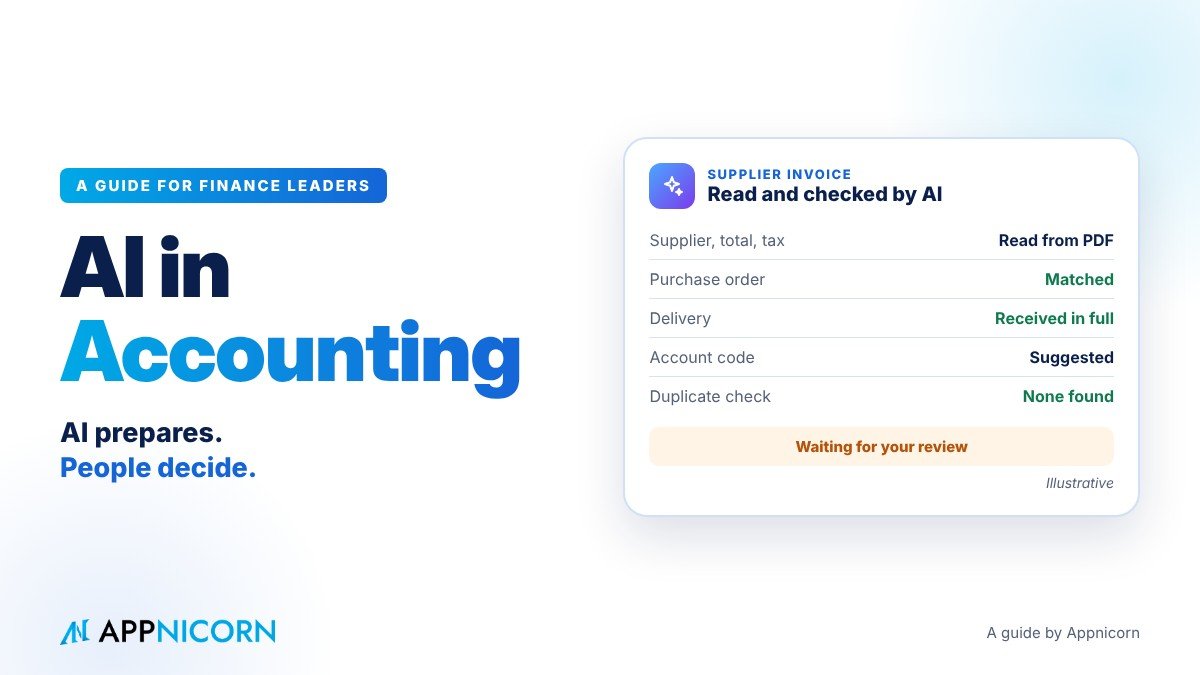
Few parts of a business have been promised as much by AI as the accounts department. Software vendors talk about "autonomous finance". Conference speakers predict the end of data entry. Meanwhile, in most companies, the accounts team is still keying in supplier invoices, chasing receipts for expense claims and spending the first week of every month closing the books.
Both pictures are partly true. AI is already doing useful work inside accounting systems, and it is getting better quickly. But it is not magic, and it does not remove the need for accountants. It changes what they spend their time on.
This guide is written for directors and finance leaders who want a clear, practical view. It explains what "AI in accounting" actually means, where it helps today, what it should never do on its own, the risks that matter, and how to introduce it without losing the control that good accounting depends on.
What "AI in accounting" actually means
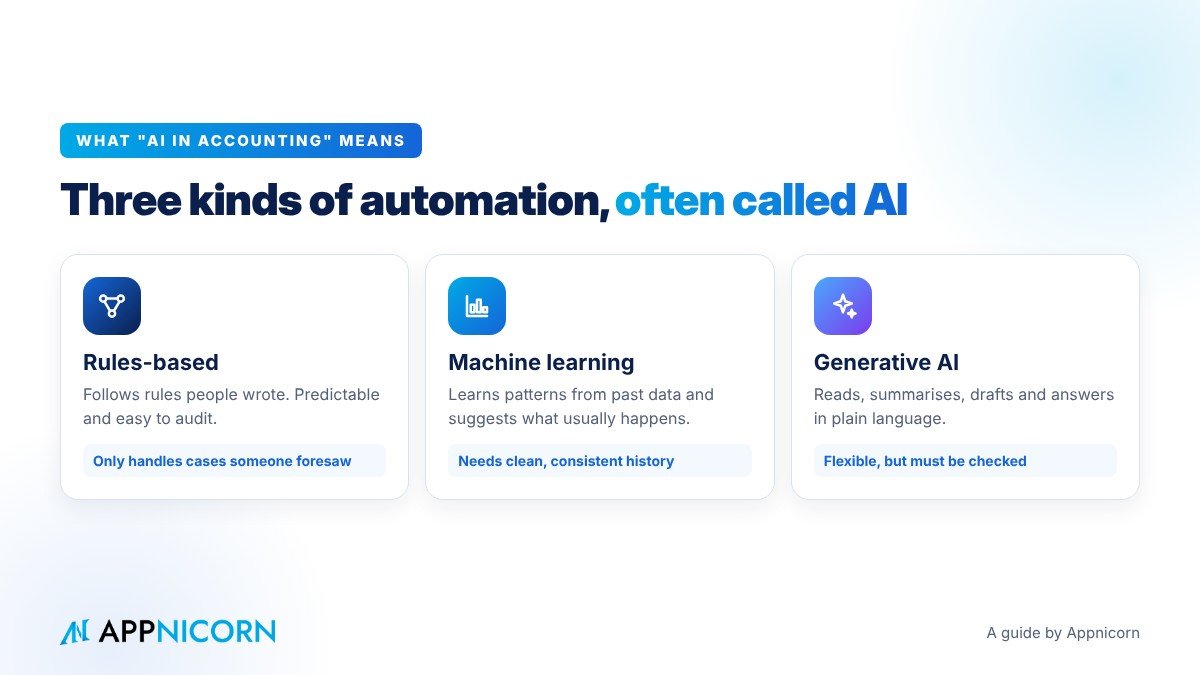
The phrase covers three quite different things, and it helps to separate them.
Rules-based automation. This is the oldest and most common kind. The system follows rules that people have written: "If the supplier is X and the amount is below Y, code it to account Z." It is not really AI, but it is often sold as AI. It is predictable and easy to audit, but it only handles the situations someone thought of in advance.
Machine learning. Here the system learns patterns from past data. It notices that invoices from a certain supplier are always coded to repairs and maintenance, or that a certain bank description usually matches a certain customer. It suggests what to do based on what usually happens. It handles variety better than fixed rules, but it can be wrong when something is unusual, and it needs good historical data to learn from.
Generative AI. This is the newest kind, built on large language models. It can read documents in natural language, extract information from them, summarise them, draft emails and explanations, and answer questions in plain words. It is very flexible, but it can also produce confident answers that are wrong, so it must be used with care in a field where accuracy is everything.
Most modern accounting tools combine all three. The useful question is not "does it have AI?" but "what exactly does the AI do, and who checks it?"
Where AI helps in accounting today
AI is most valuable where the work is high in volume, repetitive and based on documents or patterns, and where a person can easily check the result. Here are the areas where it is making a real difference.
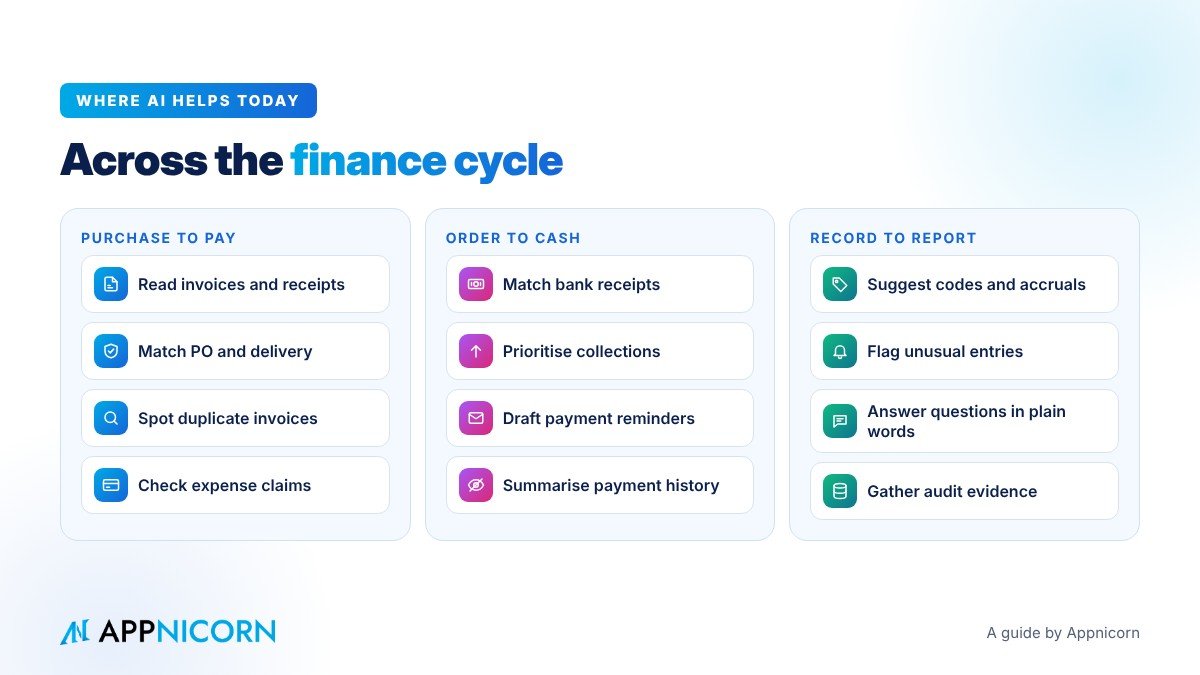
Reading invoices and receipts. Traditional scanning software could turn an image into text, but someone still had to tell the system which number was the total and which was the tax. AI can now read a supplier invoice or a receipt and pick out the supplier, invoice number, date, line items, tax and total, even when every supplier uses a different layout. In a country like Malaysia, where documents arrive in English, Bahasa Malaysia and Chinese, often on the same day, this is especially useful.
Coding transactions. Once the data is captured, AI can suggest the right account, cost centre, project or tax code, based on how similar transactions were coded before. The accountant reviews the suggestion rather than starting from a blank line.
Bank reconciliation. Matching bank lines to invoices and payments is one of the most tedious jobs in accounting, especially when customers pay several invoices at once, pay partial amounts or use unclear references. AI can propose matches, including the awkward many-to-one cases, and leave only the genuine exceptions for a person.
Accounts payable checks. Before a supplier is paid, the invoice should match what was ordered and what was received. AI can compare the invoice with the purchase order and the delivery record, flag differences in price or quantity, and spot likely duplicates, such as the same invoice submitted twice with a slightly different number.
Expense claims. AI can read claim receipts, check them against the company's claims policy, and flag items that need attention: a meal above the limit, a receipt dated outside the trip, or a claim that looks like one submitted last month.
Spotting unusual transactions. By learning what normal looks like, AI can highlight what does not: a payment to a new bank account, an unusually large journal entry posted late at night, a supplier whose invoices have suddenly increased. It does not decide that something is wrong. It points to where a person should look.
Receivables and collections. AI can help prioritise which overdue customers to chase first, draft polite reminder emails in the right tone, and summarise a customer's payment history before a credit decision.
Month-end close. AI can help prepare the close by listing what is still outstanding, suggesting accruals based on recurring patterns, and drafting first explanations for large variances between actual and budget, which the finance team then checks and completes.
Reporting and questions in plain language. Instead of building a new report every time a director asks a question, finance teams can increasingly ask the system in plain words: "Which suppliers did we spend most with this quarter, compared with last year?" The AI finds and summarises the answer, and the accountant checks it before it goes to the board.
Audit preparation. AI can gather supporting documents, summarise contracts and pull together the evidence behind a balance, making audit requests faster to answer.
What AI should not do on its own
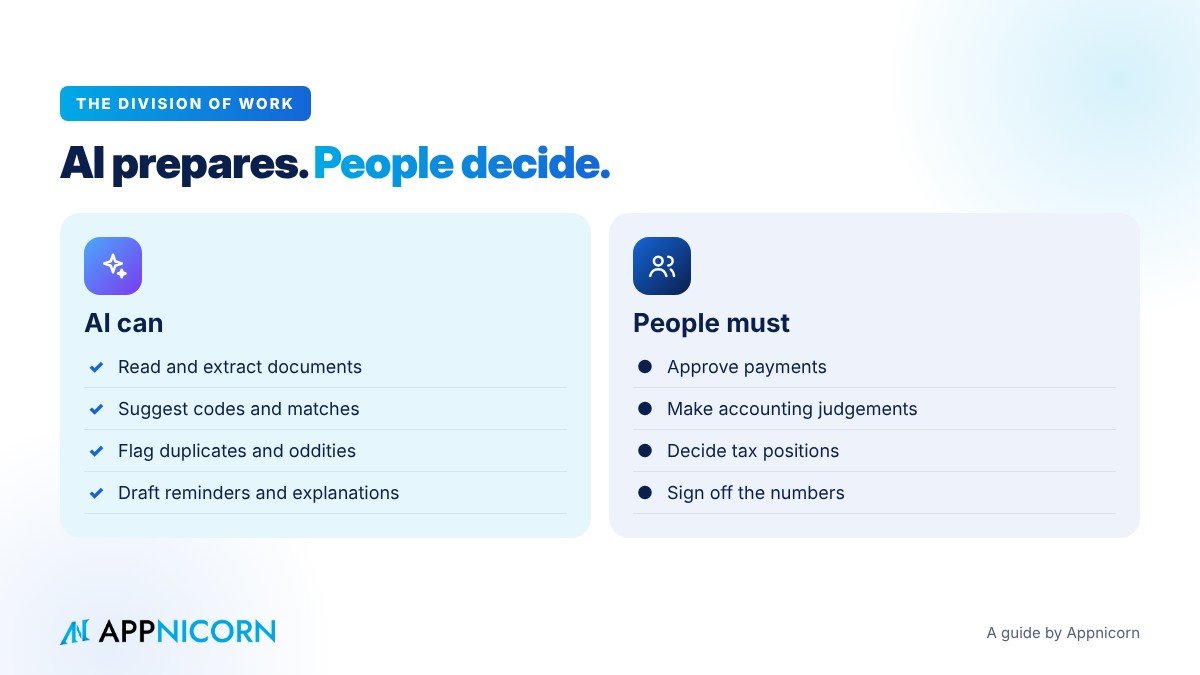
Accounting is built on judgement and accountability. Some decisions must always stay with a person, however good the technology becomes.
Approving payments. AI can prepare a payment run and flag concerns, but releasing money from the business must remain a human decision, with the right approvals.
Making accounting judgements. Revenue recognition, provisions, impairments, the treatment of unusual transactions and similar matters require professional judgement and a person who is accountable for the outcome.
Deciding tax positions. AI can help gather information and draft working papers, but how a transaction is treated for tax purposes must be decided by qualified people.
Posting material entries without review. Suggestions for routine, low-value items may be accepted in bulk once they have proven reliable. Anything material, unusual or judgemental should be reviewed before it reaches the ledger.
Signing off the numbers. The financial statements are the responsibility of the company's directors and finance leadership, not of software.
A useful rule of thumb: let AI prepare, check and point out, and let people decide, approve and sign.
The risks finance leaders should take seriously
AI brings real benefits, but it also brings risks that are particularly important in finance.
Confident mistakes. Generative AI can produce an answer that sounds right but is not. In accounting, a confidently wrong number is worse than no number. Every AI output that matters needs a way to be checked against the source.
Access to sensitive data. Accounting systems hold salaries, bank details, customer information and commercially sensitive figures. An AI tool must never be able to see or do more than the person using it is allowed to see or do. Personal data must be handled in line with the applicable data protection laws and the company's own policies.
No trail of what the AI did. If AI suggested a coding, matched a payment or drafted an explanation, the record should show that, along with who accepted it and when. Without that trail, audits become harder, not easier.
Learning the wrong habits. Machine learning repeats past behaviour. If transactions were coded inconsistently in the past, the AI will learn the inconsistency. Clean, consistent data matters more than ever.
Over-reliance. When suggestions are usually right, people stop checking them. Controls should be designed so that review stays meaningful, for example by sampling accepted suggestions and by requiring closer review above certain amounts.
Data leaving the business. Some AI tools send data to outside services to be processed. Finance leaders should know where their data goes, how it is protected and whether it is used to train anyone else's models.
The principles of safe AI in finance
The companies that use AI well in accounting tend to follow a few simple principles.
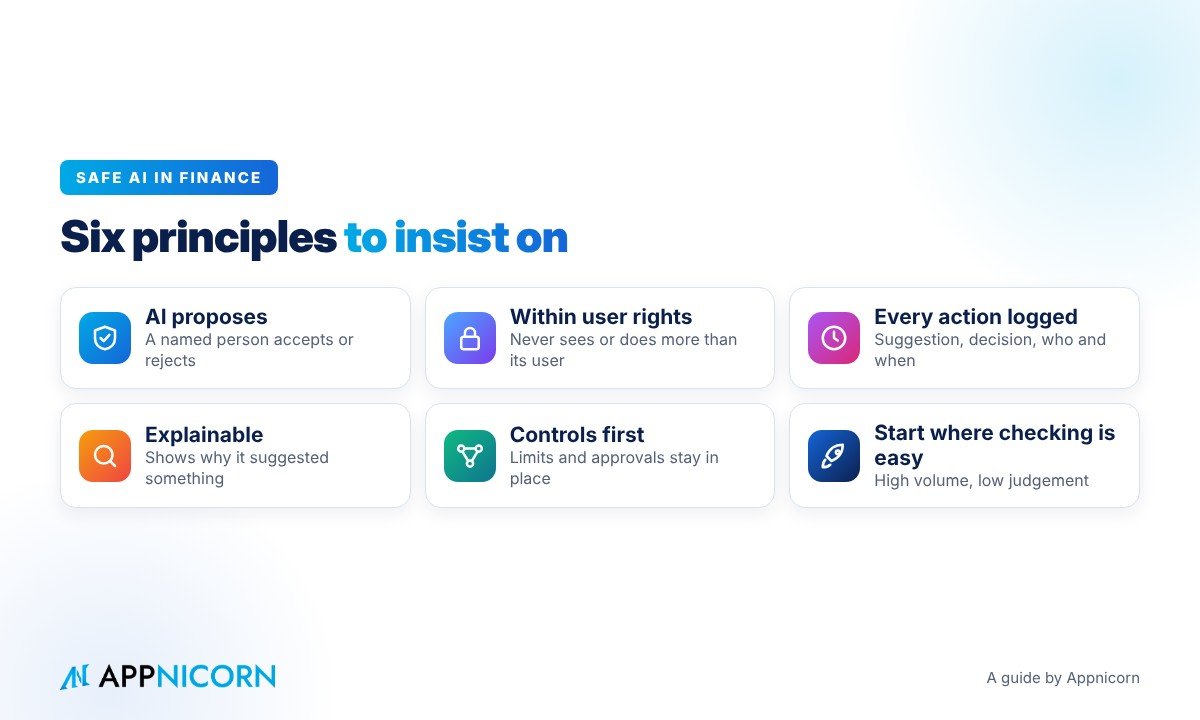
AI proposes, people decide. AI suggests codings, matches, flags and drafts. A named person accepts, changes or rejects them, especially for anything material.
AI works within each person's rights. The AI acting for a clerk sees what the clerk can see and does what the clerk can do, never more.
Every AI action is recorded. What the AI suggested, what the person decided and when are kept as part of the audit trail.
Suggestions are explainable. A good system shows why it made a suggestion, such as "matched on amount and reference" or "coded like the previous twelve invoices from this supplier", so the reviewer can judge it quickly.
Controls come first. Approval limits, segregation of duties and review steps stay in place. AI makes them faster to follow, not easier to bypass.
Start where checking is easy. Begin with high-volume, low-judgement tasks where a person can verify the result at a glance, and expand from there.
The bigger opportunity: fixing what happens before the ledger
There is an uncomfortable truth behind many accounting problems. Most of them do not start in the accounts department.
The invoice that cannot be matched often comes from a purchase that was never properly approved. The receipt that is missing belongs to a claim submitted weeks late. The disputed delivery was never confirmed on site. The customer who does not pay was given credit by a salesperson who did not know the account was overdue. By the time these problems reach the ledger, the accountant is cleaning up after a process that went wrong somewhere else.
AI can help clean up faster. But the larger gains come from fixing the processes upstream: purchase requests and approvals, claims, deliveries, credit checks and the other business processes that feed the accounting system. When those processes capture the right information, in a structured way, with the right approvals and a clear record, the accounts team receives cleaner data, and AI has much less to correct.
Malaysia's move to e-invoicing points in the same direction. As more transactions arrive as structured data rather than paper or PDF, the job shifts from reading documents to checking that the right business events happened, were approved and are recorded correctly.
A practical roadmap for finance leaders
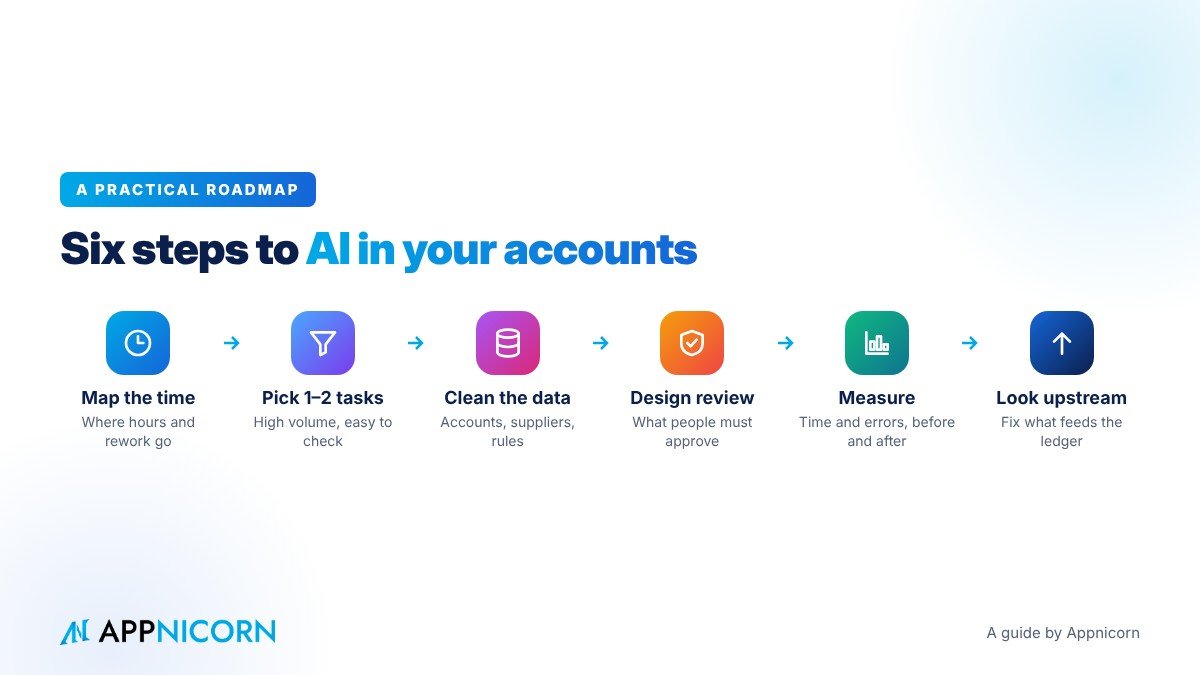
1. Map where the time goes. Before choosing any tool, list the finance tasks that take the most hours each month and the errors that cause the most rework. These are your candidates.
2. Pick one or two high-volume tasks. Supplier invoice capture, bank reconciliation and expense claim checking are common first choices, because they are repetitive and easy to verify.
3. Clean the foundations. Tidy the chart of accounts, supplier and customer records and coding rules. AI learns from your data, so give it good data to learn from.
4. Design the review. Decide what AI may suggest, what a person must review, at what amounts closer review is required, and how accepted suggestions are sampled.
5. Measure honestly. Track time spent, error rates and exceptions before and after. Expand only where the results are clear.
6. Look upstream. Once the accounts team has some breathing room, look at the business processes that feed it. That is often where the next and largest improvement lies.
Questions to ask before you choose an AI accounting tool
What exactly does the AI do in each step, and what does a person still do?
Can every AI suggestion be traced back to its source document and reason?
Does the AI respect our existing user rights, approval limits and segregation of duties?
Is every AI action recorded in the audit trail, with who accepted it?
Where is our data processed and stored, and is it used to train models outside our company?
How does the tool handle documents in the languages we actually receive?
How does it connect with the systems that feed our accounts, such as purchasing, claims, sales and delivery?
What happens when the AI is unsure? Does it say so, or does it guess?
What changes for the finance team
When AI is introduced well, the accounts team does not disappear. It changes shape. Less time goes on keying, matching and chasing. More time goes on reviewing exceptions, improving controls, analysing results and advising the business. Month-end becomes calmer. Questions from directors get answered faster. And because every suggestion and decision is recorded, the evidence for auditors is produced as the work happens, rather than assembled under pressure afterwards.
That is the real promise of AI in accounting: not fewer accountants, but accountants freed to do the work that only they can do.
Let's talk about your finance processes
Every finance function is different. The right mix of automation, AI and human review depends on your volumes, your controls and where your team spends its time today.
If you are thinking about how AI could help your accounts team, or about fixing the business processes that feed your accounting system, we would be glad to talk it through. Appnicorn is a Malaysian IT company with years of experience building business systems, and APES (said "A-pes") is the custom ERP we build with our clients, shaped around how each organisation actually works. Tell us where your finance work gets stuck, and we will explore the possibilities with you.
Talk to our team about the possibilities for your organisation.