Ask a simple question in most companies and watch what happens. "Who approved this payment?" "When was this price changed?" "Why was this delivery released before the deposit came in?"
Someone scrolls through a WhatsApp group. Someone else searches their email. A third person opens a spreadsheet with five versions saved under slightly different names. After an hour, the best answer is often "I think it was Ahmad, but he was on leave that week, so maybe not."
That gap, between what happened and what the business can prove happened, is what an audit trail closes. This guide explains what an audit trail is, why it matters far beyond the auditors, what a good one records, the common ways businesses get it wrong, and how to build one into everyday work rather than assembling it under pressure later.
What an audit trail actually is
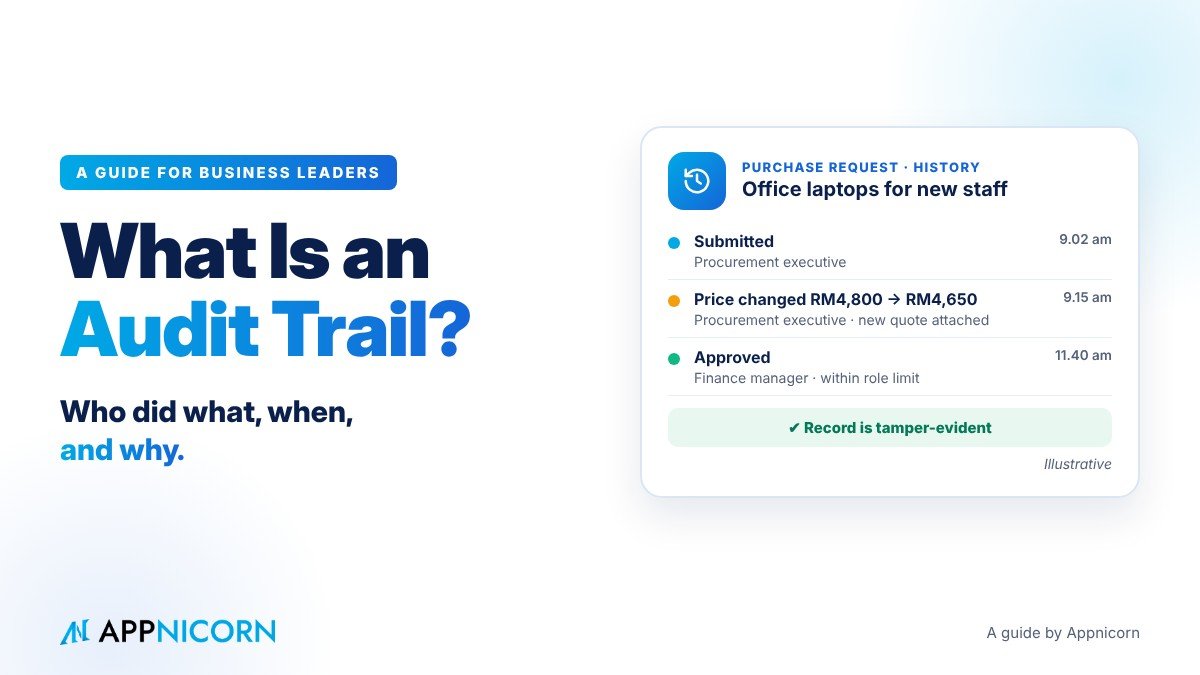
An audit trail is a reliable, time-ordered record of who did what, when, and why, for the actions that matter in a business.
It is not just a log file buried in a server. A useful audit trail lets a manager, an auditor or a regulator follow a piece of work from start to finish: the request, each review, each approval or rejection, each change, and the final outcome, with the person and time attached to every step.
Think of it as the story of a decision, written as the decision is made, by the system rather than from memory.
Why it matters, even if you are not being audited
Many directors think of audit trails as something for the external auditors once a year. In practice, the people who benefit most are inside the business.
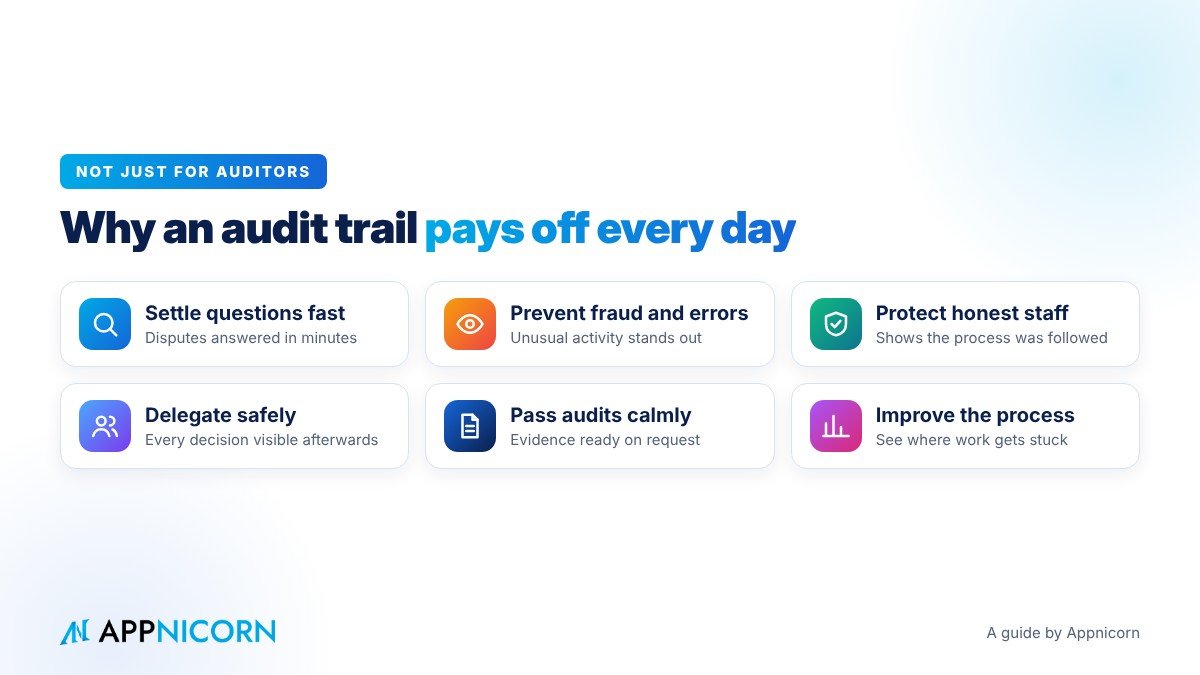
Settling questions in minutes, not days. When a customer disputes a delivery or a supplier queries a payment, the answer is already recorded. Nobody has to reconstruct events from chat messages.
Preventing fraud and errors. People behave differently when they know actions are recorded. A clear trail also makes unusual activity easier to spot, such as an approval given outside working hours or a bank detail changed just before a payment.
Protecting honest staff. A good trail does not only catch mistakes. It also shows that a person followed the process correctly, which matters when something goes wrong and blame starts looking for a home.
Making delegation safe. Directors can hand approvals to managers more confidently when every decision is visible afterwards.
Passing audits and inspections calmly. Financial auditors, ISO 27001 auditors, regulators and major customers increasingly ask for evidence, not explanations. A business that can produce the record on request spends far less time and stress on audits.
Learning from what happened. A trail shows where work gets stuck, which approvals take longest and which steps are often skipped. That is valuable information for improving the process itself.
What a good audit trail records
Not every click needs to be recorded, but the actions that carry money, risk or responsibility should be. For each of those, a good trail captures six things.
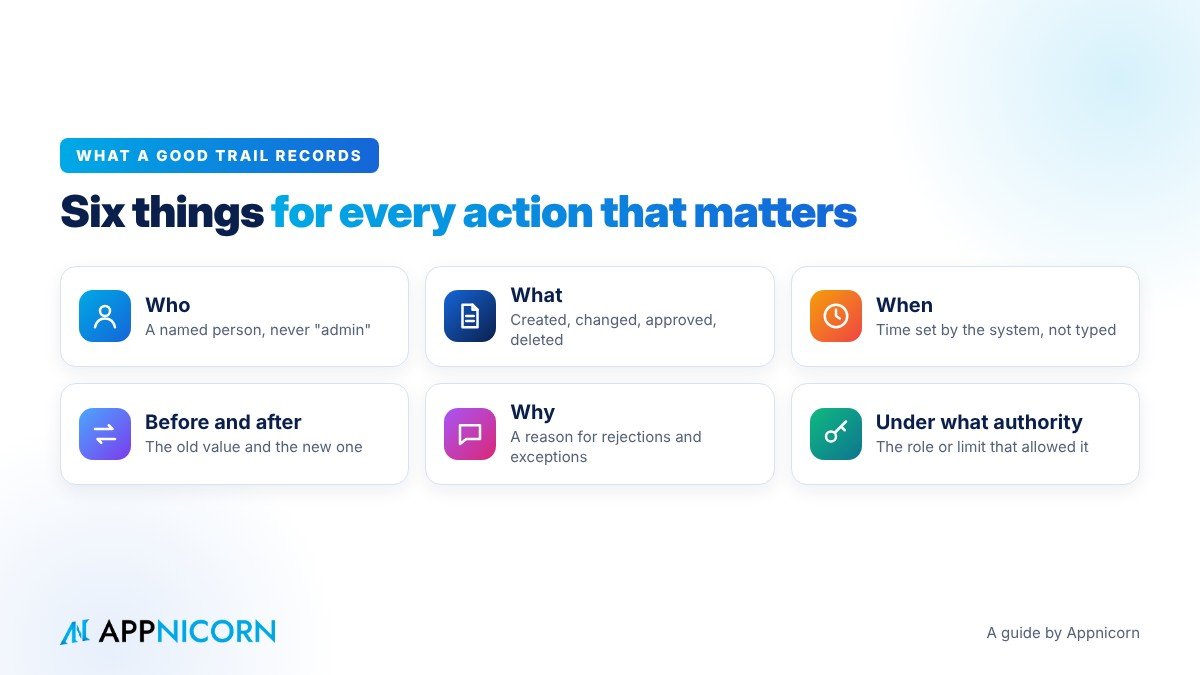
Who. The named person who acted, not a shared login such as "admin" or "accounts".
What. The action itself: created, edited, submitted, approved, rejected, deleted, exported.
When. The date and time, recorded by the system rather than typed by a person.
Before and after. For changes, what the value was and what it became. "Credit limit changed" is weak. "Credit limit changed from RM20,000 to RM50,000" is useful. (Illustrative figures.)
Why. A reason or comment where it matters, such as why a request was rejected or why an exception was allowed.
Under what authority. The role or rule that allowed the action, for example "approved by the finance manager, within the RM10,000 limit for that role". (Illustrative figures.)
Where businesses need it most
Every company is different, but the same areas come up again and again.
Purchasing and payments. Requests, quotations, approvals, purchase orders and payment releases.
Claims and expenses. Who submitted, who checked, who approved, and what was changed along the way.
Pricing, discounts and credit. Changes to price lists, special discounts, credit limits and payment terms are classic sources of leakage.
Stock and assets. Adjustments, write-offs, transfers between locations and consignment movements.
Master data. Changes to supplier bank details, customer records and user rights. These are small edits with large consequences.
Documents and contracts. Which version was approved, who signed off, and when a controlled document was issued or replaced.
Personal data. Who accessed, changed, exported or deleted personal information. Under Malaysia's Personal Data Protection Act, businesses must protect the personal data they hold, and being able to show who handled it is part of demonstrating that care.
Regulated activities. Industries such as moneylending, healthcare and finance often face specific record-keeping duties. The exact requirements depend on the industry and should be confirmed with the relevant regulator or adviser.
The common ways audit trails fail
Most businesses already have some kind of record. The problem is that it often fails exactly when it is needed.
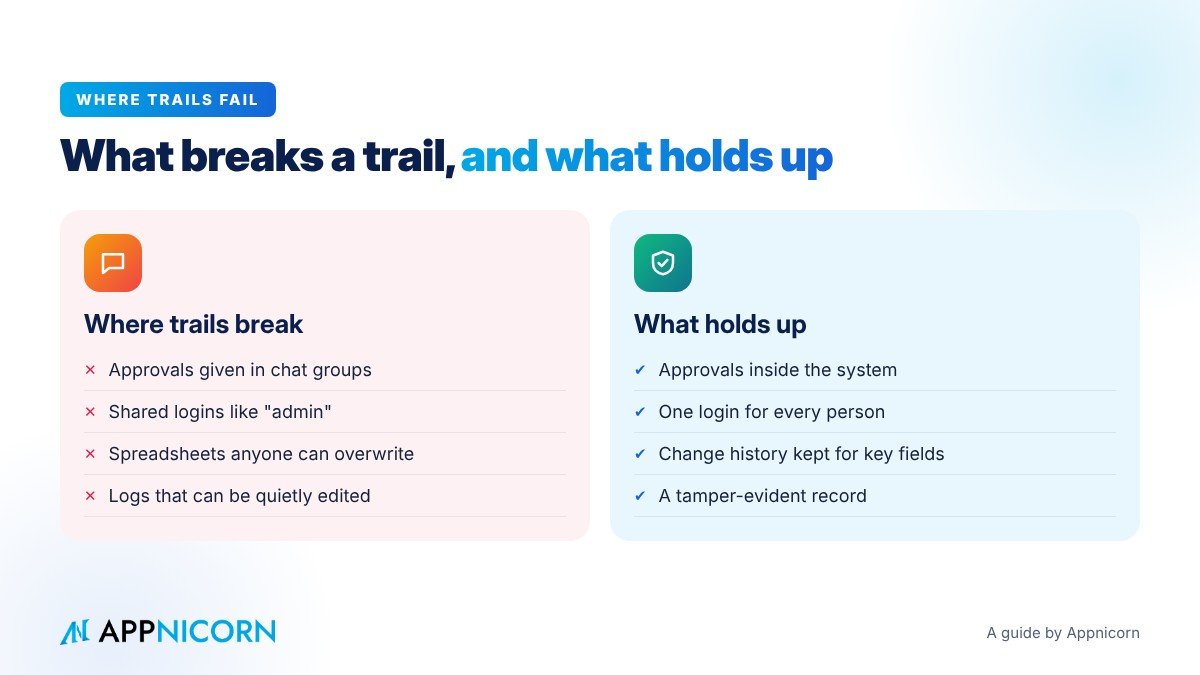
Approvals in chat. A thumbs-up in a WhatsApp group feels like an approval, but it is hard to find later, easy to misread, and not linked to the actual document or amount.
Shared logins. When five people use the same account, the record says what happened but not who did it.
Spreadsheets that anyone can edit. A spreadsheet records the current value, not the history. Once a cell is overwritten, the old value and the person who changed it are usually gone.
Records that can be quietly changed. If a person can edit or delete the log itself, the trail cannot be trusted. A trail is only as strong as its protection against tampering.
Evidence scattered across systems. The request is in email, the approval in chat, the invoice in a shared folder and the payment in the banking portal. Each piece exists, but connecting them takes hours.
Trails added after the fact. Some businesses rebuild the record when an audit is announced. That is stressful, expensive, and less convincing to auditors than evidence created at the time.
What "tamper-evident" means, and why it matters
A tamper-evident audit trail is one where any attempt to change or remove a past entry can be detected.
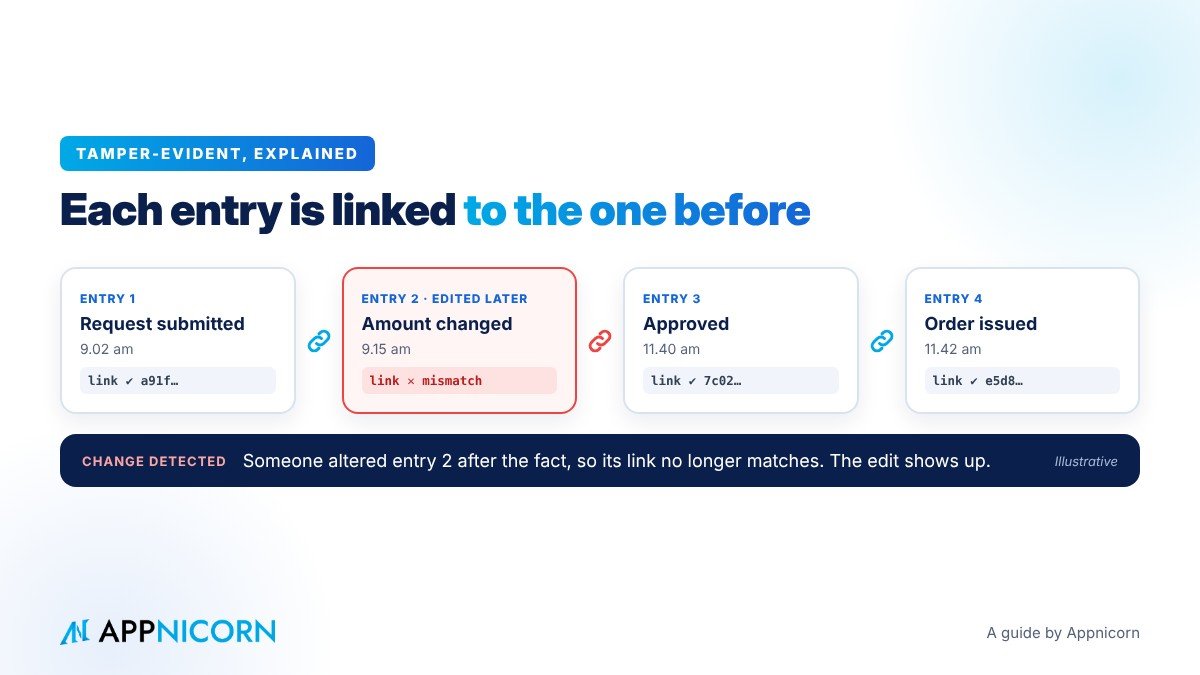
Ordinary logs can be edited by anyone with enough access. Tamper-evident records are designed so that each entry is linked to the ones before it. If someone alters an old entry, the link breaks, and the change shows up.
This matters because the value of an audit trail lies in trust. If a director, an auditor or a court cannot be confident the record is complete and unaltered, the record loses much of its worth. Tamper-evident design turns "we have logs" into "we can prove what happened".
Audit trails in the age of AI
AI is starting to do real work inside businesses: reading documents, suggesting codes, drafting replies and preparing approvals. That makes audit trails more important, not less.
When AI is involved, the trail should show what the AI suggested, which person accepted, changed or rejected the suggestion, and when. It should also be clear which person the AI was acting for, and that it never did anything that person was not allowed to do.
Without that record, a business cannot answer a basic question: did a person decide this, or did a machine? The safest principle is simple. AI may prepare and propose. A named person decides, and the decision is recorded.
How to build an audit trail into daily work
The best audit trails are not a separate task. They are a by-product of doing the work in the right way.
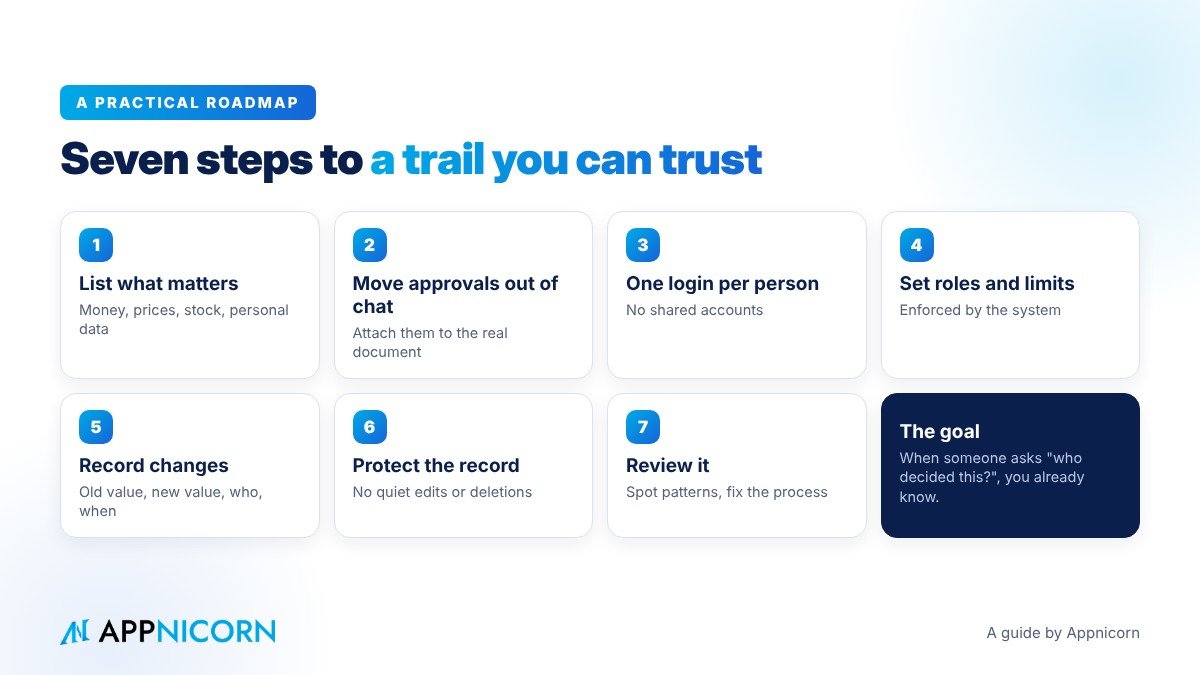
1. List the actions that matter. Start with the decisions that move money, change prices or credit, affect stock, or touch personal data. These are the actions that need a reliable record.
2. Move approvals out of chat and email. Put requests and approvals into a system where each approval is attached to the actual document, amount and person.
3. Give everyone their own login. Remove shared accounts. Every action should be traceable to a named person.
4. Set roles and limits. Decide who may approve what, up to which amount. The system should enforce those limits and record which rule allowed each action.
5. Record changes, not just results. Make sure important fields keep their history, with the old value, the new value, the person and the time.
6. Protect the record. Choose tools where the trail cannot be quietly edited or deleted, and where access to the trail itself is controlled.
7. Review it, not just store it. Check the trail regularly for unusual patterns, such as approvals outside working hours, repeated exceptions or changes to bank details, and use what you find to improve the process.
Questions to ask about any system you use or buy
Does every user have their own login, and is every important action linked to a named person?
Are approvals recorded with the document, amount, time and reason, inside the system?
Does the system keep the history of changes, including old and new values?
Can the audit trail be edited or deleted, and by whom?
Does the system enforce approval limits, or only record them?
If AI is used, does the record show what the AI suggested and who decided?
Can we produce the full story of a transaction, from request to outcome, in a few minutes?
How long are records kept, and can we set retention to match our obligations?
From "prove it" to "here is the report"
When audit trails are built into daily work, something changes. Questions that used to take a day of searching are answered in minutes. Audits stop being projects and become reports. Directors delegate with confidence. Staff are protected by the record rather than exposed by the lack of one.
The goal is not to watch people more closely. It is to make sure that when someone asks "who decided this, and why?", the business already knows.
Let's talk about your processes
Every business has its own approvals, limits and record-keeping needs. The right setup depends on how your work actually flows and where questions tend to arise today.
If you are tired of reconstructing decisions from chat messages and spreadsheets, or you want approvals and records that stand up to any audit, we would be glad to talk it through. Appnicorn is a Malaysian IT company with years of experience building business systems, and APES is the custom ERP we build with our clients, shaped around how each organisation actually works. Tell us where your records fall short, and we will explore the possibilities with you.
Talk to our team about the possibilities for your organisation.