This is an illustrative story. The company, the people and the numbers are fictional, but the problem will be familiar to almost every service business that sends technicians out to customer sites.
Meet Melissa, and her technicians
Melissa runs an air-conditioning and M&E servicing company in the Klang Valley. Her technicians service, repair and maintain cooling systems for offices, clinics, restaurants and a few factories. Some customers call when something breaks. Many more are on maintenance contracts, with scheduled visits every quarter.
Melissa's team is very good at the work itself. Her senior technician, Hafiz, can tell what is wrong with a compressor from the sound it makes in the car park. Customers ask for him by name.
The trouble is not the work. The trouble is everything that happens after the work is done.
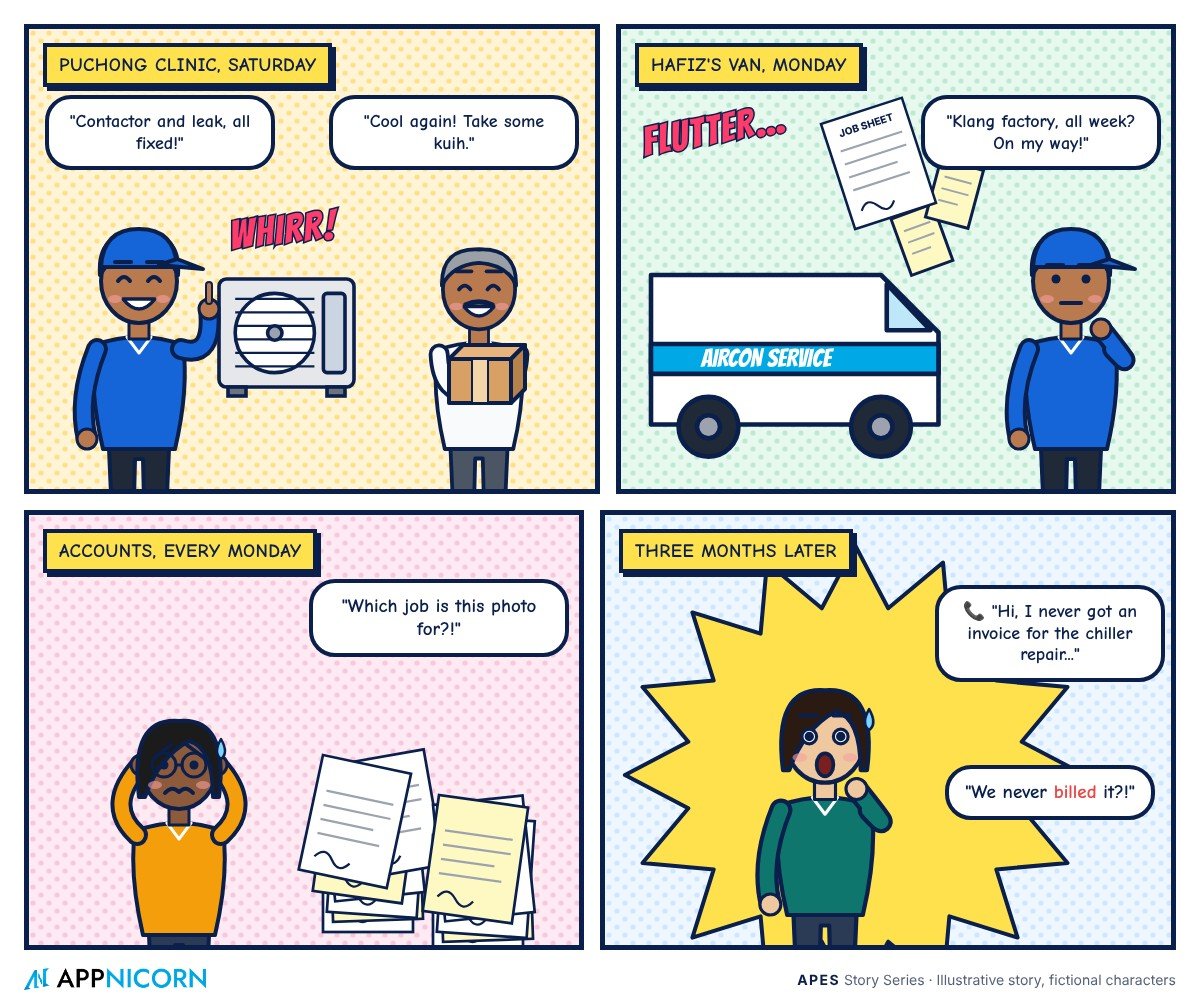
On a Friday afternoon, Melissa gets a call from a customer she has not heard from in a while. It is the operations manager of a chain of clinics. He is calling, politely, to ask why he has never received an invoice for the emergency chiller repair at his Puchong branch. Three months ago.
Melissa thanks him, puts the phone down, and stares at the wall for a long moment. She is grateful for an honest customer. She is also wondering how many customers are not calling.
How a job really moved through the company
On paper, the process was straightforward.
A customer called or sent a WhatsApp message. Wei Jie, the service coordinator, wrote the job into a shared spreadsheet and messaged a technician with the address. The technician went to site, did the work, and filled in a paper job sheet: what was found, what was done, which parts were used, and how long it took. The customer signed it. At the end of the week, the technician brought the job sheets back to the office, and Priya in accounts used them to raise invoices.
In practice, almost every step leaked.
Customers called technicians directly, because they had their numbers. Urgent jobs were arranged by phone and never made it into the spreadsheet. Job sheets stayed in van door pockets for days, sometimes weeks. Some got wet. Some were filled in at the next site from memory. Parts were taken from the van stock and written on the sheet, or not. Extra work done on site, such as replacing a capacitor while servicing a unit, was agreed with the customer verbally and remembered by nobody.
Maintenance contracts had their own problems. The visit schedule lived in a different spreadsheet. If a visit was done, someone had to remember to tick it off. If it was not done, nobody noticed until the customer complained.
Priya did her best. Every Monday, she chased the technicians for last week's job sheets, matched them against the spreadsheet and WhatsApp photos, and tried to work out what was billable. When something did not add up, she asked Wei Jie, who asked the technician, who usually said, "I think I gave it to you already."
The job that slipped through
The Puchong chiller job was a perfect example.
It came in on a Saturday morning as a call straight to Hafiz's phone. The clinic's chiller had tripped and the waiting room was getting warm. Hafiz went over, found a failed contactor and a refrigerant leak, fixed both and topped up the gas. It took most of the day. The clinic manager signed the job sheet and thanked him with a box of kuih.
Because it was a weekend call, it never went into the spreadsheet. Hafiz put the job sheet in his van. On Monday he was sent straight to a factory job in Klang that lasted all week. By the time he cleaned out his van, the job sheet was gone, probably in a pile of old delivery notes and parking receipts.
Priya never knew the job existed. The parts were used up from van stock with no record of where they went. The customer was happy, the technician had moved on, and the company had done a full day of skilled emergency work for free.
When Melissa asked the team to go back through the last six months, they found more. A maintenance visit at a restaurant, done but never invoiced. A set of filters replaced at an office and not charged. Overtime hours on a factory shutdown that were never added to the bill. None of them was huge on its own. Together, they were enough to make Melissa feel slightly ill.
The pain points behind the story
Melissa's team was not careless. They were working inside a process that relied on paper surviving and people remembering. Here is what was really going wrong.
Jobs entered the business through too many doors. Calls to the office, calls to technicians, WhatsApp messages and contract schedules all created work, but only some of it was written down in one place. Work that was not recorded could not be billed.
The job sheet was the only proof, and it was paper. Everything depended on one sheet getting from the customer's site to Priya's desk. If it was lost, late or incomplete, the job effectively did not happen.
Billing started days or weeks after the work. By the time Priya saw a job sheet, details were fuzzy. She spent hours deciphering handwriting and chasing missing information, and invoices went out late, which meant customers paid late.
Parts and extra work went unrecorded. Parts taken from van stock and small additional jobs agreed on site were the easiest things to forget. They were also pure margin.
Contract visits were invisible. Nobody could say at a glance which maintenance visits were due, which were done and which were overdue. Missed visits upset customers. Completed visits sometimes went unbilled.
Disputes had no evidence. When a customer said, "Your technician only stayed one hour," or "We never agreed to that part," Melissa had a smudged sheet, if she was lucky, and the technician's word.
What it was really costing
The obvious cost was the unbilled work. Every job that slipped through was labour, travel and parts the company paid for and never recovered.
The hidden costs were larger. Late invoices stretched cash flow, so Melissa was paying salaries and suppliers before customers paid her. Priya spent a large part of every week on chasing and checking instead of collecting. Missed contract visits put renewals at risk. And because nobody had reliable numbers, Melissa could not tell which customers, which contracts or which types of job were actually profitable.
Worst of all, she could not tell how much she was losing. She only knew about the jobs that honest customers called to remind her about.
Why the obvious fixes fell short
Melissa tried the usual remedies.
First, a rule: no job sheet, no commission. Job sheets came back faster for a few weeks, but the sheets for weekend calls and direct calls still went missing, because those jobs had never been recorded in the first place.
Next, she asked technicians to send a photo of every signed job sheet to a WhatsApp group. Now Priya had hundreds of photos to scroll through, some blurry, with no easy way to match them to customers, contracts or parts. The group became one more place where information went to hide.
She also looked at a ready-made field service app. It handled scheduling well, but it did not match how her contracts were priced, how parts were charged or how Priya needed invoices prepared. It would have meant changing the way the business worked to suit the software, and keeping yet another system in step with the others.
The underlying problem was that a job was not a single thing in her business. It was a call, a visit, a sheet, some parts, a signature and an invoice, all kept in different places. Until those were joined up, things would keep falling through the gaps.
How APES changed the story
Melissa came to Appnicorn with a clear brief: "Every job my team does must end up on an invoice, and I want to know when it does not."
The team built a service job module in APES around how Melissa's company actually works. Here is how a job runs now.
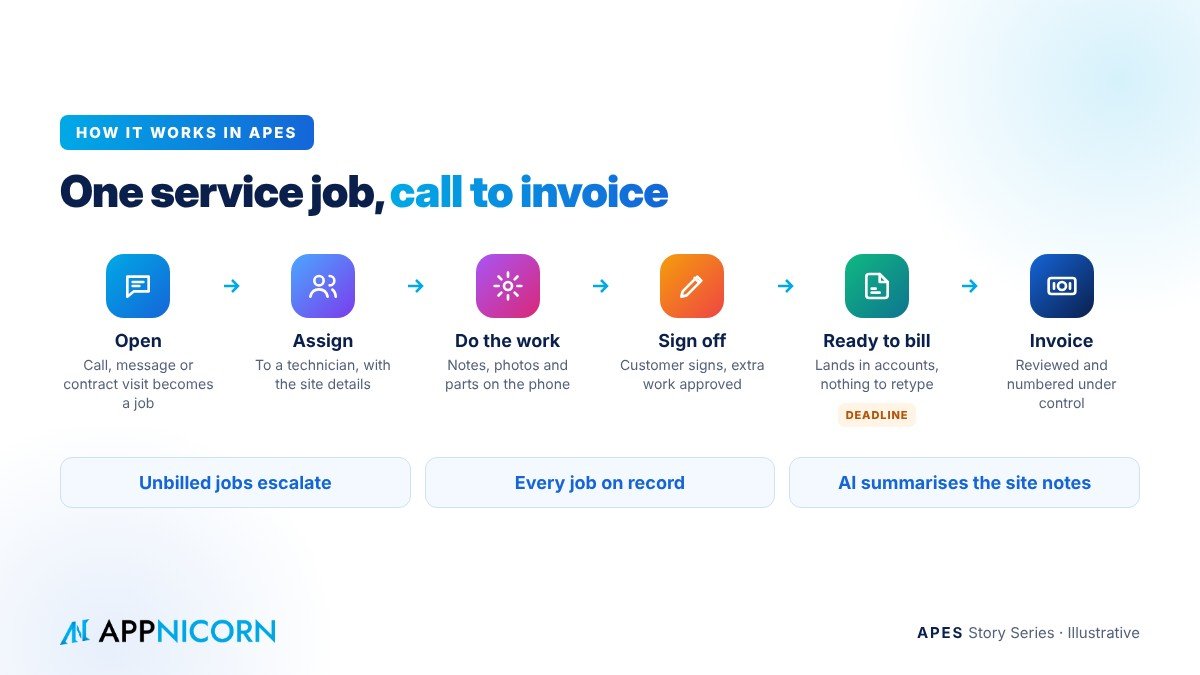
Every job starts as a job order, whatever the door. Whether a customer calls the office, messages a technician or is due a contract visit, the job is opened in APES. Technicians can create a job order on their phone for a direct call, so weekend emergencies are recorded from the start.
Contract visits schedule themselves. Each maintenance contract in APES has its visit plan. Visits due this month appear for Wei Jie to assign, and overdue visits are flagged before the customer notices.
Technicians complete the job on their phone. On site, Hafiz opens the job in APES, records what he found and what he did, adds photos, and picks the parts used. The customer signs on the phone screen. There is no paper to lose.
Parts are recorded as they are used. Parts taken from van stock are recorded against the job, so they can be charged to the customer and the van stock stays accurate.
Extra work is agreed and recorded on the spot. If Hafiz finds something else that needs doing, he adds it to the job and the customer approves it before he starts. Nobody has to remember a verbal agreement later.
Completed jobs go straight to billing. When a job is closed, it lands in Priya's ready-to-bill list with the work, the hours, the parts and the signature already attached. She reviews it and raises the invoice in minutes, with invoice numbers controlled so none are skipped or duplicated.
Nothing sits forgotten. Each step has a deadline. A job left open too long, or a completed job that has not been billed, triggers a reminder and then escalates to Melissa. The Puchong chiller job would have been on her screen within days, not on a customer's mind three months later.
Every job has a record. Calls, assignments, site notes, photos, parts, signatures and invoices are kept in a tamper-evident audit trail. When a customer questions a bill, Melissa can show exactly what was done, when and by whom.
AI helps with the paperwork. AI inside APES can read a technician's notes and photos and summarise them for the invoice and the service report, so Priya is not deciphering shorthand. It prepares. Priya checks and decides.
What changed for Melissa's team
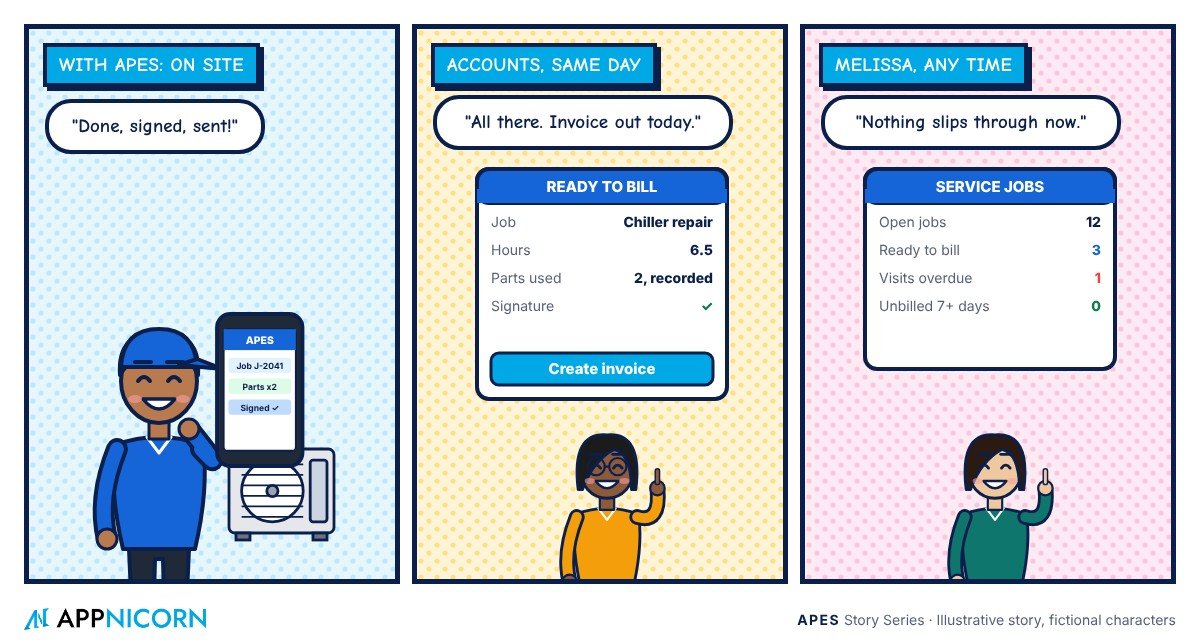
This part of the story is illustrative, but it shows the kind of change a business can expect.
Hafiz still does what he does best. He just finishes the paperwork before he leaves the site, on the same phone he already carries. Wei Jie sees every open job and every contract visit due in one place, so he plans the week instead of chasing it. Priya no longer spends Mondays hunting for job sheets. She works through a list of completed jobs, ready to bill, and invoices go out within days of the work.
For Melissa, the biggest change is that she can finally see the business. She knows how many jobs are open, how many are waiting to be billed and which contracts have visits overdue. And when the clinic chain renewed its maintenance contract, she sent the manager a full service history for every branch, signatures included.
He did not need to call about any missing invoices this time.
Is this your business?
You do not have to service air-conditioners to recognise Melissa's Friday afternoon. Ask yourself a few questions.
How many jobs come in by calling or messaging a technician directly? How long does it take for a completed job to become an invoice? If a job sheet went missing today, would anyone notice? Are the parts used on site always charged? Can you see which contract visits are overdue right now? And when a customer disputes a bill, how quickly can you show them what was done?
If those answers are uncomfortable, the problem is probably not your technicians. It is that your jobs live on paper and in chat, and billing depends on both surviving the trip back to the office.
Bring us your missing job sheets
APES (said "A-pes") is a custom ERP made by Appnicorn, a Malaysian IT company with years of experience building business systems. Every module in APES is customised to your company's unique needs, whether that is service jobs, maintenance contracts, stock, purchasing, claims or a process unique to your industry.
In APES, your rules are built into the work itself. Jobs go to the right people with deadlines and escalation, documents are numbered under control, and every step is kept in a tamper-evident audit trail. Each business gets its own workspace, so jobs, parts, contracts and invoices sit in one place. If the module you need does not exist yet, Appnicorn designs and builds it with you.
Pricing depends on the process being built, so the best first step is a conversation. Bring us last month's job sheets, the ones you can find, and we will show you how the same jobs would run in APES.