At most weighbridges, the day still depends on a person in a small cabin beside the scale. They check each lorry as it arrives, key in the plate number, press a button to capture the weight, print a slip, lift the gate and wave the driver on. At the end of the shift, the records are exported to a spreadsheet and sent to head office, where someone checks them against orders, deliveries and invoices.
That way of working has served palm oil mills, quarries, recycling yards and factories for decades. But it has well-known weaknesses. It needs someone at the scale on every shift. It depends on careful typing. It leaves room for mistakes and, at worst, manipulation. And head office only sees what happened hours or days later.
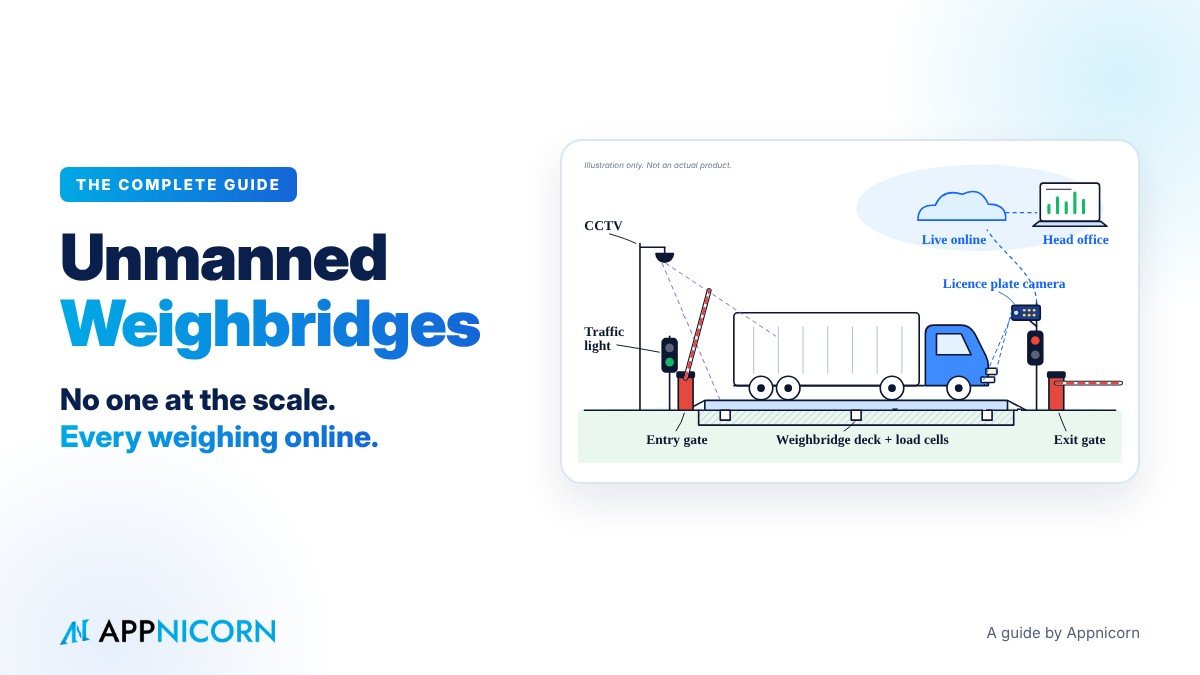
An unmanned weighbridge changes that. The lorry is identified, weighed and recorded automatically, with no one needed at the scale, and every weighing goes online as it happens.
This guide explains, in depth, what an unmanned weighbridge is, how it works step by step, the hardware and software involved, where weighbridges lose money, the benefits and the limitations, the Malaysian rules to be aware of, and how to plan a move to unmanned weighing.
What is an unmanned weighbridge?
A weighbridge, sometimes called a truck scale or, in Bahasa Malaysia, a jambatan timbang, is a large platform built over load cells that measures the weight of a vehicle and its load. The difference between the weight of the loaded vehicle and its empty weight, called the tare, gives the net weight of the goods.
An unmanned weighbridge, also called an automated or unattended weighbridge, does the same job without a dedicated operator at the scale. Cameras, gates, traffic lights and software take over the routine work: identifying the vehicle, controlling when it drives on and off, capturing a stable weight, linking it to the right transaction and recording the result.
People do not disappear from the process. They move from standing at the scale to supervising it: reviewing exceptions, approving corrections and analysing the data, often from head office rather than the site.
How an unmanned weighbridge works, step by step
Every site is set up a little differently, but a typical unmanned weighing follows the same sequence.
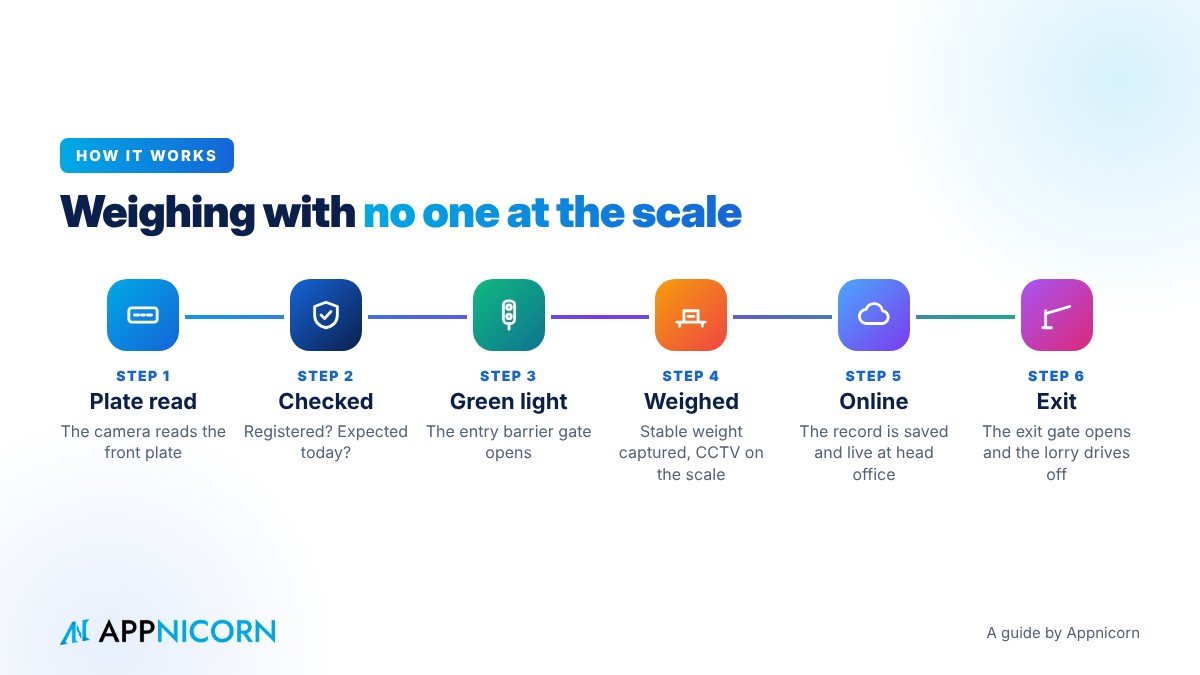
1. Arrival and identification. The lorry pulls up to the weighbridge. A licence plate recognition camera, also known as ANPR (automatic number plate recognition), reads the number plate. Some systems use RFID tags or cards on the vehicle instead of, or as well as, plate recognition.
2. Checking the vehicle against the system. The software checks whether the plate is registered, whether the vehicle is expected today, and which customer, supplier, order or product it belongs to. An unknown or unexpected vehicle can be held and flagged for a person to review.
3. Green light, gate opens. If the vehicle is cleared, the traffic light turns green and the entry barrier gate rises.
4. Driving on and positioning. The lorry drives onto the deck. The vehicle must sit fully on the platform for an accurate weight. Many systems use position sensors, light curtains or cameras to check that no wheel is hanging off the edge.
5. Weighing. The weight indicator waits until the reading is stable and then captures it automatically. CCTV covers the scale throughout, so there is a visual record of what was on the deck.
6. Recording. The weight, plate, time, direction (in or out) and linked transaction are saved. If this is the second weighing of a visit, the system calculates the net weight from the gross and tare.
7. Exit. The exit light turns green, the barrier gate opens and the lorry drives off. The record is already in the system.
8. Online and visible. In a connected system, the weighing appears at head office straight away, on a dashboard and in reports, rather than waiting for an end-of-day export.
The hardware of an unmanned weighbridge
The weighbridge and load cells. The deck, its foundations and the load cells underneath it are the heart of the system. Accuracy starts here, so the deck must be sound, level, clean and properly maintained.
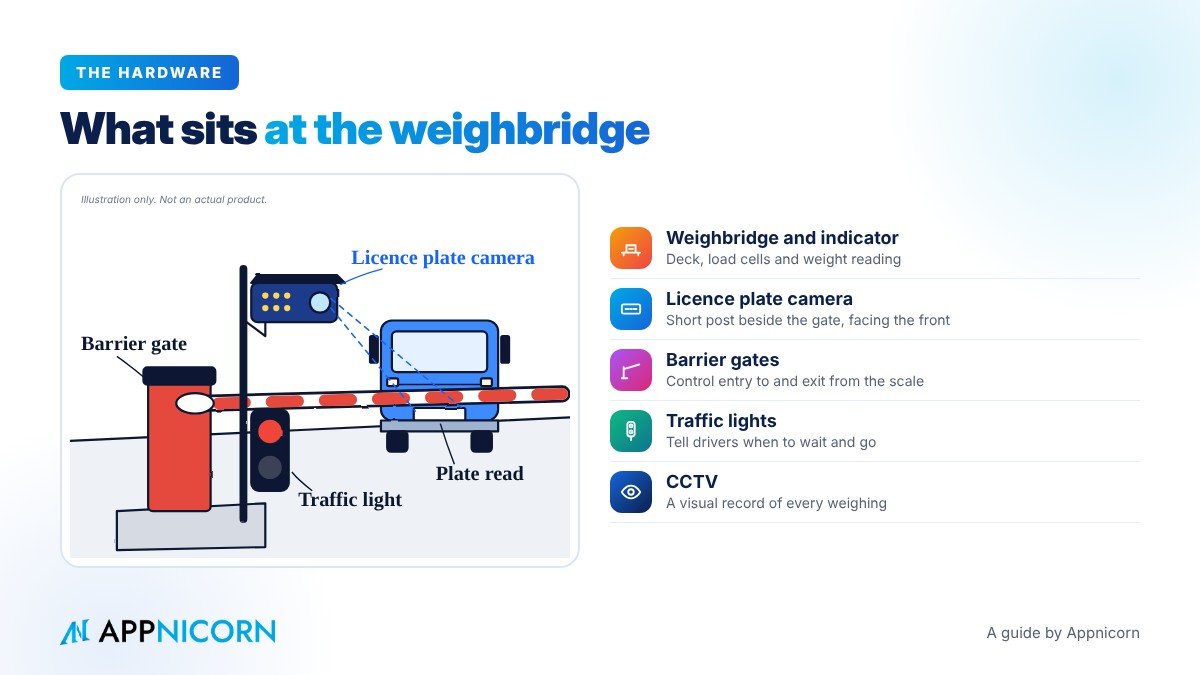
The weight indicator. This electronic unit converts signals from the load cells into a weight reading and passes it to the software.
Licence plate recognition camera. Usually mounted on a short post beside the barrier gate, facing the front of the vehicle, so it reads the front plate clearly as the lorry approaches.
Barrier gates. Entry and exit barriers control when a vehicle may drive onto and off the scale, so only one transaction happens at a time and no vehicle skips the process.
Traffic lights. Red and green lights tell the driver when to wait, when to drive on and when to leave, without anyone waving them through.
CCTV. Cameras cover the deck and approaches, giving a visual record of every weighing and helping resolve disputes. Some sites also capture a snapshot with each weighing record.
Driver terminals or kiosks (optional). Some setups give drivers a touch screen to enter details or print a slip. Many unmanned sites do not need one, because the plate and the scheduled order already tell the system what it needs to know.
Network connection. A reliable link from the site to the system lets data flow online. Good systems keep weighing if the connection drops and sync the records when it returns.
The software: where most of the value sits
Hardware makes unmanned weighing possible. Software decides how useful it is.
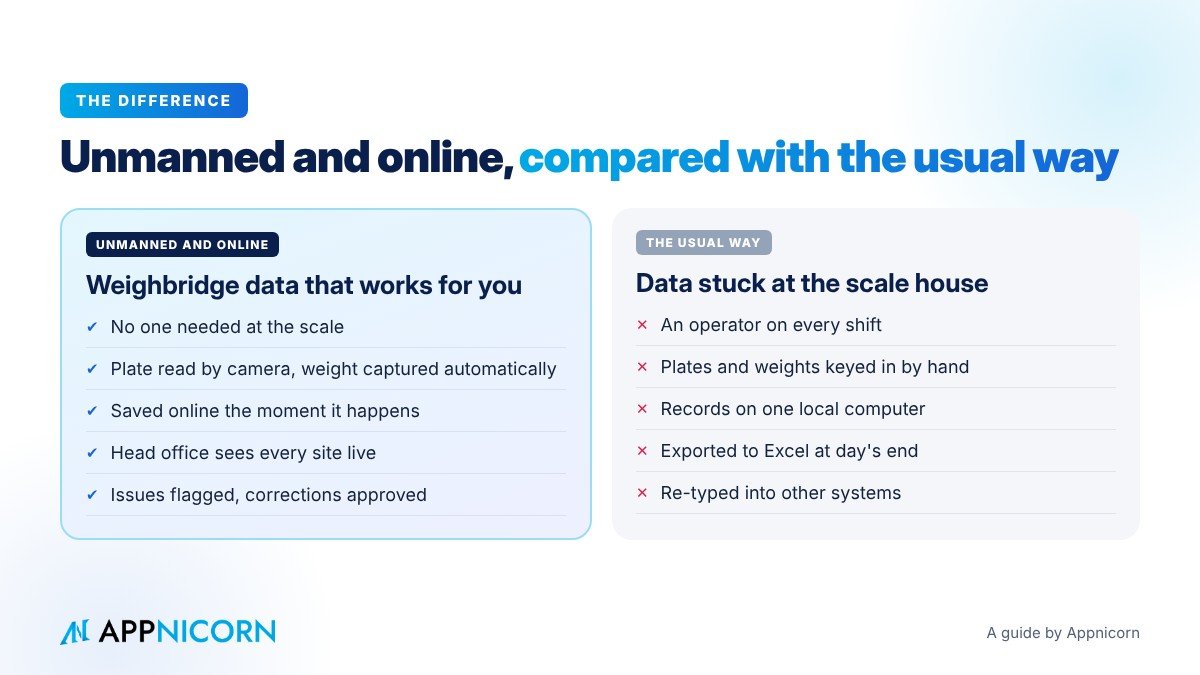
At many sites, weighbridge software runs on one local computer in the scale house. Records stay on that machine until someone exports them. Reports are built in spreadsheets, and data is re-typed into other systems.
A modern weighbridge system does more:
Live records. Every weighing is saved online the moment it happens, so there is one version of the truth.
A head-office dashboard. Managers see completed and scheduled weighings, transaction volumes in and out, and vehicle activity, for one site or several, without waiting for a file.
Schedules and vehicle data. Registered vehicles, expected arrivals for today and tomorrow, and the history of each vehicle and customer.
Flags for unusual events. The system highlights what needs a person's attention, such as a weight that does not match the order, an unregistered plate, a tare weight outside its normal range, a scheduled lorry that has not arrived, or a manual change to a weight.
Approvals. Corrections and exceptions go to the right person for approval, with a record of who approved what and when.
Analysis and reports. Trends by customer, supplier, product, vehicle and site, along with checks for finance teams before invoicing or payment.
Connections to other systems. Weighbridge data can flow to accounting, sales, purchasing or production systems, instead of being re-typed.
Where weighbridges lose money
Weighbridge records turn directly into money: what a mill pays a fruit supplier, what a quarry charges a customer, what a recycler pays for scrap. Small errors repeat across many weighings every day. Weighing equipment makers describe a familiar list of problems.
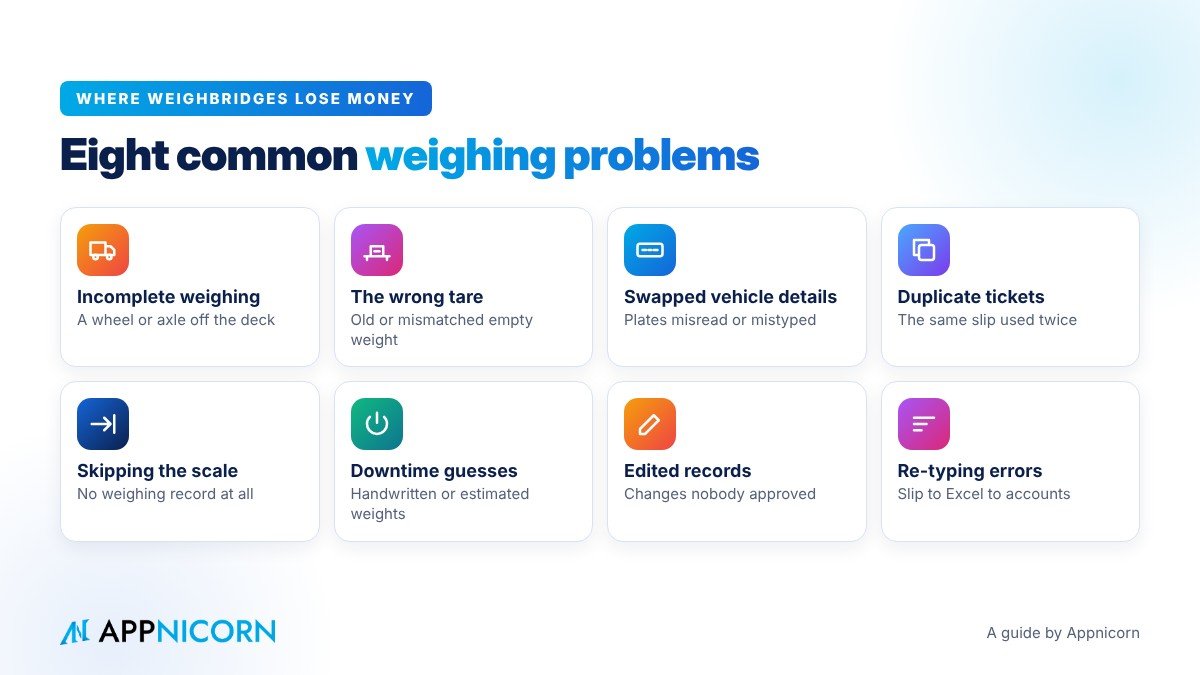
Incomplete weighing. A vehicle not fully on the deck, with a wheel or axle off the edge, gives a wrong weight.
The wrong tare. Stored tare weights save time, but if the wrong tare is applied to a vehicle, or a vehicle's tare changes and is not updated, every net weight for that vehicle is wrong.
Wrong or swapped vehicle details. Plates misread, mistyped or swapped link a weight to the wrong vehicle, customer or order.
Reused or duplicate tickets. An old ticket presented again, or the same transaction recorded twice.
Vehicles that skip the scale. A lorry that enters or leaves the site without a weighing record.
Manual weights during downtime. When the scale or system is down, estimated or handwritten weights can slip into the records.
Edited records and collusion. Where one person controls the scale and the records, there is room for weights to be changed or for arrangements between staff and drivers.
Re-typing errors. Even honest records go wrong when the same data is copied from slips into spreadsheets and then into accounting.
Malaysia's palm oil industry has spoken openly about this. In 2025, FGV described the weighbridge stage as one that "has been prone to disputes, errors and even manipulation", as it rolled out a certified digital weighbridge system across its mills.
How unmanned weighing reduces those risks
Unmanned weighing does not make fraud impossible, but it removes many of the openings and makes the rest much easier to spot.
Automatic identification removes typing errors and makes vehicle swaps harder, because the plate is read by a camera rather than entered by hand.
Gates and traffic lights enforce the sequence, so vehicles cannot skip the scale or drive on before the previous transaction is complete.
Automatic weight capture takes the reading only when it is stable, rather than whenever someone presses a button.
CCTV gives visual evidence of every weighing, which discourages tricks and settles disputes.
Live online records remove the gap between the weighing and the report, so records cannot be quietly adjusted before head office sees them.
Flags and approvals mean that unusual weights, unknown vehicles and manual changes are seen by someone other than the person at the site, with a record of the decision.
Separation of duties follows naturally: the site runs the scale, but corrections are approved elsewhere.
The benefits, beyond saving an operator
Weighing around the clock. Sites can accept deliveries early in the morning, late at night or at weekends without arranging extra shifts at the scale.
Faster turnaround. Drivers do not wait for someone to come out of the cabin. Queues at peak times shrink, and lorries spend more time moving goods.
More accurate data. Automatic plate reading and weight capture remove the most common sources of error.
Live visibility for head office. Directors and managers see what is happening at every site as it happens, rather than at the end of the day or week.
Fewer disputes, settled faster. When a customer or supplier questions a weight, the record, the time and the CCTV footage are already there.
Cleaner finance processes. Weighbridge data flows into invoicing, payments and reconciliation without re-typing, and finance teams can check flagged items before money moves.
Better decisions. With all weighings in one place, patterns become clear: which suppliers deliver lighter than expected, which customers peak on which days, which vehicles cause repeated flags.
Safer sites. Drivers can stay in their cabs, and fewer people need to work beside moving lorries.
The limitations, and how to plan around them
Unmanned weighing is not right for every site in exactly the same form. An honest plan considers the following.
Exceptions still happen. Unregistered vehicles, unreadable plates, oversize loads and failed weighings need a clear process: who is alerted, how they respond, and how the decision is recorded.
Plate reading depends on conditions. Dirty, damaged or non-standard plates, heavy rain and strong glare all affect recognition. Camera position, lighting and a fallback process matter.
Connectivity varies. Remote mills, estates and quarries do not always have stable internet. The system should keep weighing offline and sync later, so a dropped line never stops the site.
Site layout matters. There must be space for vehicles to queue, approach straight, stop at the gate and leave without reversing. Some older sites need small layout changes.
Drivers need to adjust. Clear signs, lights and a short briefing help drivers follow the new flow from the first day.
Maintenance still matters. Load cells, decks, cameras and gates need regular servicing. An automated site depends on its equipment, so preventive maintenance is part of the plan, not an afterthought.
The Malaysian picture: rules and practice
In Malaysia, weighing instruments used for trade come under the Weights and Measures Act 1972 (Akta Timbang dan Sukat 1972), enforced by the Ministry of Domestic Trade and Cost of Living (KPDN). Broadly, the Act aims to make sure that instruments used for trade follow approved designs and are verified and re-verified, and it regulates who may make, sell and verify them.
Equipment makers in Malaysia note that for weighbridges, the structure, load cells, indicator and, where applicable, software fall under pattern approval, and that instruments are verified and stamped regularly. If your weighbridge is used to buy or sell by weight, ask any supplier how verification and stamping will be handled for your setup, and check the current requirements with KPDN or a qualified adviser. This guide is general information, not legal advice.
The direction of the industry is also clear. Large operators are moving from paper slips and local computers to digital, connected weighing with automatic plate recognition and secure records. The questions for most businesses are no longer whether to modernise, but how, and how far.
Who benefits most from unmanned weighing
Palm oil mills and estates. High volumes of fresh fruit bunch deliveries from many suppliers, often at odd hours, where every tonne affects supplier payments.
Quarries and building materials. Constant outbound loads where weights drive customer invoices and site productivity.
Waste management and recycling. Weights determine gate fees or payments for material, and traceability matters.
Factories and warehouses. Inbound raw materials and outbound goods that must match purchase and sales orders.
Agriculture, logistics and bulk commodities. Any operation where lorries move goods that are bought, sold or tracked by weight.
Planning your move to an unmanned weighbridge
1. Map today's process. Walk through a full weighing from arrival to invoice. Note every manual step, every place data is typed, and every hand-off to head office.
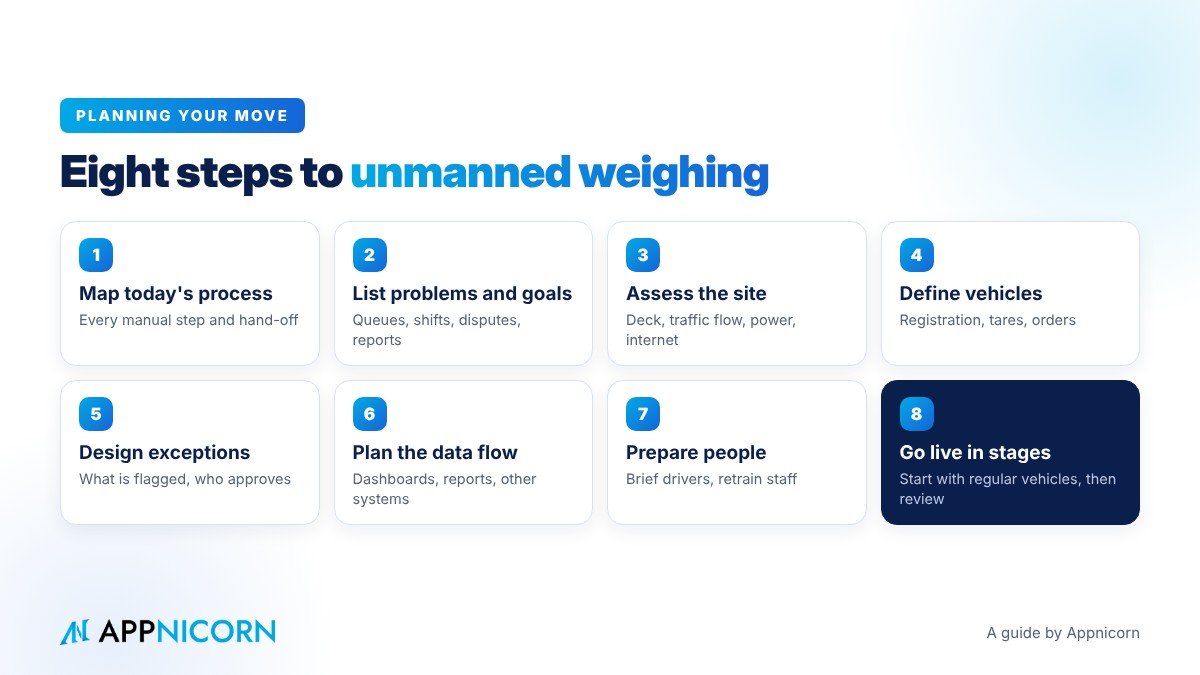
2. List your problems and goals. Long queues, staffing for night shifts, disputes, typing errors, slow reports or limited visibility across sites. Rank what matters most.
3. Assess the site. Check the condition of the deck and foundations, the traffic flow, the space for gates and camera posts, power, and internet coverage.
4. Define your vehicles and transactions. Decide how vehicles will be registered, how tares are kept up to date, and how each weighing links to customers, suppliers, orders and products.
5. Design the exceptions. Decide what the system should flag, who receives each flag, what they may approve, and how quickly they must respond.
6. Plan the data flow. Decide which dashboards and reports head office needs, and which other systems, such as accounting, should receive weighbridge data.
7. Prepare drivers and staff. Brief regular drivers and hauliers, put up clear signs, and retrain scale staff as supervisors and exception handlers.
8. Go live in stages, then review. Start with regular, registered vehicles, keep a fallback in place for the first weeks, and review flags, queues and data quality before widening the scope.
Questions to ask a weighbridge supplier
Do you supply and install both the hardware and the system, or only one of them?
Where exactly will the plate camera, gates and lights be placed at our site, and why?
How does the system handle unreadable plates, unregistered vehicles and oversize loads?
What happens if the internet drops? Does the site keep weighing, and how are records synced?
Is every weighing saved online as it happens, or exported later?
Can head office see all our sites on one dashboard?
What does the system flag, and how are approvals for corrections recorded?
Can weighbridge data go to our accounting or other systems without re-typing?
How is CCTV used, and can we keep a snapshot with each weighing if we need one?
How will verification and stamping be handled for our use?
What maintenance and support do you provide after installation?
How Appnicorn approaches unmanned weighbridges
Appnicorn supplies and installs unmanned weighbridge setups for Malaysian sites that run without an operator at the scale. The hardware covers the weighbridge itself, licence plate recognition on a short post beside the barrier gate facing the front of the vehicle, entry and exit barrier gates, traffic lights and CCTV. Unmanned sites do not need a driver kiosk; one is available on request for manned sites.
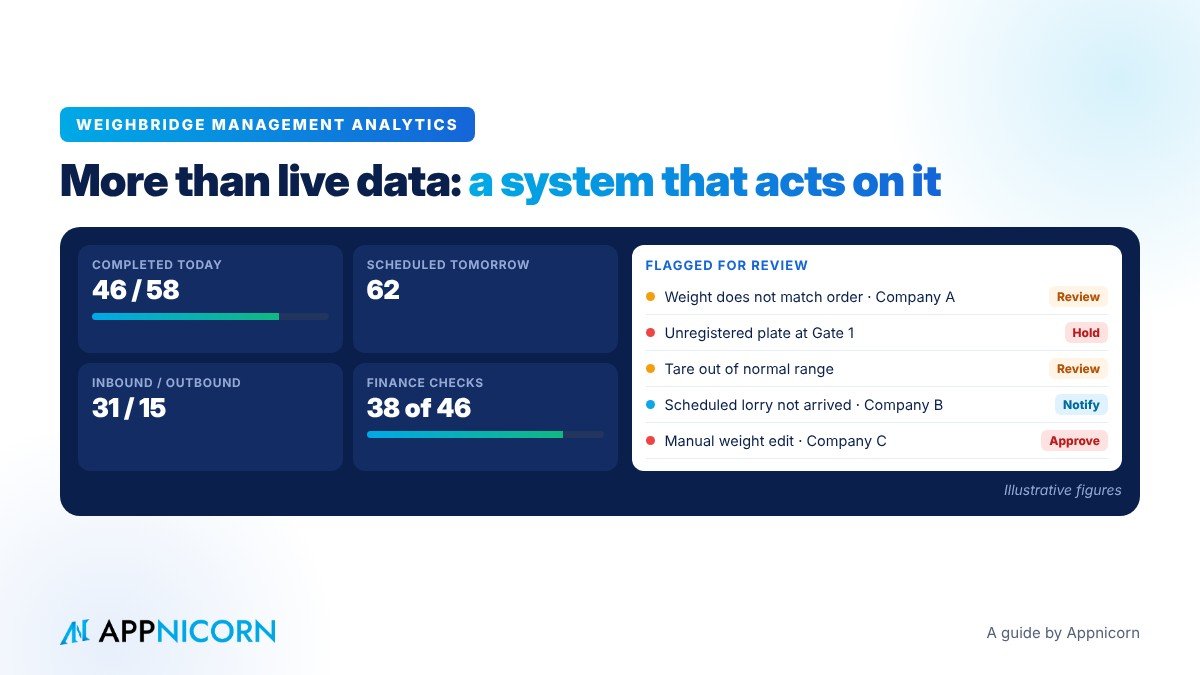
The bigger difference is what happens to the data. Every weighing goes online as it happens and appears on a head-office dashboard, without exports or re-typing. The system goes beyond showing live numbers: it analyses weighings, flags issues such as weights that do not match the order or unregistered plates, triggers approvals for exceptions and manual changes, and can connect weighbridge data to other business systems, such as accounting, depending on each client's needs. If the internet connection drops, the site keeps weighing and syncs when the connection returns.
The system runs on APES, Appnicorn's platform for building business systems, so it can be shaped around each company's own steps, approvals and reports.
Let's talk about your weighbridge
Every site is different: the lorries you receive, the hours you run, the people who need the data and the systems it should feed. The right setup starts with how your weighbridge works today.
If you are planning a new weighbridge, or want your weighing to run unmanned and online, we would be glad to talk it through. Tell us about your site, and we will explore the possibilities with you.