Home » Six Reasons a Growing Business Should Run on APES
Six Reasons a Growing Business Should Run on APES
Six Reasons a Growing Business Should Run on APES
Most businesses do not choose their software all at once. A tool gets added here to solve one problem, another gets added there to solve a different one, and a few years later the business is running on a patchwork of spreadsheets, chat threads, and disconnected apps that were never meant to work together. Nobody planned it this way. It just happened, one reasonable decision at a time.
APES takes a different approach. Instead of stitching together separate tools, it gives a business one connected system where records, approvals, permissions, and history all live in the same place. Below are six concrete reasons this matters, each shown directly in the product rather than described in the abstract.
One connected system instead of scattered tools
The first problem with a patchwork of tools is that nothing talks to anything else. A number entered in one place has to be copied, by hand, into another place, and that copying is where mistakes creep in. Nobody decided this was acceptable. It is just what happens when a business grows faster than its tools do.
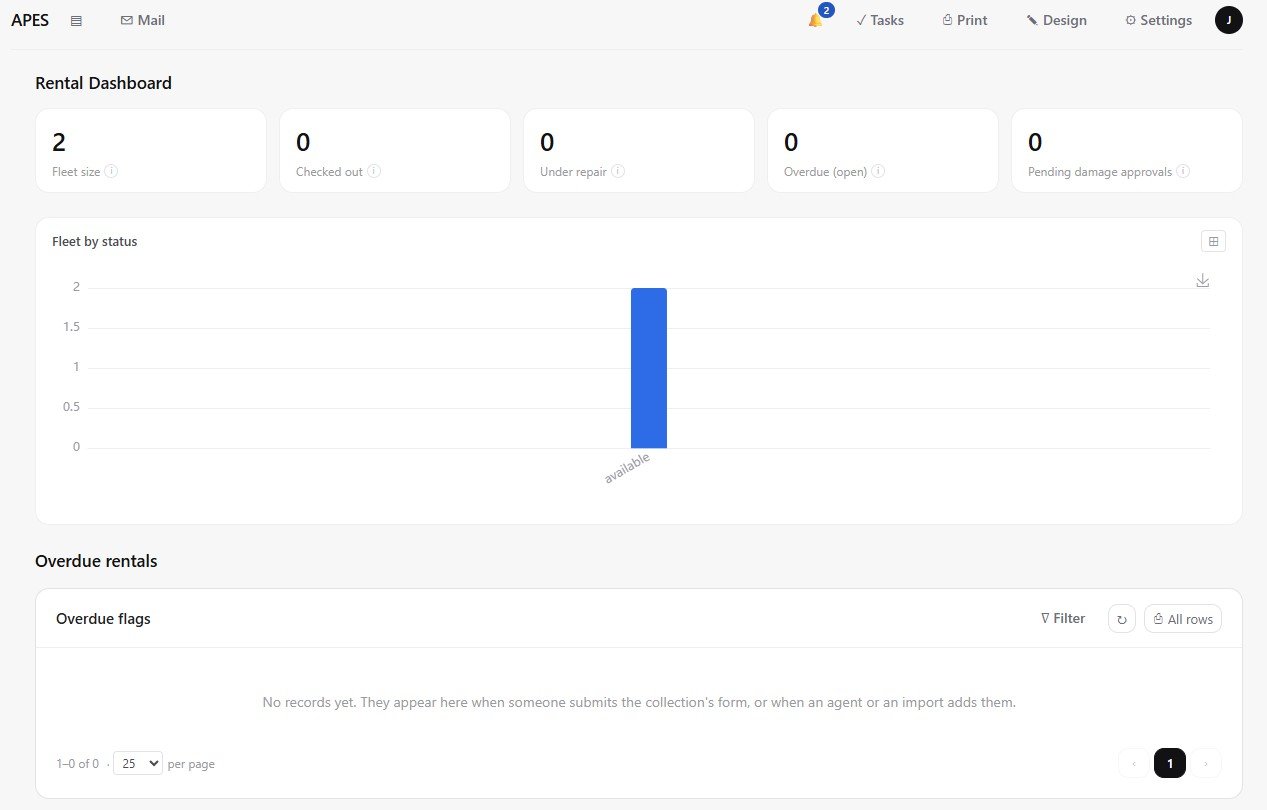
In APES, the different parts of a business, such as stock, rentals, sales, and approvals, sit inside one workspace, built from modules that share the same underlying data. A rental business, for example, gets a dashboard that shows its fleet, its active checkouts, and anything under repair, all pulled from the same records that every other part of the module also uses. Nothing here is copied from somewhere else. It is the same data, viewed from a different angle.
The Equipment Rental Dashboard, showing fleet status, checkouts, and maintenance pulled live from the same records the rest of the module uses.
Approvals follow the business's own rules, not memory or email
In most growing businesses, approval happens through habit. Someone learns, usually the hard way, that a large discount needs a manager's sign off, so they remember to email that manager before confirming the order. This works fine until that person is unavailable, or new, or simply forgets on a busy day. The rule was never written down anywhere a system could enforce it. It only ever lived in someone's head.
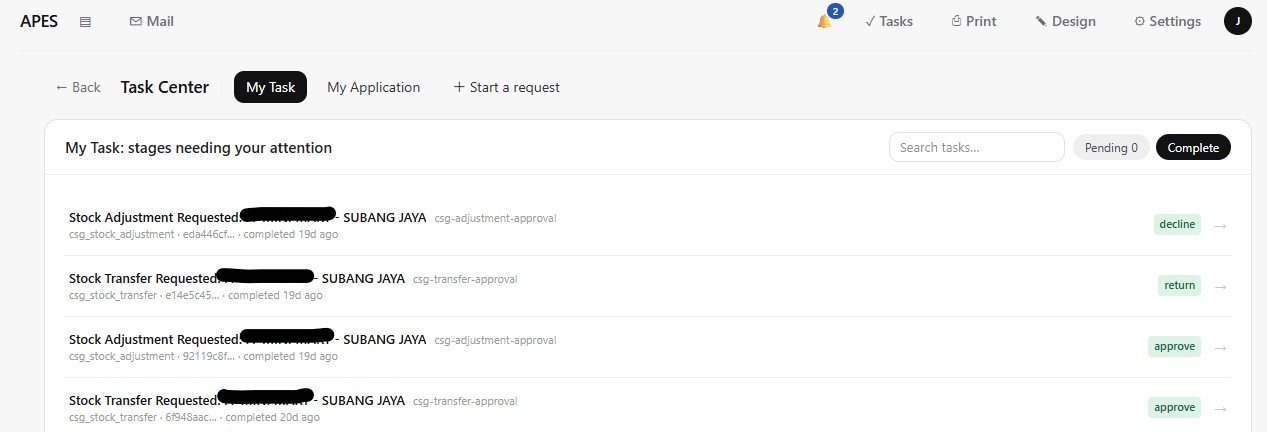
APES replaces this with workflows built directly into the platform. A workflow can decide, on its own, whether an order needs approval at all, and if it does, it turns into a task sitting in front of the correct person, staying there until they act on it. Nobody has to remember to forward anything, and nothing quietly slips through because someone was on leave that week.
The Task Center's Complete tab, showing real decisions such as approve, decline, and return, each tied to a specific request and its workflow.
Every role sees exactly what it should, nothing more
A spreadsheet, or a shared drive, generally has one setting for who can see what: everyone with the link can see everything. This is rarely intentional. It is simply the default, and it becomes a real problem the moment a business has staff who should not be looking at each other's numbers, or an external partner who should only see a narrow slice of the business.
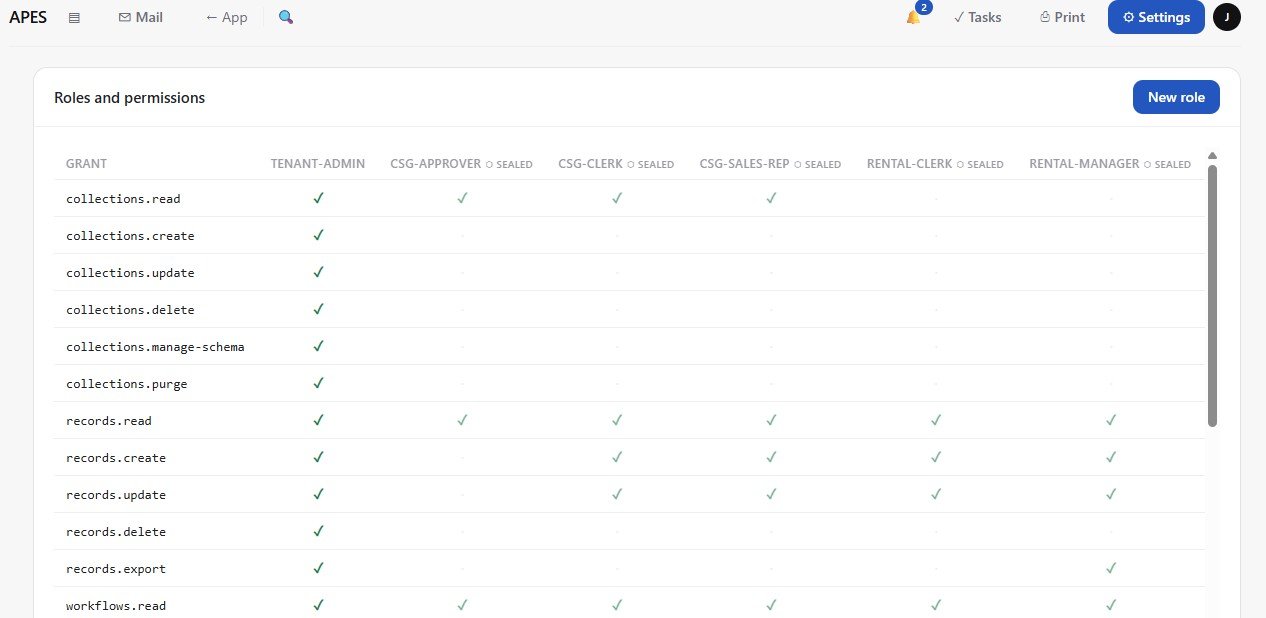
In APES, every person holds a role, and that role decides exactly what they can see and do, right down to individual actions like reading a record, updating it, or exporting it in bulk. A warehouse clerk and a sales manager can use the exact same collection of stock records and still see two entirely different sets of permissions, without either of them needing to think about it.
The roles and permissions matrix, showing exactly which actions each role can take, down to reading, creating, or deleting a single record.
Every action is automatically recorded and provable
When something goes wrong in a business built on spreadsheets and email, the first question is almost always the hardest one to answer. Who changed this number. When did it happen. Why did nobody notice sooner. Answering that usually means digging through old messages and hoping somebody remembers correctly, because nothing in a spreadsheet keeps a real history of its own.
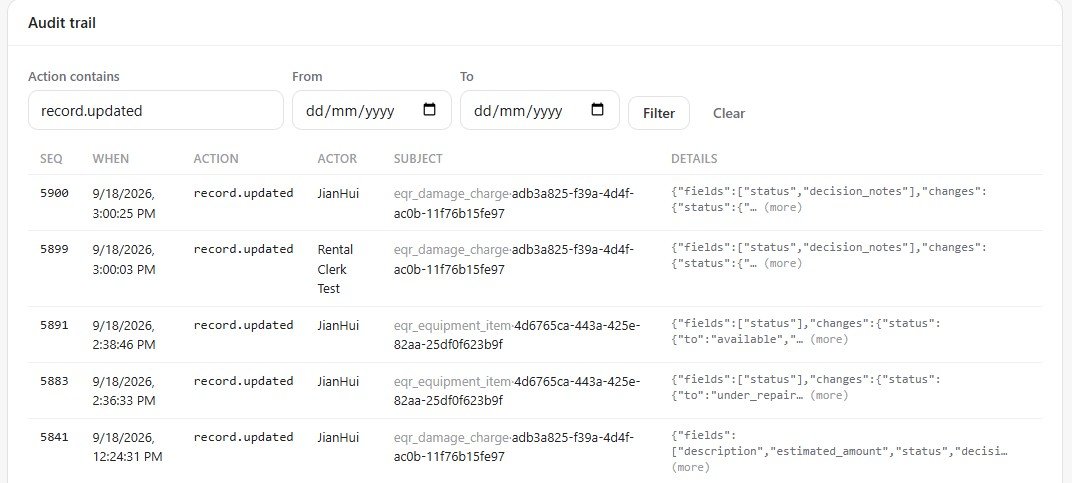
APES keeps a tamper evident record of every action taken inside it, down to who changed a field, what it changed from and to, and exactly when it happened. This is not a manual log someone has to remember to update. It happens automatically, on every single change, whether it came from a person filling in a form or a workflow running in the background.
APES logs every record change automatically, showing who made it, when, and exactly which fields changed.
The system grows through modules without breaking what already works
A common fear with business software is that growth means starting over. The business outgrows its current tool, and the only path forward is a painful migration to something new, with months of disruption along the way. This fear is not unreasonable. It happens often enough to be a real pattern, not a rare exception.
APES is built around modules, self contained pieces of functionality that install into the same workspace without disturbing what is already running. A business that starts with stock management can add equipment rental, or a lending workflow, or a completely custom module later, and the parts that were already working keep working exactly as they did before. Every module upgrade even keeps a snapshot of what the business had before the change, so nothing is ever a one way door.
An AI agent can build for you, but a person always decides what goes live
Businesses are increasingly being told that an AI agent can simply build whatever they need. This is a genuine capability, but it raises an obvious question. What stops that agent from making a change that quietly breaks something, or exposes information it should not have touched.
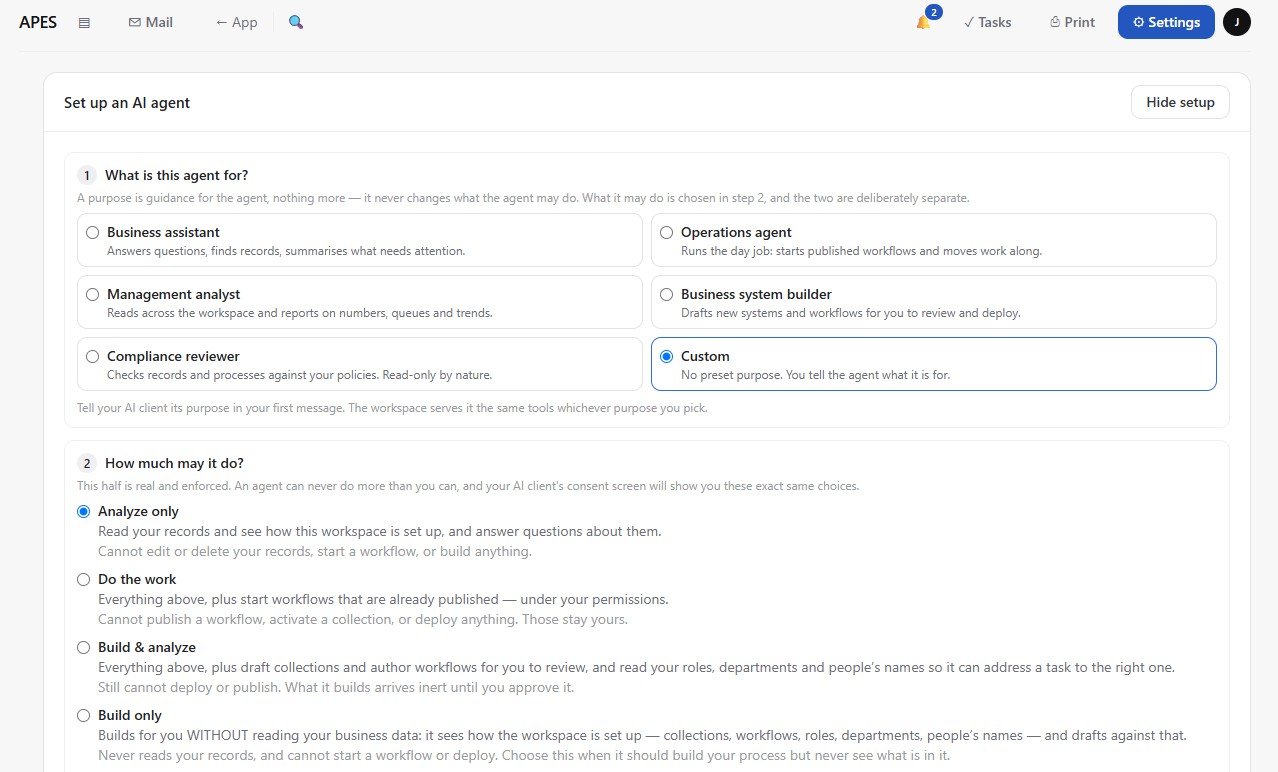
In APES, a connected AI agent can draft an entire new process, records, forms, and the workflow that ties them together, based on nothing more than a plain description of what the business wants. What it drafts never goes live on its own. It arrives as a proposal that a person has to review and deploy, and the agent itself can never act with more authority than the person who connected it. The speed of AI assistance stays paired with a human decision at the one point that actually matters.
Setting up an AI agent in APES. Its purpose is just guidance, but how much it may do is a separate, enforced choice, from analyze only up to drafting a whole new process without ever reading business data.
Put together, not separately
None of these six reasons is really about one clever feature. They are all pointing at the same underlying idea. A business that grows on scattered tools ends up with data nobody fully trusts, approvals nobody can prove happened correctly, and permissions nobody bothered to set up carefully, because there was never one place doing all of this consistently.
APES exists because a growing business eventually needs exactly that one place, where records, rules, permissions, and history all sit together instead of scattered across a dozen tools that were never meant to be a system in the first place.