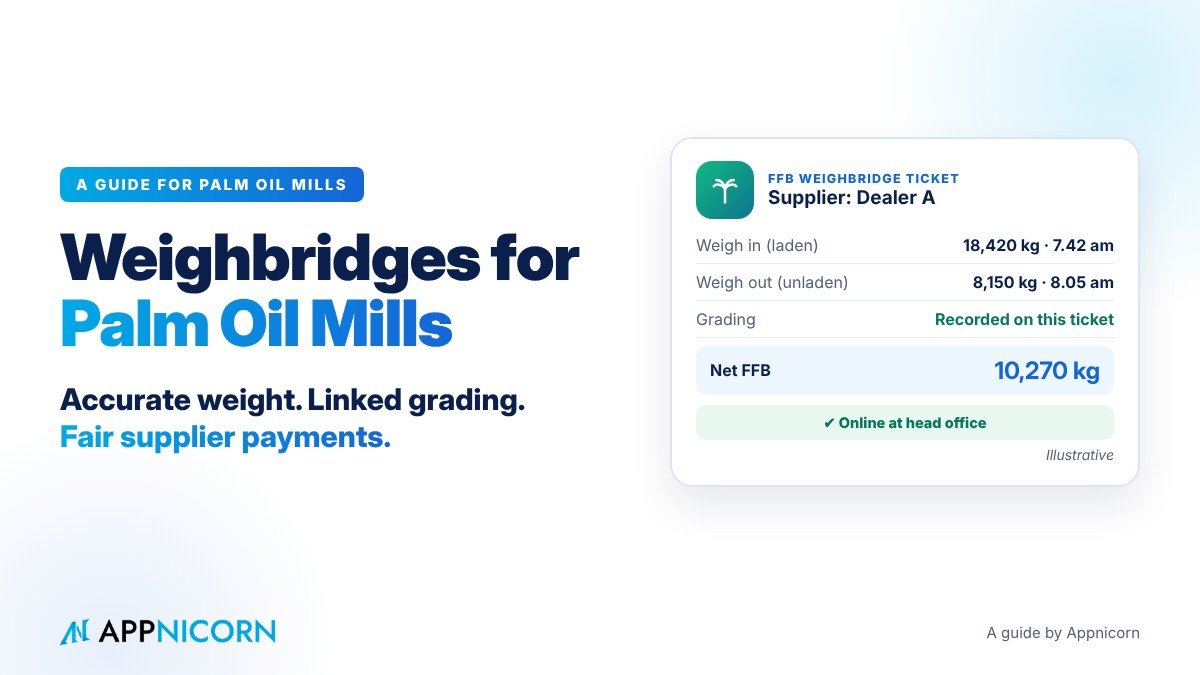
At a palm oil mill, the weighbridge is where money changes hands. Every lorry of fresh fruit bunches (FFB) that rolls onto the scale becomes a number, and that number, combined with the grading result, decides what the mill pays the estate, smallholder or dealer who sent it.
Get the weight or the grading wrong, and the error flows straight into supplier payments, oil extraction figures and, eventually, trust. It is no surprise that FGV, describing the digital weighbridge system it rolled out across its mills in 2025, said the weighbridge stage "has been prone to disputes, errors and even manipulation".
This guide is written for mill managers, owners, finance teams and dealers. It explains how FFB weighing and grading work at Malaysian mills, what the MPOB guidelines expect, where things go wrong, what traceability now demands, and how unmanned, online weighbridges can help mills run a faster, fairer and better-documented intake.
How FFB reaches the mill
FFB arrives at a mill through two main channels. Some comes directly from estates and larger growers. Much of the rest comes through dealers, who buy from smallholders and small estates, often run collection centres or ramps, and arrange transport to the mill.
Either way, the mill's intake has to handle a steady, often uneven stream of lorries, from early morning to late evening during peak crop months, each carrying fruit that must be weighed, graded and paid for correctly.
The FFB intake, step by step
MPOB's guideline on good business practice for oil palm fruit (Garis Panduan Amalan Perniagaan Buah Kelapa Sawit) sets out how weighing, grading and records should be handled. In broad terms, an intake looks like this.
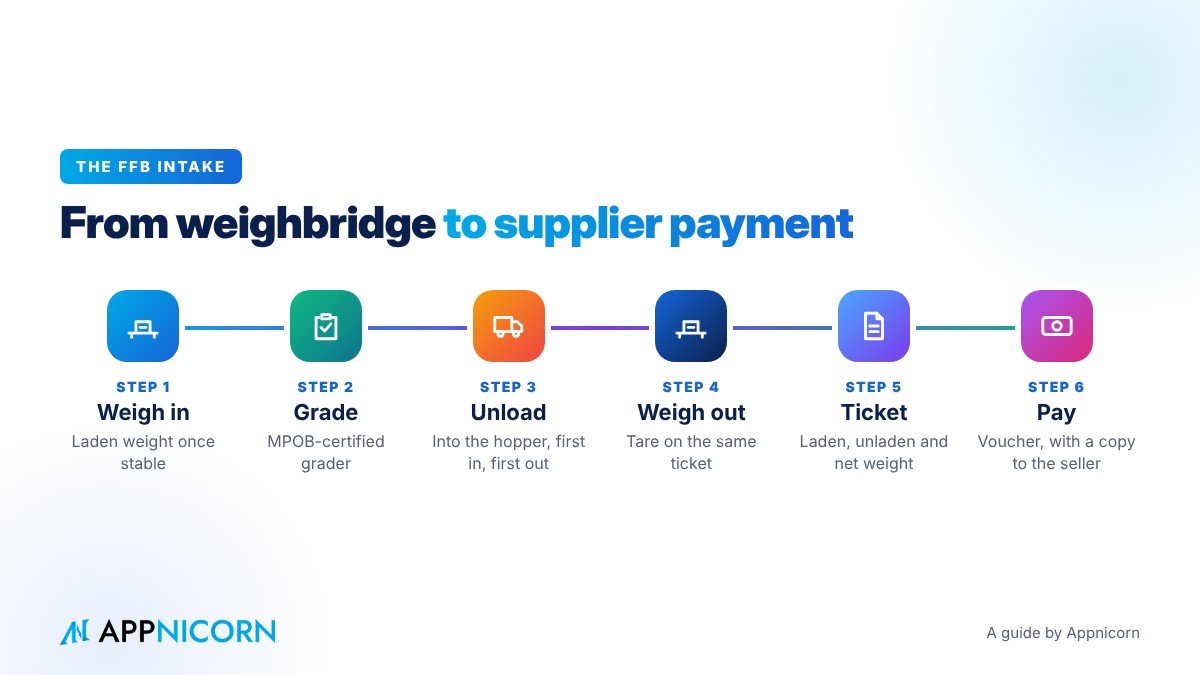
1. Weigh in. The loaded lorry is weighed on the mill's weighbridge. The guideline says the laden weight should be printed only once the vehicle is correctly positioned on the weighbridge and the reading is stable, and that no one should be on the weighbridge during weighing. The seller or their representative may be present.
2. Grade. The fruit is graded according to MPOB's FFB Grading Manual, using a grading form, by an MPOB-certified grader. The seller or their representative may witness the grading.
3. Unload. The fruit is tipped into the loading ramp or hopper. MPOB's code of practice for mills calls for unloading into the hopper rather than onto the apron, with fruit handled first in, first out.
4. Weigh out. The empty lorry returns to the same weighbridge and is weighed again on the same ticket. This gives the tare (unladen) weight. The difference between the laden and unladen weight is the net weight of FFB.
5. Ticket. The weighbridge ticket records, at a minimum, the premises' name and address, the date and time, a ticket number, the vehicle registration, the item weighed, the seller's name, and the laden, unladen and net weights.
6. Price and pay. The mill calculates the consignment value from the net weight, the graded oil extraction rate and the current price, and issues a payment voucher, with a copy to the seller.
Why grading and weight are inseparable
In Malaysia, FFB is priced against oil extraction. Under the MPOB guideline, the consignment price is worked out from the price for each 1% of basic oil extraction rate, multiplied by the graded oil extraction rate offered to the supplier, multiplied by the net FFB weight in tonnes.
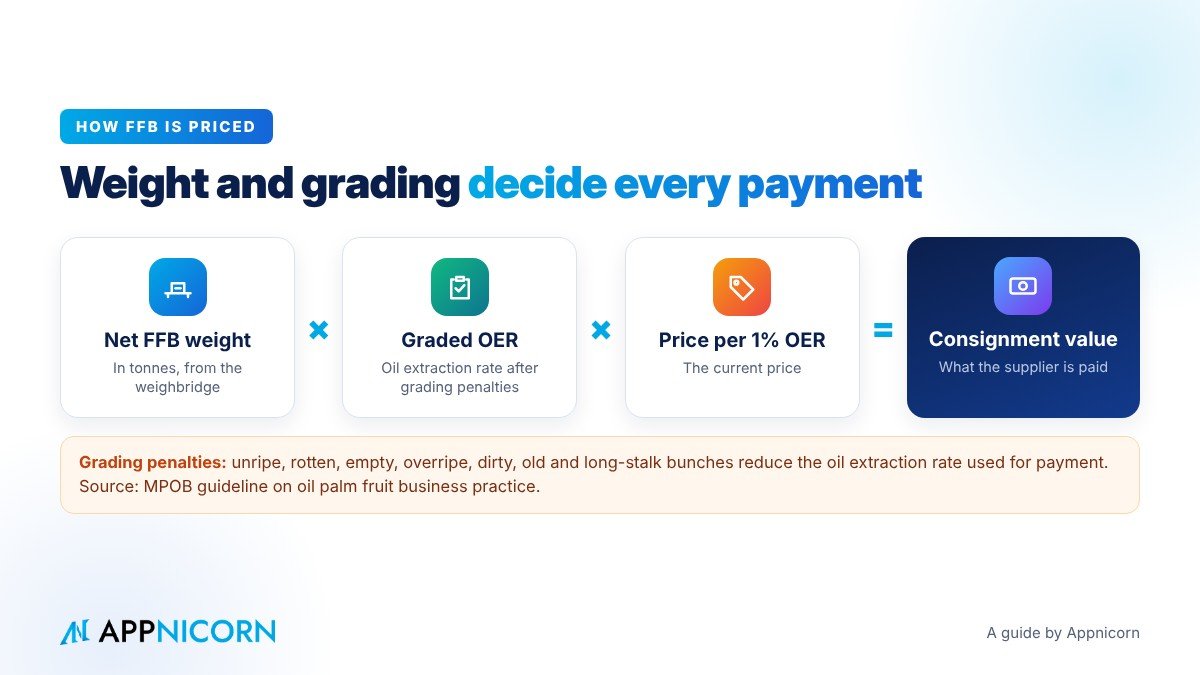
Grading is what links the two. Bunches that meet quality standards carry no penalty. Non-quality bunches, such as unripe, rotten, empty, overripe, dirty, old or long-stalk bunches, attract penalties that reduce the oil extraction rate used for payment. Some poor-quality bunches may be rejected from the consignment altogether.
That means a mill's payment for every load depends on two records made minutes apart: the weight from the weighbridge and the result from the grading platform. If either is wrong, or if they are not reliably linked to the same lorry and the same supplier, the payment is wrong.
Where intake goes wrong
Lorries not fully on the scale. A wheel or axle off the deck gives a wrong laden or unladen weight.
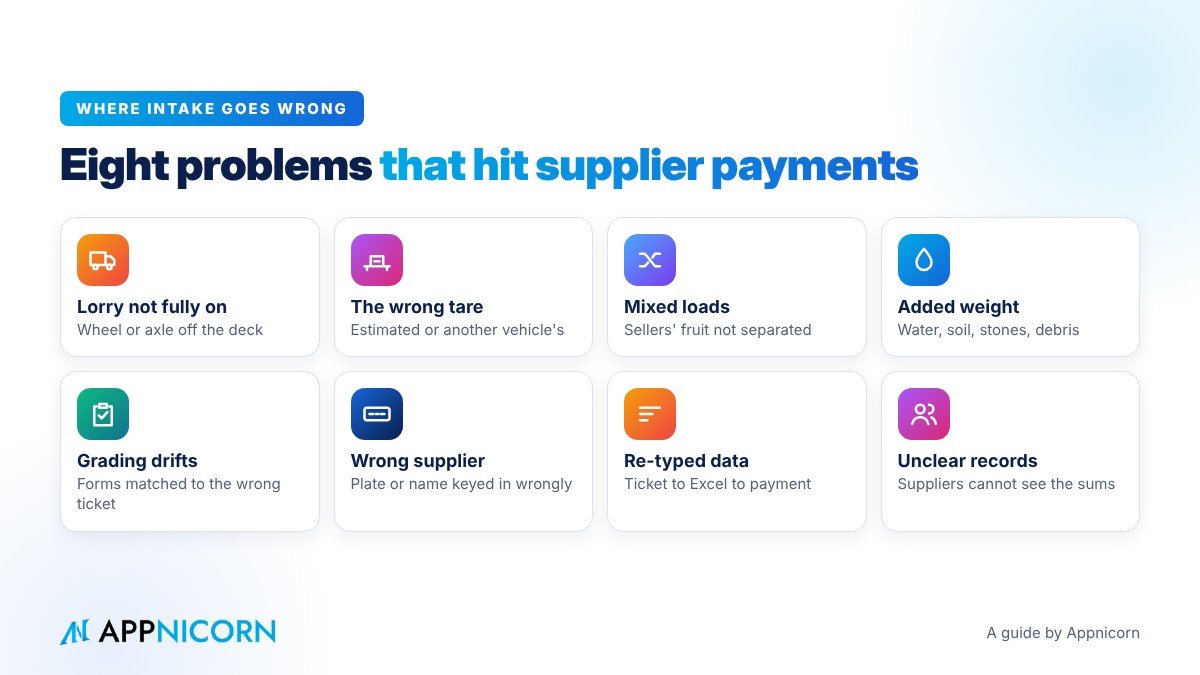
The wrong tare. Using a stored or estimated tare instead of weighing the lorry after unloading, or applying the tare of a different vehicle.
Mixed loads. When fruit from different sellers travels in one lorry, the MPOB guideline expects each seller's fruit to be separated so it can be weighed separately. Mixing loads makes fair payment impossible.
Added weight. The guideline prohibits spraying FFB with water and expects collection areas to be free of stones, soil, sand and taps that could be used to add weight. Water, dirt and debris inflate the weight the mill pays for.
Grading records that drift from the weighing. Paper grading forms that are completed later, filed separately or matched to the wrong ticket.
Re-typed data. Weights copied from tickets into spreadsheets and then into payment systems, with errors at every step.
Unclear records for suppliers. When a smallholder or dealer cannot see how their payment was calculated, even honest mistakes turn into suspicion.
Grower guides make the point from the other side. One widely used smallholder handbook advises farmers that "just relying on the records of the trader or middleman is not a good idea", and encourages them to attend weighing and sorting and keep their own records. Mills that make their records clear and consistent remove a common source of friction.
Traceability: the weighbridge ticket is now evidence
Traceability has moved from a nice-to-have to a requirement for many mills and dealers.
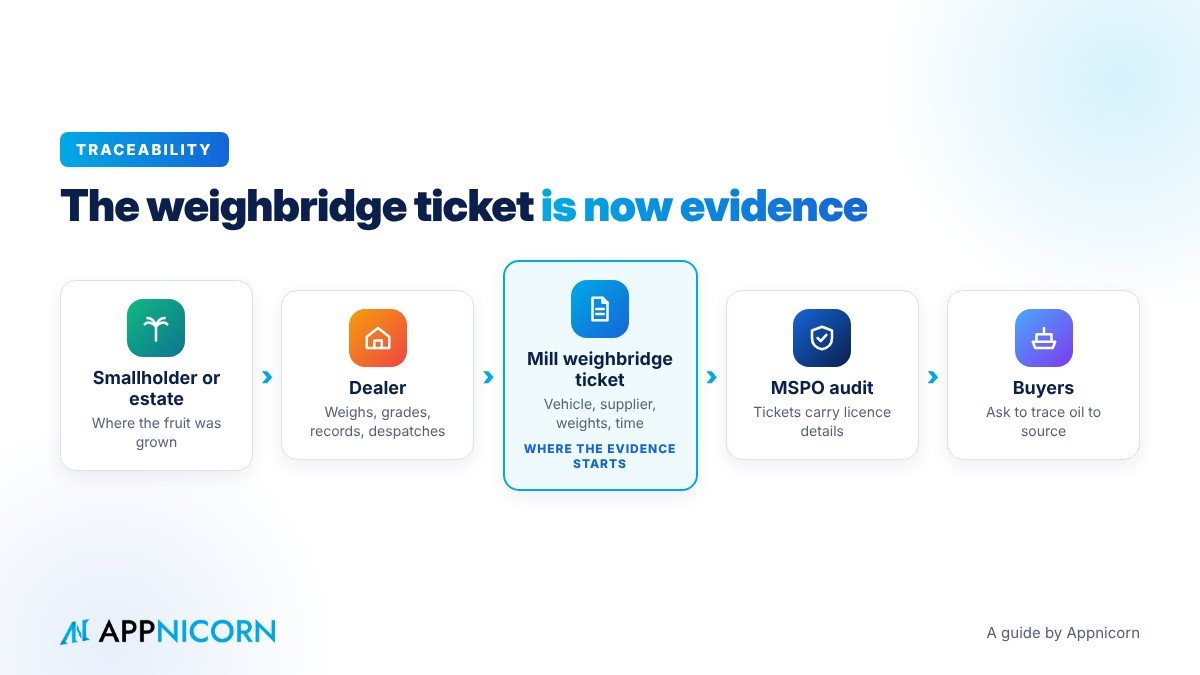
Under the Malaysian Sustainable Palm Oil (MSPO) standard, dealers' operations explicitly include receiving FFB from suppliers, weighing and grading it, recording transaction details and despatching it to the mill. MSPO's 2026 audit guidance for dealers says transaction documents, including weighbridge tickets and delivery notes, must carry the name and MPOB licence number of the certified entity, and that a licensed entity remains fully responsible even where a weighbridge is shared.
MPOB has also been building a traceability platform in which mills document the dealer source of the FFB they receive. And buyers serving markets such as the European Union, with its deforestation regulation, increasingly want to trace palm oil back to the plots where the fruit was grown.
All of this depends on clean intake records: which vehicle, from which supplier or dealer, carrying how much fruit, graded how, on which date and at what time. The weighbridge is where that chain of evidence starts.
What an unmanned, online weighbridge changes for a mill
An unmanned weighbridge uses licence plate recognition, barrier gates, traffic lights and CCTV to identify each lorry, control when it drives on and off, and capture the weight automatically. An online system then records every weighing as it happens.
For a mill, that brings practical benefits.
Faster intake at peak hours. Lorries do not wait for an operator to key in details. The plate is read, the gate opens, the weight is captured, and the lorry moves on to grading.
Consistent weighing. Weights are captured automatically when stable, and the sequence of gates and lights keeps one transaction on the scale at a time.
Every load linked to a supplier. Registered vehicles are matched to suppliers and dealers, so each ticket carries the right name, and unregistered or unexpected lorries are held and flagged.
Weigh-in and weigh-out on one record. The second weighing after unloading is tied to the first, so the net weight is calculated from real gross and tare readings.
Visual evidence. CCTV covers the scale, which helps settle questions about what was on the deck.
Live visibility. Mill managers and head office see completed and scheduled weighings, inbound volumes by supplier, and flagged items as they happen, across one mill or several.
Exceptions that go to the right person. A tare outside its normal range, a weight that does not match what a supplier usually delivers, or a manual change to a record can be flagged for review and approval, with a record of who decided what.
Cleaner payments. Weighbridge data can flow into payment and accounting processes instead of being re-typed, so finance teams check exceptions rather than retyping tickets.
Records ready for audits. When every ticket is online, complete and consistent, preparing for an MSPO audit or answering a buyer's traceability request becomes a report, not a search through paper.
What unmanned does not change
It is worth being clear about the limits.
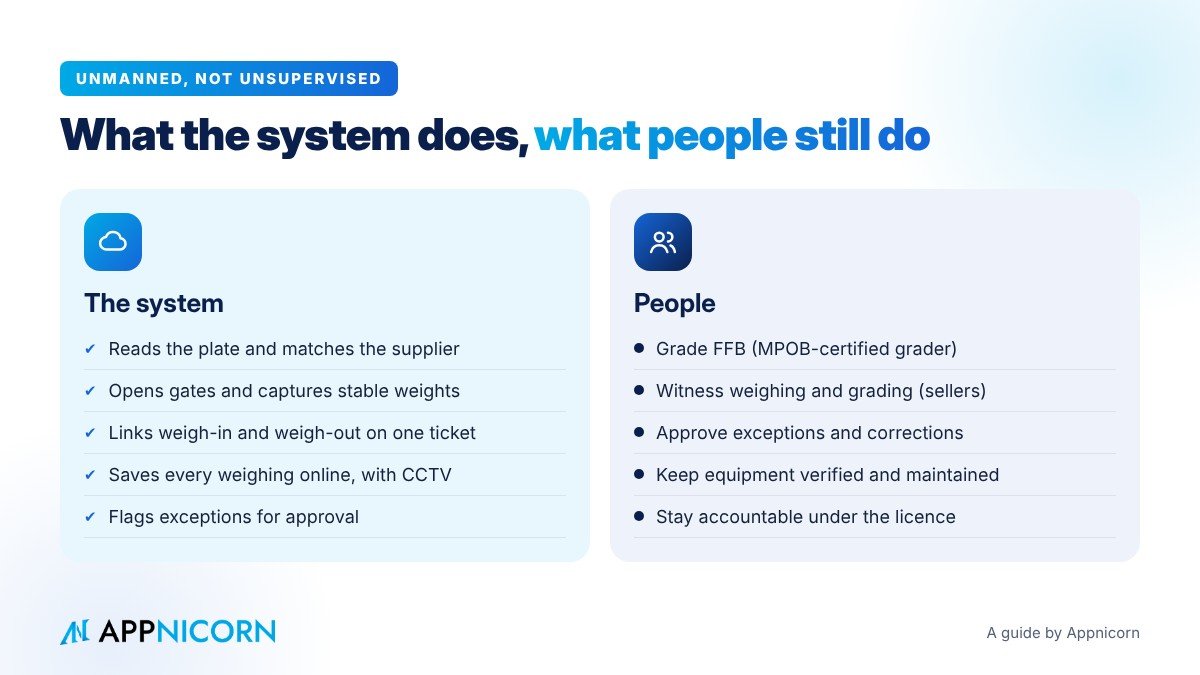
Grading remains a human job. The MPOB guideline expects grading by an MPOB-certified grader using the MPOB grading manual. Automation can make grading records easier to keep and link, but it does not replace the grader.
Sellers keep their rights. Sellers or their representatives may witness weighing and grading. Clear tickets, visible screens and accessible records support that right.
Licence conditions still apply. The MPOB guideline also sets out staffing expectations for licensed premises, covering grading, weighbridge operation, daily records and payments. An unmanned weighbridge changes how weighing is done, not who is accountable. Mills should confirm with MPOB how their setup fits their licence conditions.
Verification still applies. Weighing equipment used for trade must be certified under the Weights and Measures Act 1972. Ask any supplier how verification and stamping will be handled.
Site conditions matter. Mud, rain, glare and dirty plates affect cameras and decks. Remote mills may have patchy internet. Good systems keep weighing offline and sync when the connection returns, and good maintenance keeps cameras and load cells reliable.
A practical checklist for mill managers
1. Walk an intake from gate to payment. Note every paper form, every manual entry and every place data is re-typed.
2. Register vehicles, suppliers and dealers. Link each lorry to the supplier or dealer it delivers for, with licence details where required.
3. Fix the tare process. Weigh every lorry after unloading on the same ticket, and flag tares outside the vehicle's normal range.
4. Link grading to the ticket. Make sure each grading result is recorded against the same transaction as its weights.
5. Decide what should be flagged. Unregistered plates, unusual weights, tare anomalies, mixed loads and manual edits are common candidates.
6. Give suppliers clear records. Tickets and payment vouchers that show weights, grading and calculation reduce disputes.
7. Plan for peaks and outages. Check queue space for peak crop months, and make sure weighing continues if the internet drops.
8. Prepare for audits. Keep tickets, delivery notes and grading records together, searchable, with the right licence details.
How Appnicorn approaches mill weighbridges
Appnicorn supplies and installs unmanned weighbridge setups for Malaysian sites, including palm oil mills. The hardware covers the weighbridge, licence plate recognition on a short post beside the barrier gate facing the front of the lorry, entry and exit barrier gates, traffic lights and CCTV. Unmanned sites do not need a driver kiosk; one is available on request where a site prefers a manned setup.
Every weighing goes online as it happens and appears on a head-office dashboard, without exports or re-typing. The system analyses weighings, flags issues such as unregistered plates, tares out of range or weights that do not match what was expected, triggers approvals for exceptions and manual changes, and can send weighbridge data to other systems, such as accounting, depending on each mill's needs. If the internet drops, the site keeps weighing and syncs when the connection returns.
The system runs on APES, Appnicorn's platform for building business systems, so it can be shaped around each mill's own intake steps, approvals and reports.
Let's talk about your mill
Every mill's intake is different: the mix of estates, smallholders and dealers, the peak-season queues, the reports head office needs and the audits you face.
If you are planning a new weighbridge or want your FFB intake to run unmanned and online, we would be glad to talk it through. Tell us how your intake works today, and we will explore the possibilities with you.