APES Lets Your Team Build New Tools Without Hiring Developers
APES is a business platform that lets your own team build new tools by describing what they need in plain language. You do not need to hire a developer. You do not need to write a technical spec. You just say what you want, and APES builds it for you.
The Old Way Was Slow
Most businesses run on a mix of spreadsheets, paper forms, and software that was never quite built for how the team actually works. When something is missing, like a way to track claims or approve stock adjustments, the usual answer is to either force the work into a tool that was not built for it, or hire someone to build something new.
Hiring a developer takes time. You have to explain what you want, wait for a quote, wait for the build, then wait again while it gets fixed to match what you actually meant. Even a small internal tool can take weeks. For a growing business, that delay adds up. The team keeps working around the gap with spreadsheets while they wait.
How APES Changes This
APES flips this around. Instead of writing a technical spec and handing it to a developer, you just describe what you need to your own AI client, connected directly to your APES workspace. You can say something as simple as this:
“I want a claim module with tax calculation.”
APES reads that request and drafts a full working module. This includes the data structures to hold the information, the forms your team will fill in, the pages that show the records, and the approval steps that move a request from submitted to approved. All of it comes back as one proposal, built specifically around what you asked for.
Nothing gets installed automatically. The draft shows up under your workspace's Modules section, where you or someone on your team can look it over before it goes live. You stay in control of what actually gets added to your business.
Built On the Same Foundation as Everything Else
A module built this way is not a separate, fragile add-on sitting outside your real system. It runs through the same underlying engine as every other part of APES. It reads and writes data the same way. It follows the same permission rules. It shows up in the same audit trail as everything your team already does inside the platform.
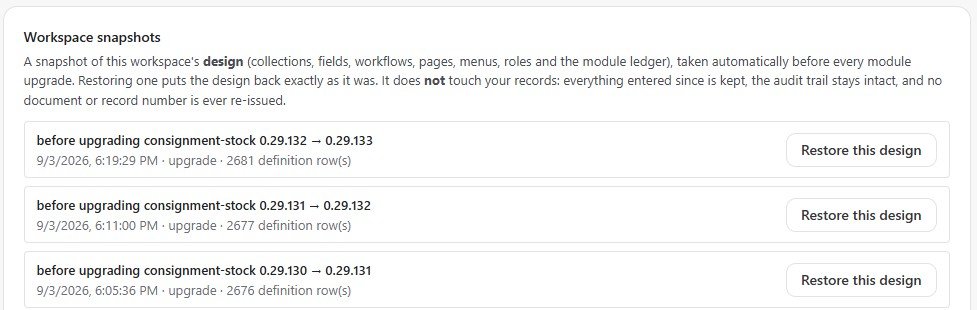
This matters because it means a module your team asked for does not become a maintenance headache. When APES itself gets updated, your custom module gets those updates too. Your own changes and customisations are never quietly overwritten, so nothing you built gets lost the next time the platform improves.
Real Tools, Not Just Mockups
The module that comes back is not a sketch or a prototype. It includes the actual pieces a working business tool needs.
Collections hold your data, structured the way your business actually thinks about it. Forms give your team a real way to enter information, with the right fields already in place. Pages let people view and search their records without digging through spreadsheets. Workflows carry a request through its full life, from the moment someone submits it to the moment someone approves or declines it.
For the claim module example above, this means your team would get a real form to submit a claim, a page to see all claims and their current status, and an approval step where the right person signs off, with tax already calculated correctly along the way.
Why This Matters for a Growing Business
A small business often cannot justify hiring a developer for every internal tool it needs. The cost does not match the size of the problem. A growing business runs into new gaps constantly. New processes appear as the business grows into new areas, and old spreadsheets stop being enough.
APES lets a business close these gaps itself, on its own schedule, without bringing in outside help every time. A manager who notices a gap in how the team tracks something can describe what is missing and get a working answer back, often the same day. The business does not have to choose between living with the gap and paying for a custom build.
This also means the people asking for the tool are often the same people who understand the problem best. They are not translating their needs through a developer who has never done the job themselves. They describe the actual problem directly, in their own words, and get a tool shaped around that problem.
You Still Review Before Anything Goes Live
Even though APES builds the module for you, it does not skip your judgment. Every proposal is reviewed before it becomes part of your real workspace. You can look at exactly what was drafted, check that it matches what your team actually needs, and only then let it go live.
This review step matters because it keeps a business in control of its own data and its own processes, even while moving fast. Nothing changes on its own without someone checking it first.
Getting Started
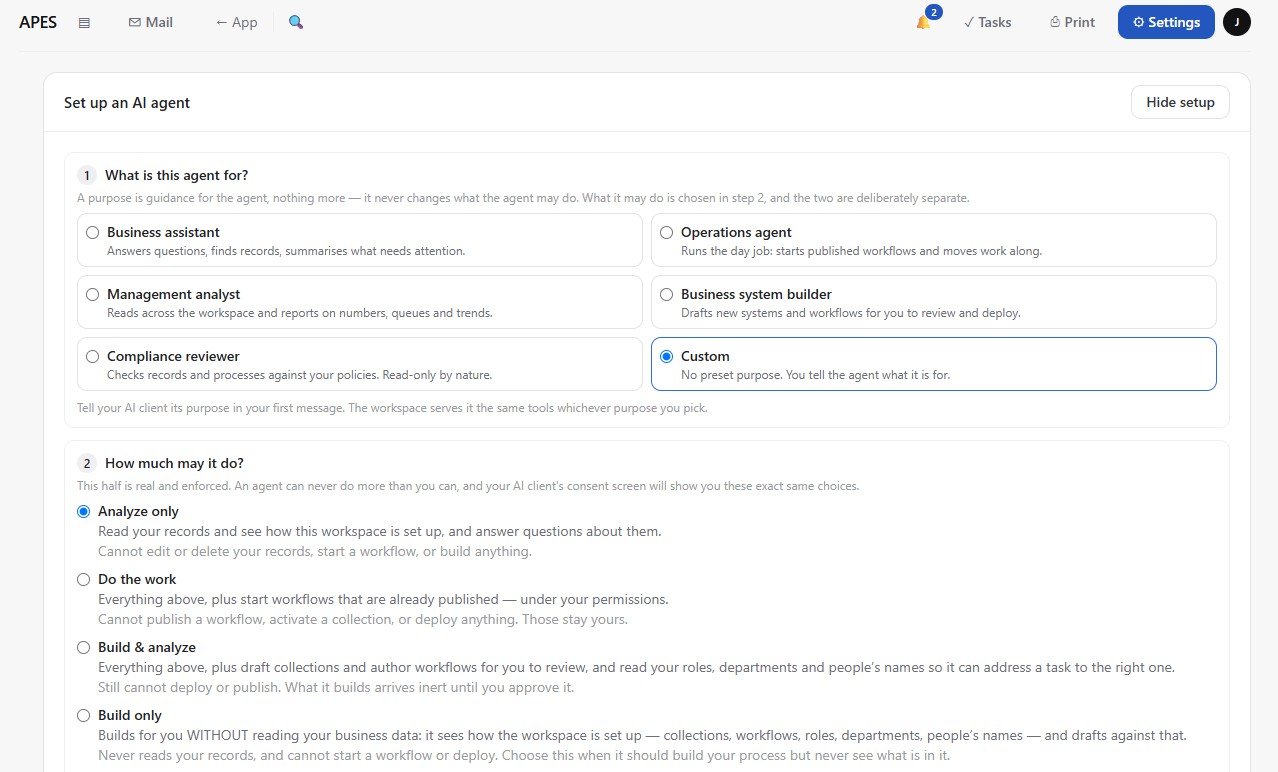
Turning this on takes one setup step. Under Settings, in the People section, you connect your AI client to your workspace using the “Build with me” preset. After that one connection, you can describe what you need whenever a gap shows up, and APES will draft a module for you to review.
For a business that is tired of waiting on developer time for every internal tool, this is a direct way to close that gap. You describe the problem. APES builds the answer. You review it, and your team gets a real tool that fits directly into the system they already use every day.