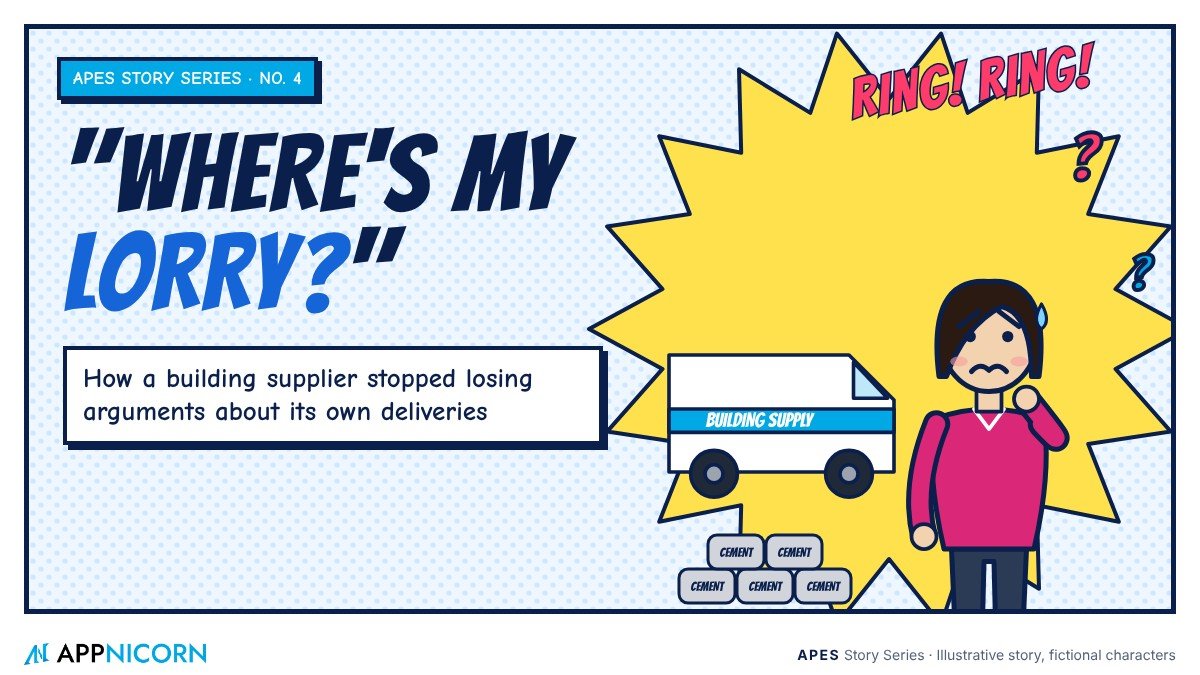
This is an illustrative story. The company, the people and the numbers are fictional, but the problem will be familiar to any business that runs its own lorries.
Meet Aminah, and her lorries
Aminah runs a building materials supply company on the edge of Shah Alam. Cement, sand, tiles, pipes, roofing sheets and the hundreds of small items a construction site gets through in a week. Her customers are contractors, renovators and hardware shops, and almost all of them want the same thing: the right goods, on site, on time.
To make that happen, Aminah runs her own fleet of six lorries. Her dispatcher, Suresh, plans the day's trips. Her drivers, including Ah Keong, who has been with the company longer than some of the lorries, load up at dawn and spend the day crawling through Klang Valley traffic. Back at the office, Grace handles customer service, and Nadia in accounts turns deliveries into invoices.
The goods are good, the prices are fair, and customers keep coming back. But every day, at around ten in the morning, the phones start ringing with the same question.
"Where's my lorry?"
How a delivery really worked
On paper, the process was simple.
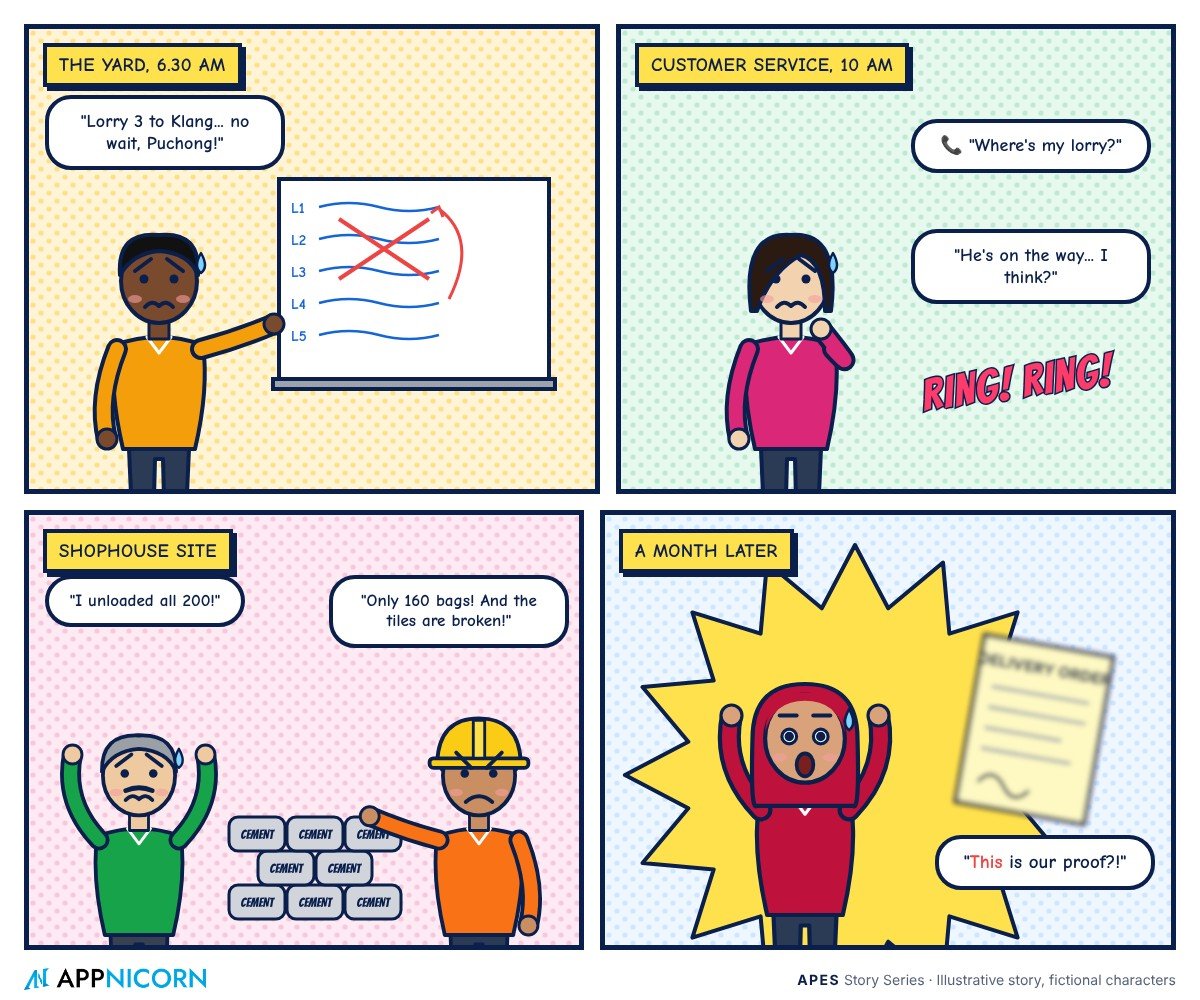
A customer placed an order by phone, WhatsApp or through a salesperson. The order was keyed into the accounting system, which printed a delivery order. Each evening, Suresh gathered the next day's delivery orders, sorted them on a whiteboard by area, and assigned them to lorries. In the morning, each driver received a stack of delivery orders and a WhatsApp message with the sequence.
On site, the driver unloaded the goods, asked someone to sign the delivery order, and moved on. At the end of the day, the signed copies came back to the office in the driver's folder. Nadia used them to raise invoices. If a delivery was short or something was damaged, the driver was supposed to write it on the delivery order.
In practice, it was rather looser than that.
Plans changed through the day, by phone and by WhatsApp, and the whiteboard did not keep up. Urgent orders were squeezed in by calling a driver directly. When a site was closed or not ready, the goods came back to the yard and the delivery order went into a "redeliver" pile that only Suresh fully understood. Whoever was standing nearest signed the delivery order, often without counting anything, and sometimes with a scribble nobody could identify. Shortages and damage were written in the margin, or mentioned by phone, or forgotten.
And Grace, who had no way to see where any lorry was, spent her mornings calling drivers who were trying to drive, so she could tell customers something better than "he is on the way."
The forty bags of cement
The trouble came to a head with one of Aminah's best customers, a contractor building a row of shophouses.
The contractor's purchasing manager called Nadia to say they would not be paying last month's invoice in full. According to their site, a delivery of two hundred bags of cement had arrived forty bags short, and one pallet of floor tiles had been broken. They wanted a credit note.
Nadia went looking for the signed delivery order. The original had gone missing somewhere between the lorry and the office. What she had was a photo Ah Keong had sent to the drivers' WhatsApp group. It was taken at an angle in the late afternoon sun. The signature was a squiggle, there was no name, and the quantity column had no notes at all.
Ah Keong was sure he had unloaded everything. He also remembered that the site was chaotic, that a different lorry from another supplier had been unloading at the same time, and that the tiles had looked fine when he left. But he could not prove any of it.
The contractor's site supervisor was equally sure. And the contractor was a customer Aminah could not afford to lose.
So Aminah did what many business owners do. She issued the credit note, absorbed the loss, and kept the customer. Then she went back to her office and asked herself how many times this had happened before, and how many times it would happen again.
The pain points behind the story
Aminah's drivers were honest and hardworking. Her customers were not trying to cheat her. The problem was that the delivery process produced no reliable evidence, and almost no visibility.
The plan lived on a whiteboard and in chat. Suresh's plan was a good one, but once the lorries left the yard, the changes lived in phone calls and WhatsApp messages. Nobody else could see the real plan for the day.
Nobody knew where a delivery was. Without a live status, every customer enquiry became a phone call to a driver. Customer service could not answer simple questions, and drivers were distracted on the road.
Proof of delivery was a piece of paper. A signed delivery order was the only evidence that goods had arrived, and it had to survive a day in a lorry cab. When it was lost, blurry or signed by an unknown person, a dispute became one person's word against another's.
Exceptions were not captured at the moment they happened. Shortages, damage and refused goods were the most important things to record, and the least likely to be recorded properly. By the time anyone asked, the details were gone.
Failed deliveries disappeared into a pile. Goods that came back to the yard depended on Suresh remembering to rebook them. Some customers waited days for a redelivery that nobody had scheduled.
Invoicing waited for paper. Nadia could not invoice until the signed delivery orders came back, so invoices went out late. When a delivery was disputed, the whole invoice was held up.
There were no numbers to manage by. Aminah could not say how many deliveries were on time, how many failed, which customers disputed most often, or how productive each lorry really was.
What it was really costing
The obvious cost was the credit note. Forty bags of cement and a pallet of tiles, written off to keep a customer happy.
The real cost was much larger. Every unresolved dispute meant a delayed payment, which strained cash flow. Grace's mornings went on chasing information instead of looking after customers. Drivers lost time answering calls and redoing failed deliveries. Suresh spent his evenings rebuilding a plan that had fallen apart by noon. And because no one could prove what had happened on any given delivery, Aminah was quietly paying for other people's mistakes, and sometimes for nobody's mistake at all.
Perhaps worst of all, her customers' experience depended on luck. A customer who happened to call when Grace could reach a driver got a good answer. Another, on a different morning, got "I'll call you back."
Why the obvious fixes fell short
Aminah tried to fix it.
First, she told drivers to photograph every signed delivery order and send it to the group. The photos helped a little, but they were inconsistent, hard to search and impossible to match quickly to an invoice. And a photo of a signed form still did not say how many bags were actually unloaded.
Then she added GPS trackers to the lorries. Now Grace could see roughly where each lorry was, which was an improvement. But a dot on a map did not tell her which deliveries were done, which were next, or what had gone wrong at the last stop.
She also looked at a separate delivery app. It had nice features, but it did not know about her orders, her stock or her invoices. Someone would have had to retype every delivery order into it and every result back out of it, every single day.
The deeper problem was that the delivery was disconnected from everything around it: the order before it and the invoice after it. A delivery was not just a trip. It was the moment when the order became real, and the business had no reliable way to capture that moment.
How APES changed the story
Aminah came to Appnicorn with a brief that was refreshingly direct: "I want to know where every delivery is, and I never want to lose an argument about my own delivery again."
The team built a delivery module in APES around how Aminah's company actually works. Here is how a delivery runs now.
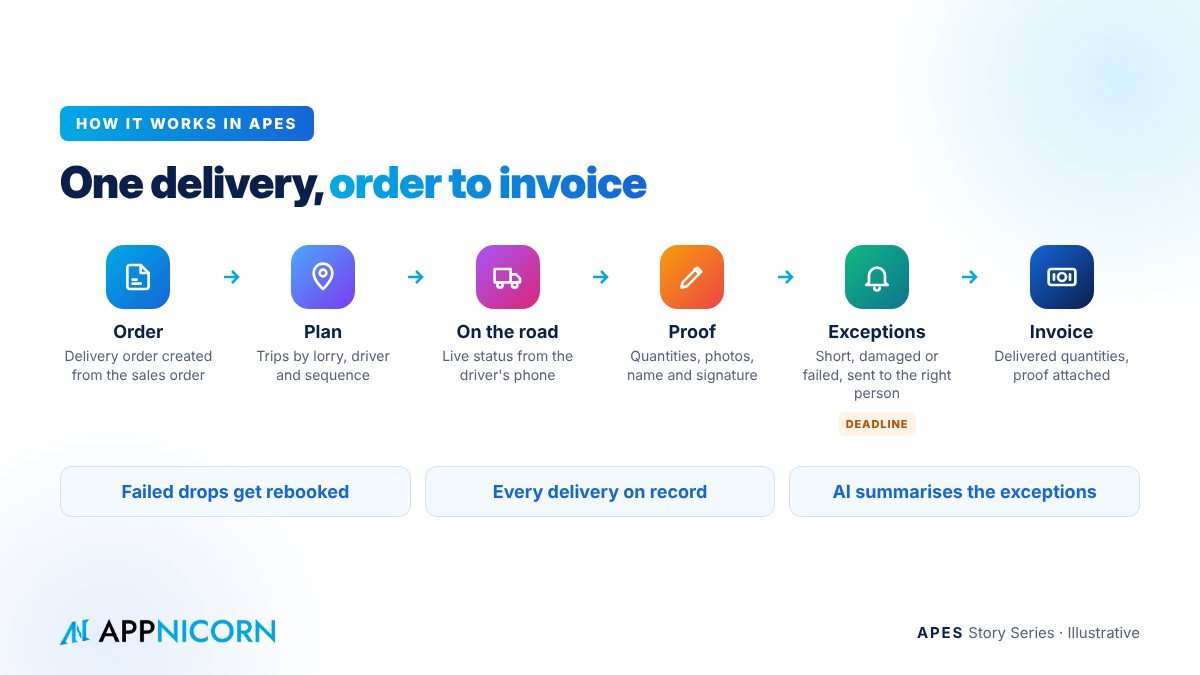
Every delivery starts from the order. When a sales order is confirmed in APES, a delivery order is created from it with the items, quantities, site address and contact person. Nothing needs to be retyped.
Trips are planned in one place. Suresh plans each day's trips in APES, assigning delivery orders to lorries and drivers and setting the sequence. When something changes during the day, he changes it in APES, and the driver sees the update straight away.
Drivers work from their phones. Each driver opens the day's trip in APES on his phone. He marks when he leaves the yard, when he arrives at each site and when each delivery is done. Grace can see the status of every delivery without making a single call.
Proof of delivery is captured on site. At each stop, the driver records the quantity actually delivered for each item, takes photos of the goods as unloaded, and records the name of the person receiving them, who signs on the phone screen. The time is recorded automatically. Ah Keong's next cement delivery comes with a clear, dated record of two hundred bags, photographed on the ground.
Exceptions are recorded when they happen. If goods are short, damaged or refused, the driver records it at the stop with a reason and a photo. The exception goes straight to the right person, so a replacement, a return or a credit note can be decided the same day, while the facts are fresh.
Credit notes follow the rules. A credit note can only be raised against a recorded delivery exception, and it goes through the approval Aminah has set, with the evidence attached. Nobody issues one on a phone call alone.
Failed deliveries are never forgotten. If a site is closed or not ready, the driver marks the delivery as failed with the reason. It goes back to Suresh's list to be rebooked, and if it is not rebooked within the time Aminah has set, it is escalated.
Invoices follow the delivery. As soon as a delivery is confirmed, Nadia can invoice the quantities actually delivered, with the proof of delivery attached to the record. Invoice numbers are controlled, so none are skipped or duplicated, and disputes are settled by looking at the record, not by searching for paper.
Every step is on record. Plans, changes, departures, arrivals, quantities, photos, signatures, exceptions and credit notes are kept in a tamper-evident audit trail. When a customer questions a delivery, Aminah can show exactly what happened, when, and who received it.
AI helps with the reading. AI inside APES can summarise the day's exceptions for Aminah and Suresh, so they can see the pattern at a glance: which sites, which items, which reasons. It prepares. They decide.
What changed for Aminah's team
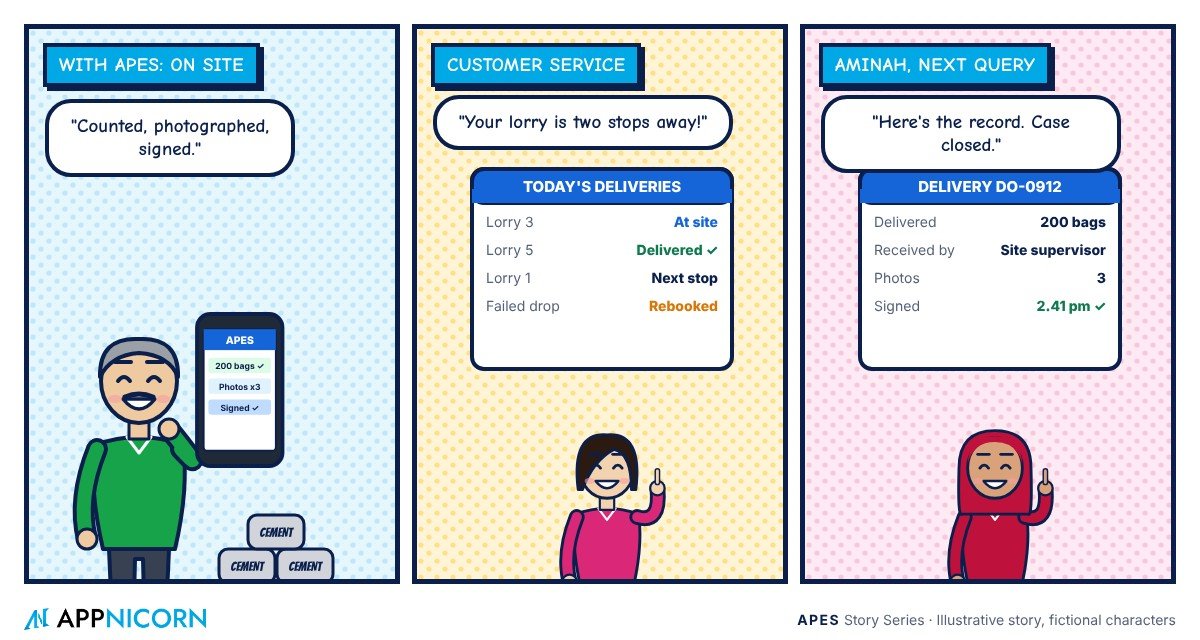
This part of the story is illustrative, but it shows the kind of change a business can expect.
Suresh still plans the trips, but the plan no longer falls apart by noon. Changes happen in one place, and every driver sees them. Ah Keong still drives, still knows every shortcut in Klang, and no longer has to answer his phone at traffic lights. Grace can tell a customer exactly where their delivery is, often before they ask. Nadia invoices within a day of delivery, with the evidence already attached.
And when the shophouse contractor queried a delivery a few weeks later, Aminah did not reach for her credit note book. She sent the record: the quantity, the photos, the name of the site supervisor who received the goods and the time he signed. The query was closed in a single message.
The contractor is still a customer. They now pay on time.
Is this your business?
You do not have to sell cement to recognise Aminah's mornings. Ask yourself a few questions.
How many calls does your team take each day asking where a delivery is? If a customer disputes a delivery from last month, how long does it take to find the proof, and how good is it? Are shortages and damage recorded at the moment they happen? What happens to a failed delivery, and who makes sure it is rebooked? How long after a delivery does the invoice go out? And do you know how many of your deliveries were on time last week?
If those answers are uncomfortable, the problem is probably not your drivers. It is that your deliveries live on paper, a whiteboard and a chat group, and none of them talk to each other.
Bring us your "Where's my lorry?"
APES (said "A-pes") is a custom ERP made by Appnicorn, a Malaysian IT company with years of experience building business systems. Every module in APES is customised to your company's unique needs, whether that is deliveries, sales orders, stock, purchasing, service jobs or a process unique to your industry.
In APES, your rules are built into the work itself. Tasks go to the right people with deadlines and escalation, documents are numbered under control, and every step is kept in a tamper-evident audit trail. Each business gets its own workspace, so orders, deliveries, stock and invoices sit in one place. If the module you need does not exist yet, Appnicorn designs and builds it with you.
Pricing depends on the process being built, so the best first step is a conversation. Bring us tomorrow's delivery plan and the last dispute you could not settle, and we will show you how both would run in APES.