How APES Makes Sure Nothing Gets Missed
Every business has a version of the same quiet failure. A request goes out, and then it just sits somewhere. An email waiting for a reply. A form waiting for someone to notice it. A task that was assigned out loud in a meeting and never written down anywhere a person could check on it later. Nothing about this looks like a crisis in the moment. It only becomes visible weeks later, when a customer asks why nothing happened, and the honest answer is that nobody was actually watching for it.
APES is built around a simple idea that removes this failure mode almost entirely. If something needs a person to act, it should not depend on that person remembering, checking, or happening to notice. It should land in front of them directly, stay there until it is handled, and be visible to anyone who needs to check on its progress.
A Request Becomes a Task, Not a Hope
The most common way work gets lost is that it was never really assigned to anyone in the first place. It was mentioned, or emailed, or left in a shared document, and everyone involved assumed someone else was tracking it.
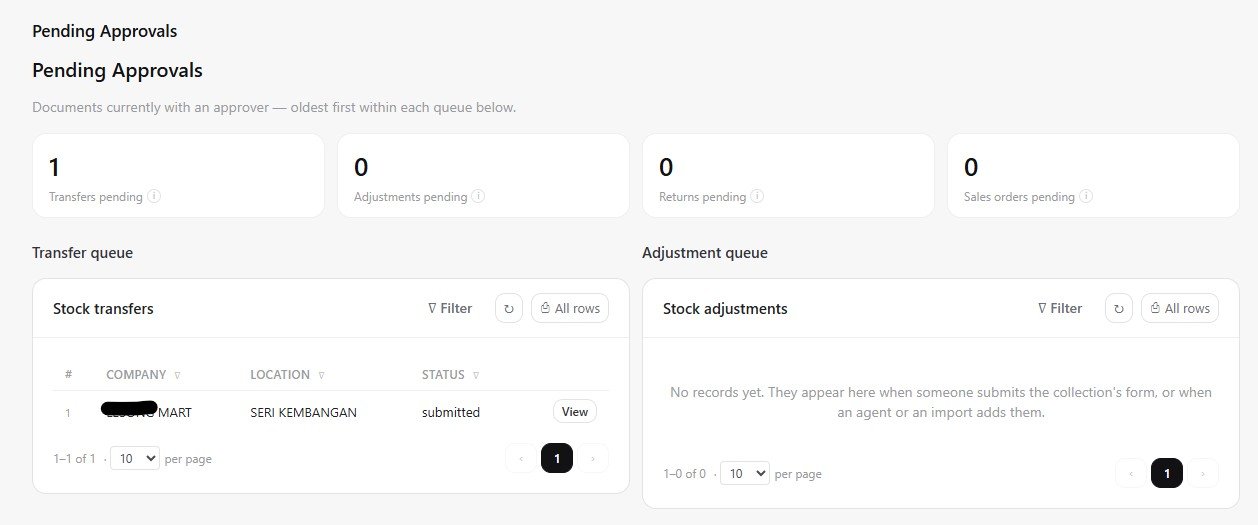
In APES, a request that needs a decision becomes an actual task, sitting in a specific person's queue, or in the queue of anyone holding a particular role. It does not disappear into an inbox alongside a hundred other unrelated messages. It sits in one place built specifically for exactly this purpose, and it stays there, visibly unresolved, until someone actually acts on it.
Nothing Requires Someone to Go Looking For It
A task that a person has to remember to check for is only slightly better than no task at all. APES surfaces what needs attention directly, through a notification that appears the moment something arrives, rather than requiring anyone to open a separate screen on the off chance something is waiting.
This matters especially for anything time sensitive. A large stock transfer waiting on approval, a damage charge waiting on a manager's decision, a document waiting on a signature, all of these show up the same way, as a clear, visible signal rather than something a person has to go hunting for on a slow afternoon.
A Full Record of What Was Asked and What Was Decided
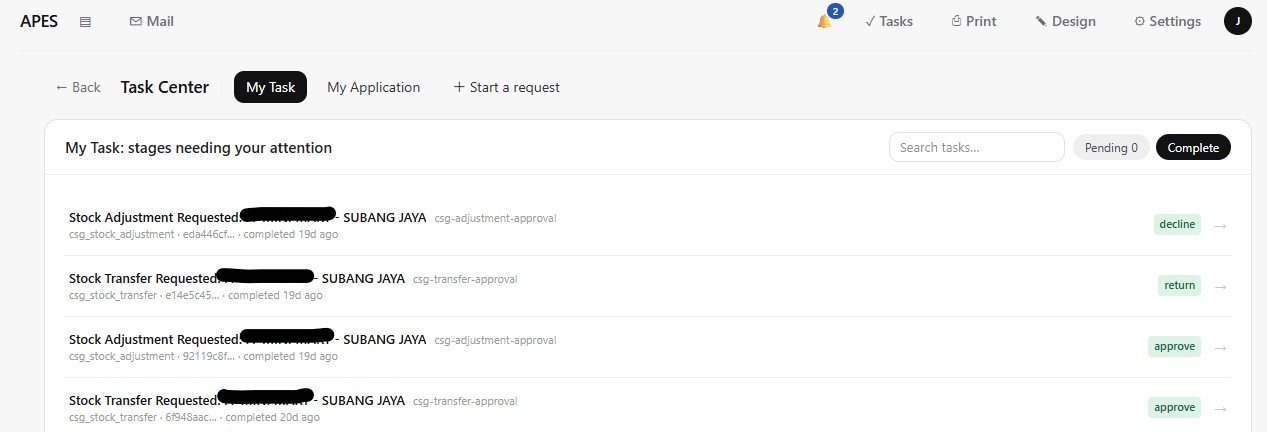
Once a task is resolved, the story does not just disappear. Every decision made through a task in APES is kept, with exactly what was asked, who decided it, what they chose, and when. This is not a separate log someone has to remember to update after the fact. It is simply what the task center already shows, moved from the pending list into a completed history that stays searchable afterward.
This turns a question that used to require asking around, such as who approved this and when, into something that can be answered directly, without needing to track down the person involved and hope they remember correctly.
Escalation Happens on Its Own, Not When Someone Finally Notices
Even a well designed task queue has a weak point if nothing happens when a task sits too long. A request stuck for a week because the assigned approver is on leave is not actually different from a request that was never assigned in the first place, unless something notices and does something about it.
A workflow in APES can be given a timeout, so if nobody acts within a set amount of time, the task automatically moves down a different path, whether that means escalating to someone else, notifying a manager, or simply flagging that it needs attention. Nobody has to be the person who happens to remember to check whether an old request is still sitting there. The system already knows how long is too long, because that rule was set once when the process was built.
A Business Can Reach People Where They Already Are
Not every business lives entirely inside one piece of software, and APES does not assume otherwise. Alongside its own in app notifications, it can reach a person through email, or through workplace chat tools such as Lark or DingTalk that a team may already use every day. A workflow does not need to guess where someone will actually see a message. It can be told to reach them through the channel that business already relies on.
This matters because a notification that arrives somewhere nobody checks is functionally the same as no notification at all. Meeting a team where they already are, rather than asking them to adopt a new habit just to see what needs their attention, is a large part of why a task actually gets seen in time rather than discovered late.
Starting a Request Is Just as Easy as Responding to One
All of this works in the other direction too. A person does not need to know which workflow to trigger or how the process behind a request actually works. APES gives every person a place to simply start a request, described in their own words for what they need, and the platform routes it into the correct process from there.
This closes a gap that trips up a lot of otherwise well designed systems, where the person receiving a task has a clean experience, but the person who needs to submit one in the first place has no idea where to begin. Nobody should need a training session just to ask for something.
Visibility That Does Not Depend on Asking Around
A manager checking on the health of a process should not need to interrupt three different people to find out whether something is moving. Because every task, every decision, and every escalation already lives in one place, a business can see exactly what is currently waiting, on whom, and for how long, without needing to ask.
This is really the underlying theme across everything described here. Work does not get lost because people are careless. It gets lost because nothing was actually watching it, and nobody had an easy way to check. APES closes that gap directly, so a business's actual attention goes toward doing the work, not toward the separate, exhausting job of making sure the work does not quietly fall through.