Picture a typical afternoon for a director of a growing company. A stack of purchase requests waits on the desk. The phone shows a dozen WhatsApp messages asking "boss, can approve?". A sales manager is waiting to hear whether a customer can have a special price, and the finance team needs a decision on a payment before the bank closes. Every one of these is a small decision. Together, they take most of the day.
And yet, despite all that signing and replying, costly decisions still slip through. A discount is given on the strength of a verbal "ok". A purchase is split into two smaller ones to stay under a limit. A payment is released because the approval message was found, but nobody checked what it was actually approving.
The problem is not that the director approves too little or too much. It is that the approval process itself has no structure. This guide explains what a proper approval workflow is, why approvals break down as companies grow, how to design one that gives you control without slowing the business down, and how to get started.
What an approval workflow is
An approval workflow is the defined path a request follows from the person who asks to the person who decides, and on to whatever happens next. It answers a few simple questions every time. What is being requested, and with what supporting information? Who needs to approve it, based on the amount, the department or the type of request? How long should they take? What happens if they do not respond? And once a decision is made, what happens next, and where is the decision recorded?
In a small company, these answers live in the owner's head and the approval workflow is simply "ask the boss". In a growing company, that stops working. The answers need to be written down as rules, and the rules need to be applied by a system rather than remembered by people.
Why approvals break down as companies grow
Approvals usually start informally, and that is fine at first. The trouble is that informal approvals do not scale.
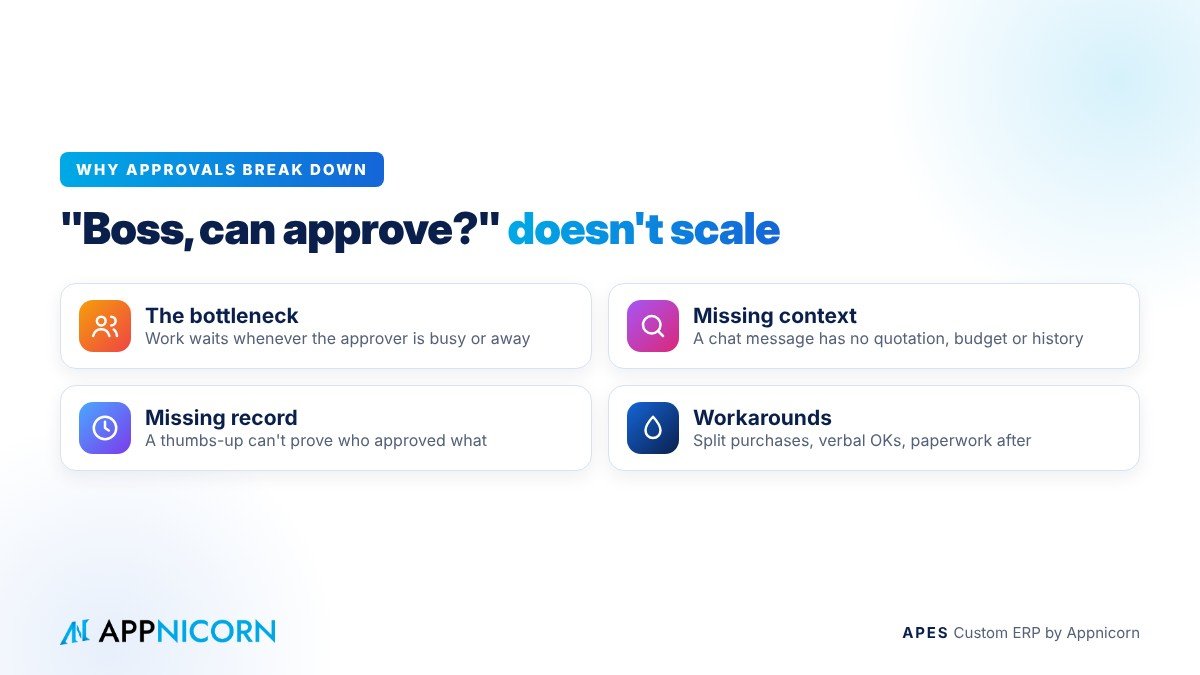
The first sign is the bottleneck. When every decision goes to one or two people, work waits whenever they are busy, travelling or on leave. Staff learn to chase, and the people at the top spend their days answering instead of leading.
The second is the missing context. A WhatsApp message saying "can approve the PO for the supplier?" does not show the quotation, the budget, the previous price or whether there were cheaper options. The approver is asked to decide without the information a good decision needs.
The third is the missing record. When an approval is a thumbs-up in a chat group, or a signature on a paper form that is later filed somewhere, it is very hard to prove later who approved what, when and on what basis. That matters when a supplier disputes a payment, when an auditor asks a question, or when a decision turns out to have been a mistake.
The fourth is the workaround. When the official process is slow, people find ways around it: splitting a purchase to stay under a limit, getting a verbal approval and filling in the paperwork afterwards, or simply going ahead and asking for forgiveness later. Each workaround weakens the control the approval was meant to provide.
What weak approvals really cost
The costs of a weak approval process are rarely visible on their own, which is why they are easy to tolerate.
Margin leaks through discounts and special prices that were never properly approved, or were approved without seeing the full picture. Costs creep up through purchases that would have been questioned if the right person had seen them in time. Cash flow suffers when payments, invoices and credit decisions wait for an approval that nobody is chasing. And the business carries risk it cannot see, because there is no reliable record of how important decisions were made.
There is a human cost too. Capable managers become frustrated when they cannot get a decision, and senior people feel buried in trivial approvals while important ones wait.
What a good approval workflow looks like
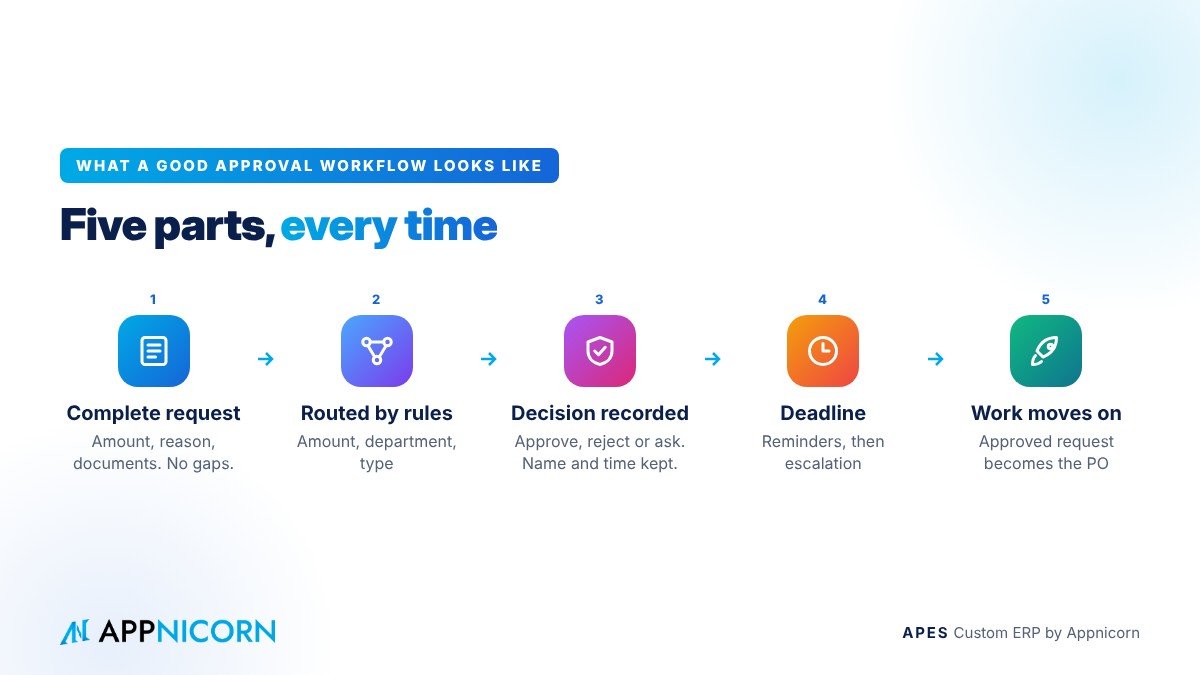
A good approval workflow has a few clear parts, and each one solves one of the problems above.
It starts with a proper request. The request is made in a form, not a message, and the form asks for what the approver needs: the amount, the reason, the supplier or customer, the budget it belongs to and the supporting documents. A request that is missing required information cannot be submitted.
Next comes routing. Rules decide where the request goes, based on things like the amount, the department, the project or the type of request. Small, routine requests go to a department head. Larger or unusual ones go further up. Nobody has to decide who to ask.
Then comes the decision itself. The approver sees the full request in one place and can approve it, reject it, or send it back with a question. Their decision is recorded with their name and the time.
Deadlines and reminders keep the request moving. Each approval step has an expected response time, reminders go out as it approaches, and if the deadline passes, the request is escalated to the next person instead of sitting in an inbox.
Finally, the approval triggers what happens next. An approved purchase request becomes a purchase order. An approved discount is applied to the order. An approved claim goes to finance. The approval is not a separate step that someone has to remember to act on. It moves the work forward by itself.
Designing your approval matrix
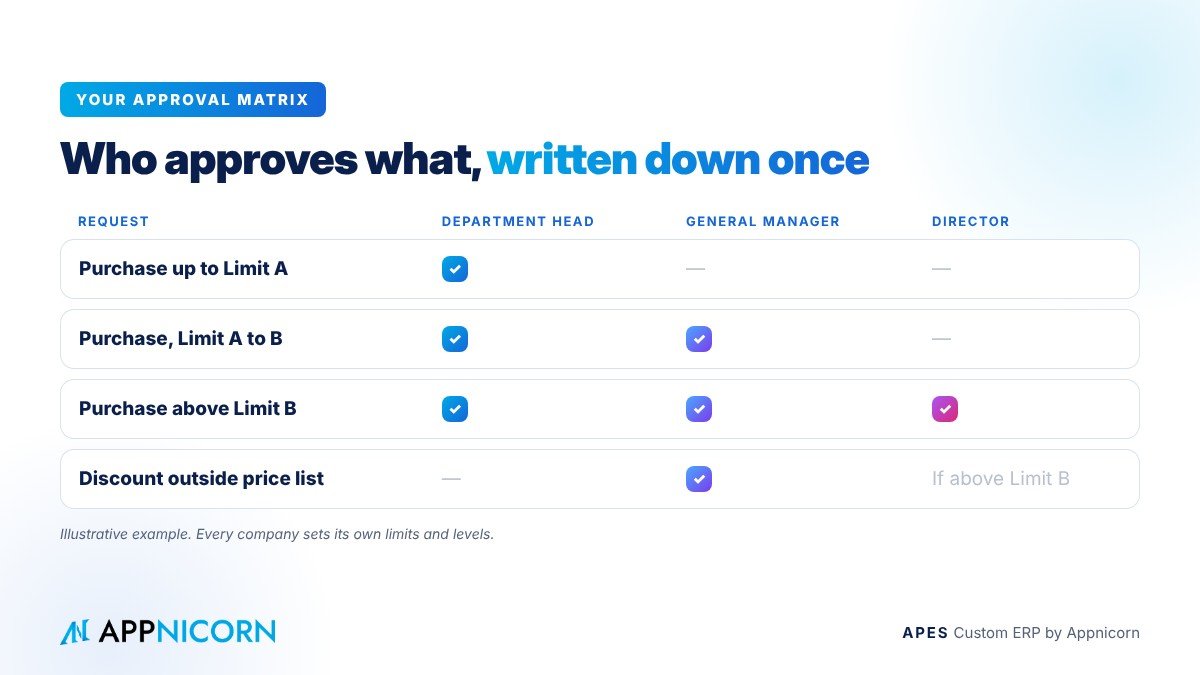
At the heart of every approval workflow is an approval matrix, sometimes called an authority matrix. It is simply a table of who may approve what, and up to what level.
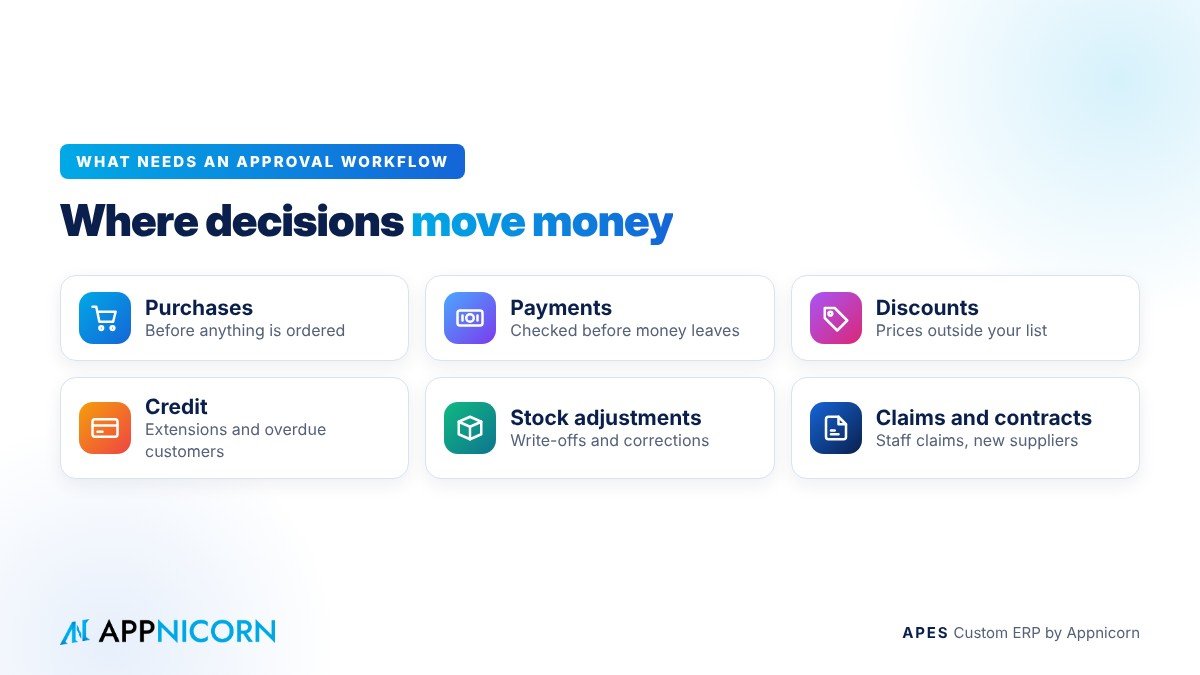
Building one is a management exercise, not a technical one. Start by listing the types of decision that matter in your business: purchases, payments, discounts and special prices, credit extensions, write-offs, stock adjustments, new suppliers, new customers, staff claims, contracts. For each type, decide the levels. For example, and purely as an illustration, a purchase up to a first limit might need only the department head, a purchase between the first and second limit might need the department head and the general manager, and anything above the second limit might also need a director.
Then decide the exceptions. What happens when an approver is on leave? Which requests are urgent enough to have a faster path? Which ones, such as a request from a director for their own expenses, need a different approver to avoid a conflict of interest?
Written down, the matrix becomes your company's policy on decisions. Built into a system, it becomes how decisions are actually made, every time, for everyone.
Balancing control and speed
A common fear is that more structure means more delay. In practice, a well-designed approval workflow is usually faster than the informal one it replaces, because requests arrive complete, go straight to the right person and do not wait for someone to chase them.
The key is to approve only what matters. Not every request needs a director. Routine purchases within budget can go to a department head. Very small, low-risk requests may need no approval at all, only a record. The more carefully you match the level of approval to the level of risk, the faster the routine work moves and the more attention senior people can give to the decisions that really count.
It also helps to keep the number of levels low. Every additional approver adds time. If a request needs five signatures, it is worth asking whether all five people are really adding judgement, or whether some are just passing it along.
Why your approval workflow should be built around your business
Every company's approval matrix is different. The limits, the levels, the types of decision and the exceptions all reflect how that particular business is organised and where its risks lie. A generic approval feature that only allows a simple "manager approves" step will not hold a real matrix, and the gaps will be filled with WhatsApp and paper again.
This is one of the strongest reasons companies choose a custom ERP. When the approval workflow is designed around your own rules, it can route by amount, department, project or request type, attach the documents your approvers need, and connect directly to the purchasing, sales, stock or claims process that the approval controls.
Approvals as evidence
A good approval workflow does more than control decisions. It also proves them.
When every request, decision and comment is recorded with who made it and when, the business has a complete history of how it spends money and makes commitments. When a supplier disputes a payment, the record shows exactly what was approved. When an auditor asks how a large purchase was authorised, the answer is a report rather than a search through emails and files. And when a decision turns out to have been wrong, management can see where the process failed and fix the rule, rather than blame a person.
Where AI fits in
Artificial intelligence can make approvals faster and better informed, as long as it stays in its proper place. It can read the attached quotation or invoice and pull out the key details, summarise a long request so the approver sees the essentials at a glance, flag missing information, or draft a reply.
What AI should not do is make the decision. In a well-governed system, AI prepares and a person approves. That keeps accountability where it belongs, with a named person, and keeps the business in control of its own decisions.
How to get started
Start with the approval that hurts most. For many companies that is purchasing, because it is frequent and directly affects costs. For others it is discounts, credit or staff claims.
Write down your approval matrix for that one type of request, including the levels and the exceptions. Agree it with the people involved. Then put it into a system and make the system the only way to get that type of approval. If people can still get the same approval through WhatsApp, the old habits will return.
After a few weeks, look at what the record tells you. Which requests wait longest? Which approvers are overloaded? Which limits are too low or too high? Adjust the rules, then move on to the next type of approval.
APES: approvals built around your rules
APES (said "A-pes") is a custom ERP made by Appnicorn, a Malaysian IT company with years of experience building business systems. Every module in APES is customised to your company's unique needs, and approvals are at the heart of it.
In APES, your approval rules are built into each module, whether that is purchasing, sales, stock, delivery, claims or a process unique to your industry. Requests are routed to the right people according to your own levels, with deadlines, reminders and escalation so that nothing sits forgotten. Every request and decision is kept in a tamper-evident audit trail, and documents such as purchase orders are numbered under control. Each business gets its own workspace, so requests, approvals and the work they control all sit in one place.
AI works inside APES as a governed assistant. It can read and summarise the documents attached to a request and draft the next step, but it never acts beyond the rights of the person it works for, and a person always makes the decision. As we put it: AI proposes, APES authorises.
Pricing depends on the process being built, so the best first step is a conversation. Show us where your business is losing money. Bring your current approval process, however informal, and a few recent decisions that went wrong, and we will show you how they would run in APES.
Talk to Appnicorn about approvals built around your business.