Business Process Control: Why Business Process Governance Matters More Than Ever
In modern organizations, business process control is becoming a critical requirement rather than a nice-to-have capability. As companies scale, operations naturally become more complex, involving multiple teams, systems, and decision layers. Without a structured approach to control, even well-designed workflows can drift into inconsistency. This is where business process governance plays a central role—ensuring that processes do not just exist, but operate in a controlled, consistent, and accountable manner across the entire organization.
Understanding Business Process Governance
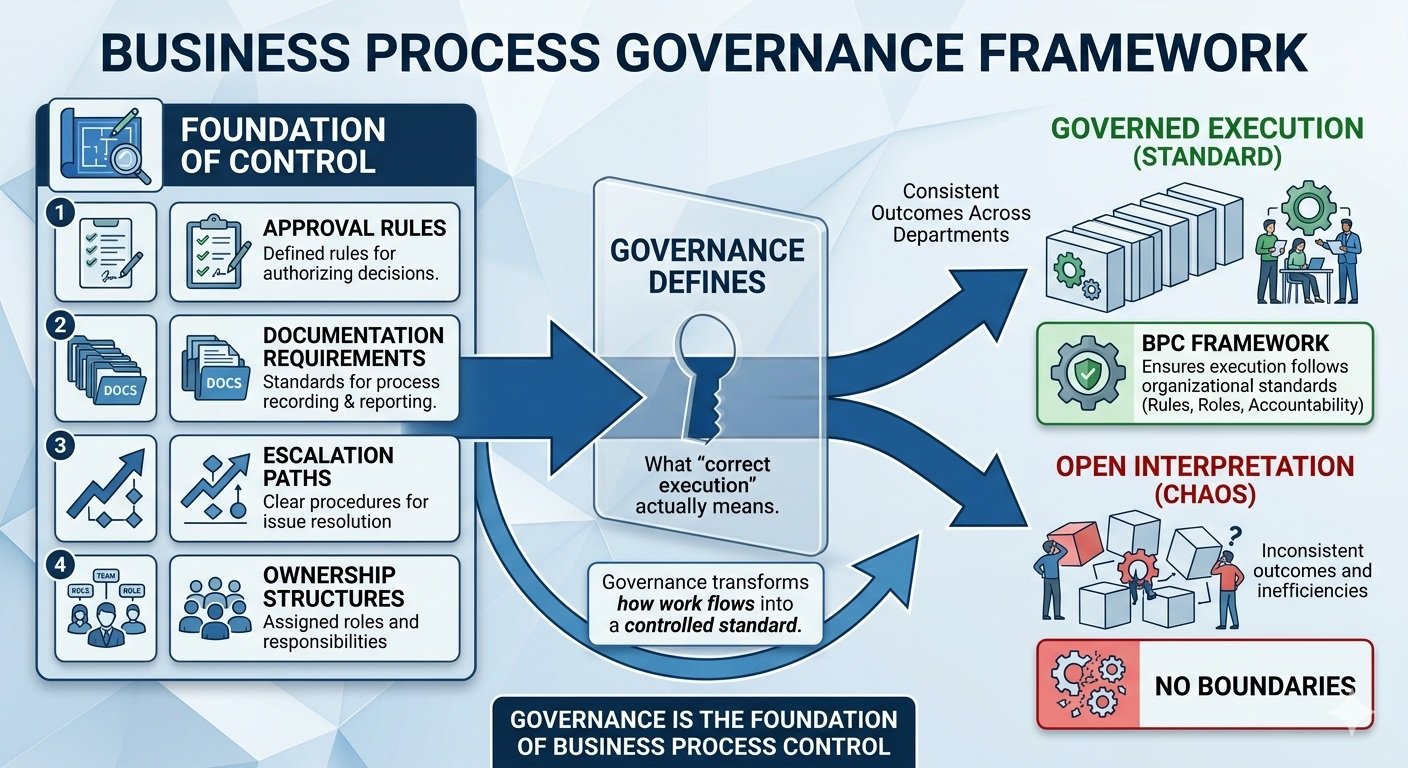
Business process governance refers to the framework that defines how processes should behave within an organization. It establishes the rules, roles, responsibilities, and accountability structures that guide execution. While process design focuses on how work flows, governance ensures that the flow follows organizational standards.
At its core, governance sets the foundation for business process control by defining what “correct execution” actually means. This includes approval rules, documentation requirements, escalation paths, and ownership structures. Without these clearly defined boundaries, processes become open to interpretation, leading to inconsistent outcomes across departments.
Why Business Process Control Cannot Rely on Processes Alone
Many organizations assume that once workflows are documented or automated, control is automatically achieved. However, this is not the case. Processes alone define activity flow, but they do not guarantee compliance or consistency in execution.
In reality, business process control breaks down when individuals interpret rules differently or when exceptions are handled inconsistently. For example, one manager may approve a request based on urgency, while another strictly follows policy thresholds. Even if both operate within the same system, the lack of governance creates variability that weakens overall control.
The Role of Governance in Strengthening Business Process Control
Governance strengthens business process control by introducing structure and standardization into how decisions are made. It ensures that rules are not optional guidelines but enforced standards that guide every execution.
When governance is properly implemented, organizations can define who has authority to approve actions, what conditions must be met before a process advances, and how exceptions should be handled. This reduces ambiguity and ensures that processes behave consistently regardless of who is executing them.
More importantly, governance introduces accountability. Every action can be traced back to responsible roles, making it easier to identify gaps, enforce compliance, and maintain operational discipline.
Enforcement: Turning Governance into Action
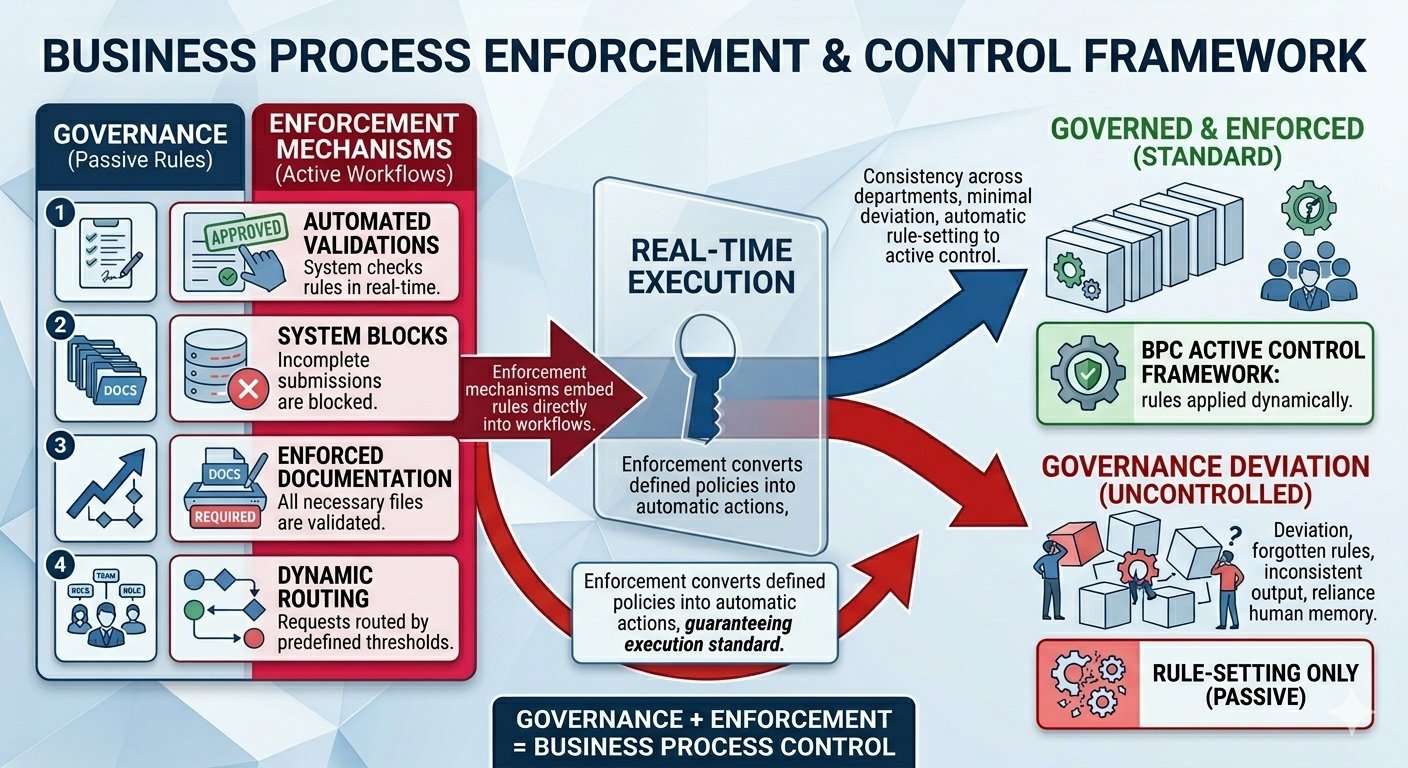
While governance defines rules, enforcement ensures those rules are actually applied in real-time execution. This is a critical component of business process control because policies alone are not enough to guarantee behavior.
Enforcement mechanisms embed rules directly into workflows. For example, systems can automatically validate approvals, block incomplete submissions, enforce required documentation, or route requests based on predefined thresholds. This removes reliance on human memory and reduces the risk of deviation from established governance structures.
By combining governance and enforcement, organizations shift from passive rule-setting to active control.
Monitoring and Continuous Business Process Control
True business process control also requires continuous monitoring. Organizations must be able to track how processes perform over time, identify deviations, and detect inefficiencies or risks early.
Monitoring tools such as audit trails, compliance reports, and performance dashboards provide visibility into how well governance rules are being followed. This allows organizations to move from reactive problem-solving to proactive process improvement.
Without monitoring, even well-governed and enforced systems can gradually drift over time as business conditions change or exceptions accumulate.
The Outcome: Scalable and Reliable Operations
When governance, enforcement, and monitoring work together, business process control becomes a continuous system rather than a manual effort. Processes become predictable, auditable, and scalable across departments and regions.
Organizations benefit from reduced operational risk, improved compliance, faster decision-making, and greater transparency. More importantly, they gain the ability to scale without losing control over how work is executed.
In this way, business process governance is not just about defining rules—it is about enabling sustainable control over how an organization operates at scale.
Conclusion
Business process control is no longer achieved through documentation, workflow automation, or governance alone. It emerges when governance, enforcement, and monitoring work together as a unified system that shapes how work is actually executed in real time. Without this alignment, organizations risk scaling inefficiency, inconsistency, and compliance gaps—even with advanced automation in place.
As businesses continue to grow and operations become more complex, the need for structured, enforceable control becomes critical. Governance defines the rules, enforcement ensures they are applied, and monitoring keeps them continuously in check. Together, they create the foundation for scalable, reliable, and accountable operations.
To understand how strong your current process controls are, Appnicorn provides a structured APES Governance Assessment that helps identify gaps in your business process control framework.