Operational Excellence: Why Sustainable Business Success Requires More Than Efficiency
Operational excellence has become one of the most frequently discussed objectives in modern business. Organizations invest heavily in technology, process improvement initiatives, automation projects, and management frameworks in pursuit of greater efficiency and performance. While these efforts often generate measurable benefits, many organizations discover that improving efficiency alone does not necessarily lead to operational excellence.
True operational excellence extends beyond cost reduction, productivity improvements, or workflow optimization. It represents an organization's ability to consistently execute its business objectives through controlled, reliable, and repeatable operations. It requires organizations to create an environment where processes function predictably, decisions are made consistently, risks are managed effectively, and accountability exists throughout the business.
As organizations grow and operational complexity increases, achieving operational excellence becomes less about optimizing individual activities and more about ensuring that the systems governing those activities remain effective, scalable, and sustainable.
What Is Operational Excellence
Operational excellence refers to an organization's ability to consistently deliver value to customers while maintaining high standards of efficiency, quality, compliance, and operational control. It is not a one-time project or a specific methodology. Rather, it is an ongoing commitment to improving how the organization operates while ensuring that business objectives are achieved consistently over time.
Organizations that achieve operational excellence are typically characterized by their ability to execute reliably. Their processes are clearly defined, responsibilities are understood, decisions are made through established mechanisms, and performance can be measured and improved continuously. Operational excellence creates a foundation that allows organizations to grow without sacrificing quality, compliance, or operational control.
While efficiency remains an important component of operational excellence, it is only one part of a much larger picture. An organization may operate efficiently yet still experience significant operational risks if its processes lack governance, accountability, or oversight.
Why Operational Excellence Matters
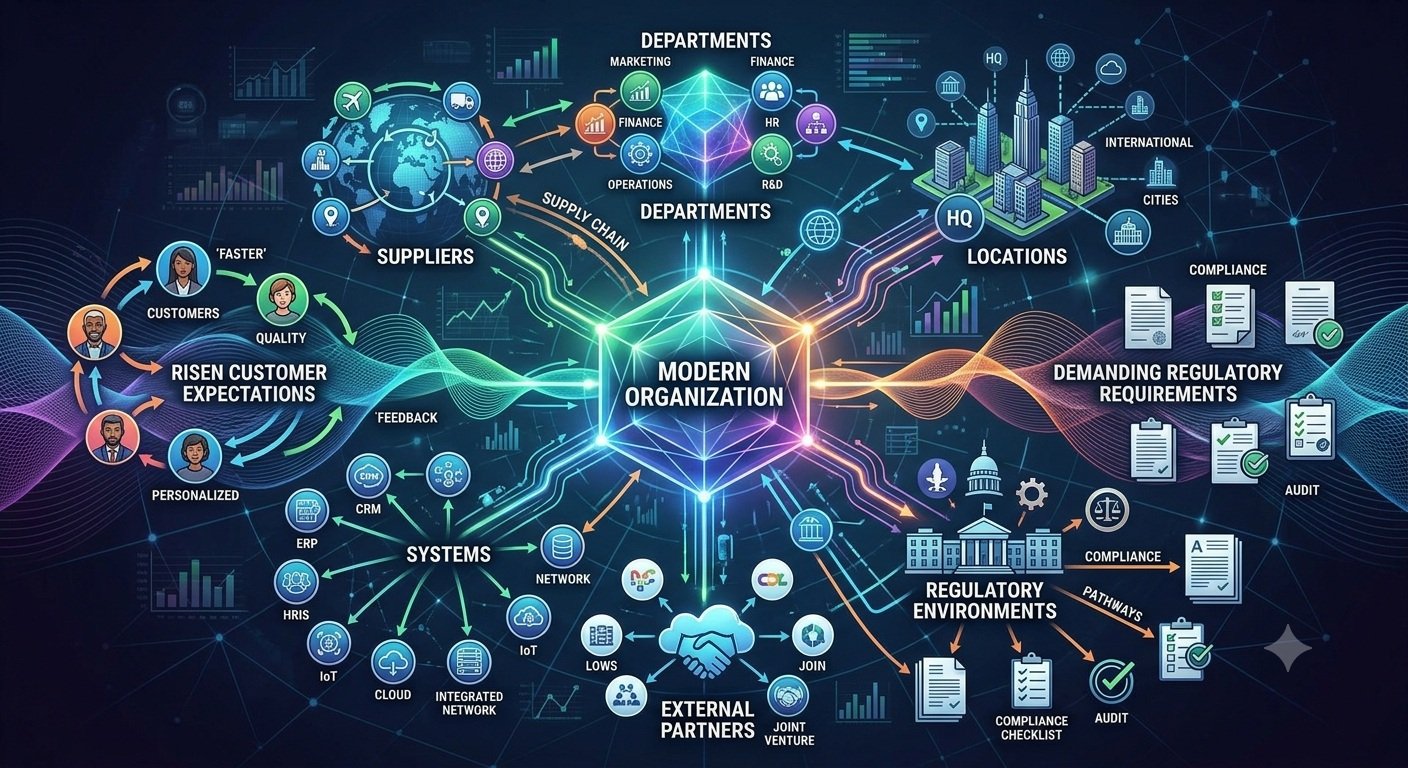
Modern organizations operate within increasingly complex environments. Business activities are distributed across departments, locations, suppliers, systems, and external partners. At the same time, customer expectations continue to rise while regulatory requirements become more demanding.
Under these conditions, even minor process weaknesses can have significant consequences. Delayed approvals can slow critical operations. Inconsistent decision-making can create confusion across departments. Poor process visibility can reduce management's ability to identify operational risks before they become serious problems.
Operational excellence helps organizations address these challenges by creating a framework for consistency and control. When processes operate effectively, organizations can respond more quickly to change, maintain higher levels of quality, improve customer satisfaction, and reduce the operational risks associated with growth.
Perhaps most importantly, operational excellence creates confidence. Business leaders gain greater visibility into operations, employees understand how work should be performed, and stakeholders can trust that organizational activities are being executed according to established standards.
The Relationship Between Processes and Operational Excellence
Every organization operates through a collection of business processes. Procurement activities, inventory management, customer service, finance operations, production activities, human resource functions, and approval workflows all rely on processes to achieve desired outcomes.
As a result, operational excellence is fundamentally dependent on process effectiveness.
When processes are poorly designed or inconsistently executed, operational performance inevitably suffers. Employees may interpret procedures differently, approvals may be handled inconsistently, and exceptions may be managed without sufficient oversight. Over time, these variations create inefficiencies, increase operational risk, and reduce organizational performance.
Conversely, when processes are standardized and consistently executed, organizations achieve greater predictability and control. Operational activities become easier to monitor, performance becomes easier to measure, and improvement opportunities become easier to identify.
This relationship explains why organizations pursuing operational excellence often invest heavily in process improvement initiatives. However, process improvement alone is not always sufficient.
Why Automation Alone Does Not Create Operational Excellence
Digital transformation has encouraged many organizations to automate large portions of their operations. Workflow systems, ERP platforms, business process management solutions, and enterprise applications have become common tools for improving efficiency and reducing manual work.
Automation undoubtedly contributes to operational excellence by accelerating activities, reducing administrative effort, and improving visibility into business operations. However, automation should not be confused with operational control.
A process can be automated while still allowing significant governance gaps to exist. Approvals may be routed electronically but assigned to inappropriate stakeholders. Business rules may exist but not be enforced consistently. Exceptions may still be handled outside established procedures. Critical decisions may remain difficult to audit or verify.
As organizations become more sophisticated, many discover that automation improves execution speed but does not necessarily improve process discipline. Activities may occur faster, yet underlying governance weaknesses remain unchanged.
This is why many organizations continue to experience compliance issues, operational failures, approval bypasses, and accountability gaps despite substantial investments in workflow automation technologies.
The Role of Governance in Operational Excellence
Operational excellence requires more than efficient execution. It requires processes that are governed effectively.
Business process governance provides the structure that enables organizations to maintain control over operational activities. It establishes the policies, approval requirements, responsibilities, controls, oversight mechanisms, and accountability structures necessary to ensure that processes operate according to organizational expectations.
Governance helps ensure that decisions are made by the appropriate individuals, approvals occur when required, exceptions are managed appropriately, and compliance requirements are consistently followed. It creates transparency regarding how work is performed and provides the auditability necessary to support operational accountability.
As organizations grow, governance becomes increasingly important because operational complexity naturally increases. More employees, more systems, more transactions, and more decision points create additional opportunities for inconsistency and risk. Governance provides the framework needed to manage this complexity while maintaining operational control.
In many respects, governance serves as the foundation upon which operational excellence is built. Without governance, organizations often become dependent on manual oversight and individual judgment. While this approach may function in smaller environments, it becomes increasingly difficult to sustain as operations expand.
Common Barriers to Operational Excellence
Many organizations pursue operational excellence but struggle to achieve sustainable results because underlying governance challenges remain unresolved.
One common challenge is inconsistent process execution. Employees may perform similar activities differently depending on their department, location, experience level, or interpretation of procedures. These variations create uncertainty and reduce operational predictability.
Another challenge involves approval management. Organizations frequently rely on emails, messaging platforms, spreadsheets, or verbal communication to manage approvals. While these approaches may appear flexible, they often reduce visibility, weaken accountability, and increase operational risk.
Exception management also presents significant challenges. Every organization encounters situations that fall outside standard procedures. Without structured governance, exceptions can be handled inconsistently, creating compliance concerns and increasing operational exposure.
Many organizations also struggle with accountability. When responsibilities are unclear, it becomes difficult to determine who approved decisions, who owns specific activities, and whether established controls were followed. These issues often remain hidden until they contribute to operational failures, audit findings, customer complaints, or financial losses.
How APES Supports Operational Excellence
APES (Automated Process Enforcement System) was designed to address one of the most common challenges organizations face when pursuing operational excellence: ensuring that business processes are consistently governed and enforced.
While many platforms focus primarily on workflow automation, APES functions as a governance and enforcement layer across operational processes. It helps ensure that business rules, approval requirements, segregation of duties, accountability mechanisms, and exception controls are consistently applied throughout the organization.
The platform works alongside existing ERP systems, workflow applications, operational platforms, and enterprise technologies. Rather than replacing existing investments, APES strengthens operational control by helping organizations ensure that critical processes are executed according to established policies and governance requirements.
This capability becomes increasingly valuable as organizations grow and operational complexity increases. By reducing reliance on manual oversight and improving process enforceability, organizations can strengthen accountability, improve auditability, and create a more controlled operating environment.
Conclusion
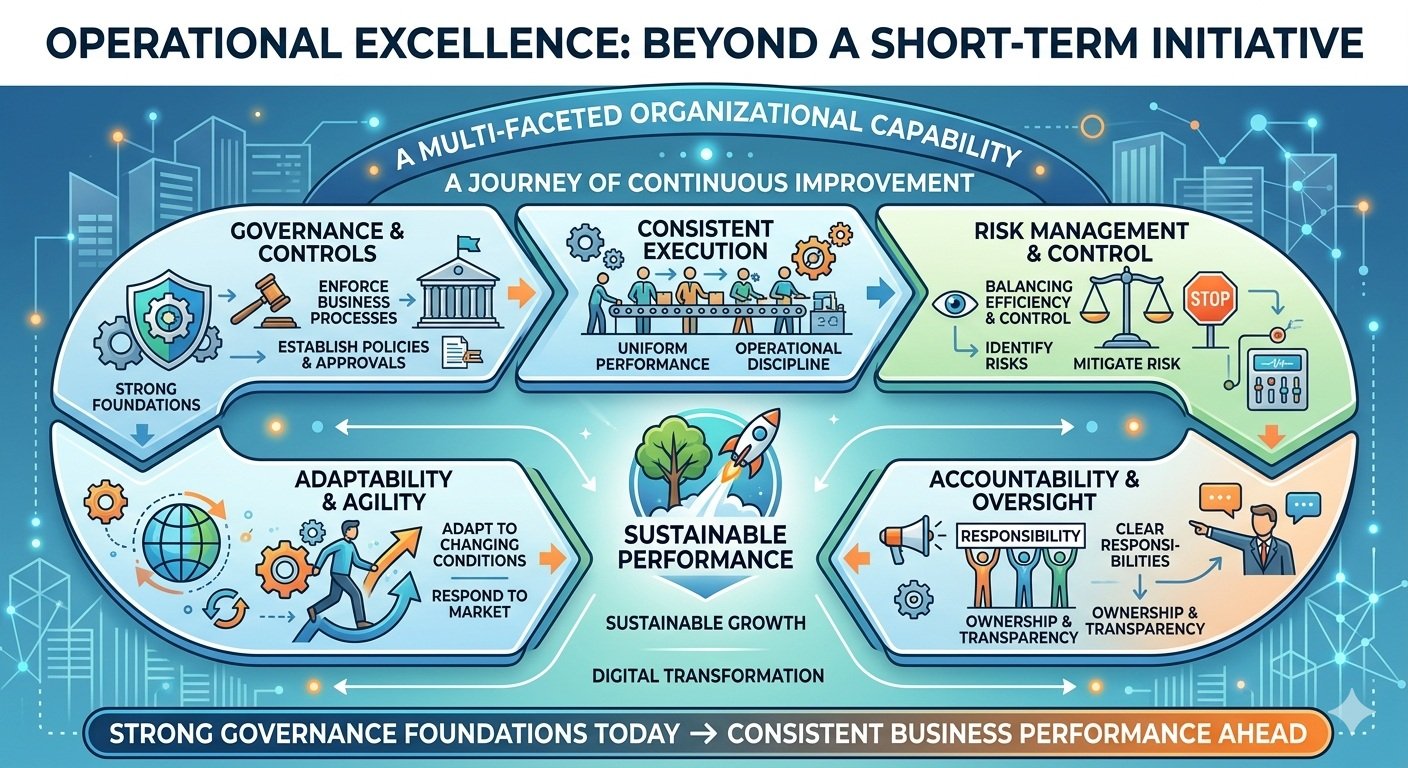
Operational excellence should not be viewed as a short-term initiative or a technology project. It is an organizational capability that develops through the continuous improvement of processes, governance structures, accountability mechanisms, and operational controls.
Organizations that achieve operational excellence understand that sustainable performance requires more than efficiency alone. It requires the ability to execute consistently, manage risk effectively, maintain accountability, and adapt to changing business conditions without sacrificing control.
As organizations continue to expand and digital transformation accelerates, operational excellence will increasingly depend on the ability to govern and enforce business processes across complex operational environments.
Organizations that establish strong governance foundations today will be better positioned to achieve sustainable growth, maintain operational control, and deliver consistent business performance in the years ahead.