Business Process Improvement: Driving Sustainable Operational Performance Through Structured Optimization
Business process improvement refers to the systematic approach of analyzing, redesigning, and enhancing organizational processes to achieve better efficiency, effectiveness, and consistency. It is a fundamental discipline within modern organizations, particularly those operating in complex and fast-changing environments where operational performance directly influences competitiveness and profitability. While often associated with cost reduction and productivity gains, business process improvement extends far beyond incremental efficiency enhancements. It focuses on creating processes that are more reliable, more scalable, and more aligned with organizational objectives.
Understanding Business Process Improvement
Business process improvement is the practice of evaluating how work is currently performed within an organization and identifying opportunities to enhance performance. This includes examining workflows, decision points, approval structures, resource allocation, and system interactions to determine where inefficiencies, delays, inconsistencies, or risks may exist. The objective is not only to make processes faster but also to make them more controlled, predictable, and resilient.
Effective business process improvement requires a clear understanding of how processes operate in practice rather than how they are documented. In many organizations, actual operational behavior differs significantly from formal procedures. This gap often leads to inefficiencies, compliance risks, and inconsistent outcomes. By addressing these gaps, organizations can align process execution with intended business outcomes.
Why Business Process Improvement Matters
As organizations grow, operational complexity increases across departments, systems, and geographical locations. More employees become involved in process execution, and more decisions are distributed across different levels of the organization. Without structured improvement efforts, this complexity can lead to fragmentation, inefficiency, and loss of control.
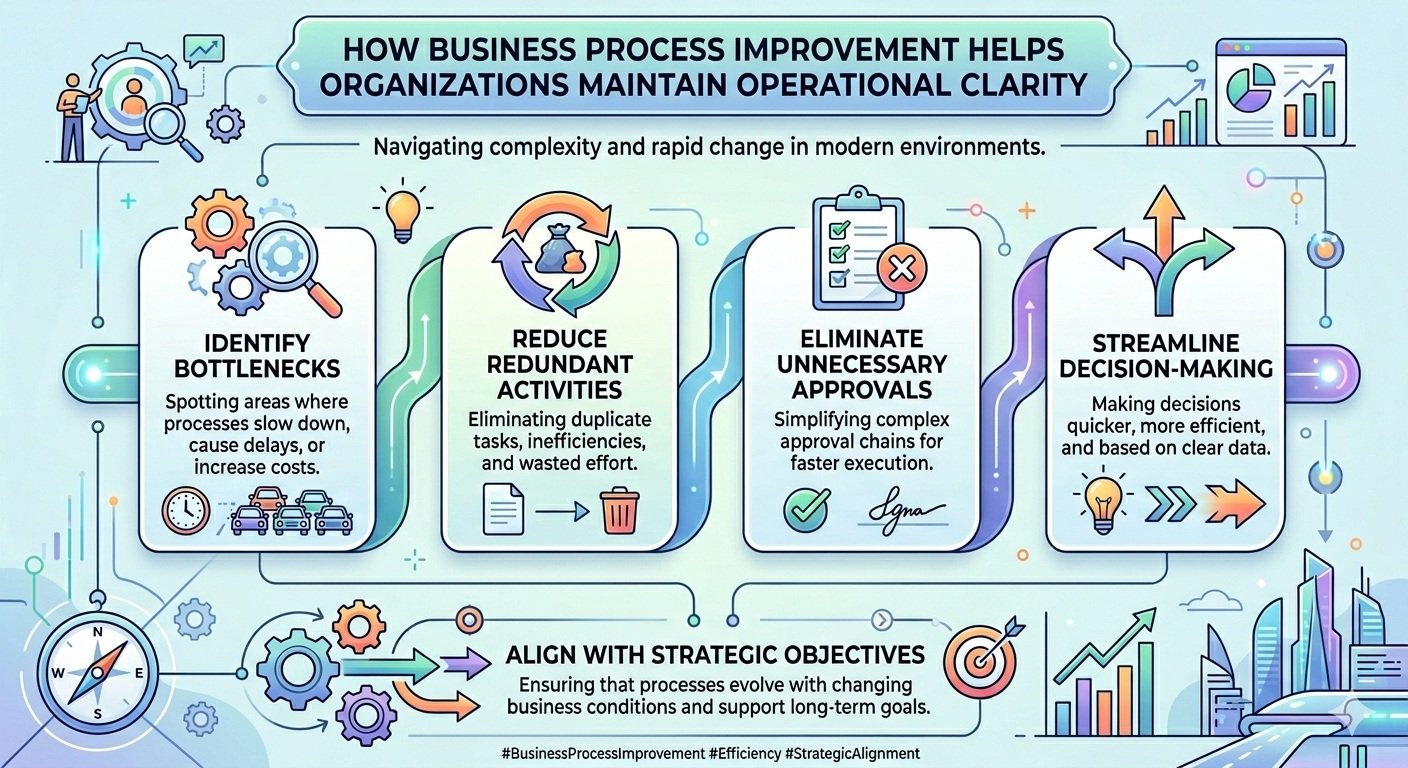
Business process improvement helps organizations maintain operational clarity in this environment. It enables leaders to identify bottlenecks, reduce redundant activities, eliminate unnecessary approvals, and streamline decision-making. More importantly, it ensures that processes remain aligned with strategic objectives even as business conditions evolve.
Organizations that invest in continuous business process improvement are better positioned to respond to change, maintain operational stability, and deliver consistent outcomes. This capability becomes especially critical in industries where compliance, quality, and accountability are essential to long-term success.
The Relationship Between Process Design and Execution
One of the most common challenges in business process improvement is the gap between process design and actual execution. Many organizations invest significant effort in designing workflows, documenting procedures, and implementing systems. However, execution often deviates from the intended design due to manual workarounds, inconsistent interpretations, or lack of enforcement.
This disconnect can reduce the effectiveness of even well-designed processes. Approvals may be bypassed, exceptions may be handled inconsistently, and responsibilities may become unclear across departments. As a result, operational performance becomes dependent on individual behavior rather than structured process design.
Effective business process improvement addresses this challenge by ensuring that process design is not only documented but also consistently enforced. This requires mechanisms that guide user behavior, standardize decision-making, and provide visibility into how processes are executed in real time.
Key Barriers to Business Process Improvement
Many organizations struggle to achieve meaningful business process improvement due to recurring structural challenges. One of the most common barriers is inconsistent process execution across teams and locations. When different groups interpret processes differently, operational variability increases and performance becomes difficult to manage.
Another significant barrier is the reliance on manual oversight for approvals and control enforcement. When governance depends heavily on individuals rather than systems, processes become vulnerable to delays, errors, and inconsistencies. This is especially problematic in environments with high transaction volumes or complex approval requirements.
A further challenge is limited visibility into process performance. Without clear data on how processes are executed, organizations struggle to identify inefficiencies or detect deviations from expected behavior. This limits their ability to make informed improvement decisions.
These barriers highlight the importance of not only designing better processes but also ensuring that those processes are properly governed and consistently executed.
The Role of Governance in Business Process Improvement
Business process improvement is closely linked to governance because sustainable improvement requires control and consistency. Governance provides the structure needed to ensure that processes operate according to defined rules, approval requirements, and accountability frameworks.
Without governance, process improvements may only deliver temporary benefits. Even optimized processes can degrade over time if they are not consistently enforced. Employees may revert to informal practices, bypass controls, or introduce variations that reduce effectiveness.
Governance strengthens business process improvement by embedding controls directly into operational workflows. It ensures that processes are executed as designed, that approvals are completed by the appropriate stakeholders, and that exceptions are managed within defined boundaries. This creates a stable foundation for continuous improvement.
Continuous Business Process Improvement as a Strategic Capability
Modern organizations increasingly view business process improvement as an ongoing capability rather than a one-time initiative. Business environments are constantly evolving due to changes in customer expectations, regulatory requirements, technology, and market conditions. As a result, processes must be continuously evaluated and refined.
Continuous business process improvement enables organizations to remain adaptive while maintaining operational control. It allows them to respond to inefficiencies as they arise, incorporate feedback from operational teams, and refine processes based on performance data.
Organizations that adopt this approach develop a culture of operational awareness and accountability. Employees become more engaged in identifying inefficiencies, and leaders gain better visibility into how work is performed across the organization.
Business Process Improvement and Operational Excellence
Business process improvement is a critical component of operational excellence. While operational excellence focuses on the overall ability of an organization to deliver consistent and high-quality outcomes, business process improvement provides the mechanisms through which this performance is achieved.
By continuously refining processes, organizations reduce inefficiencies, improve consistency, and strengthen control over operations. However, operational excellence cannot be achieved through improvement alone. It also requires governance, enforcement, and alignment between processes and organizational objectives.
When combined effectively, business process improvement and governance create a powerful foundation for sustainable performance. Processes become more efficient, more consistent, and more resilient to change, enabling organizations to operate at a higher level of maturity.
Building a Sustainable Improvement Framework
To achieve long-term success, organizations must move beyond isolated process improvement initiatives and establish a structured framework for continuous enhancement. This includes defining clear process ownership, establishing performance metrics, implementing governance mechanisms, and ensuring accountability across all operational levels.
A sustainable business process improvement framework enables organizations to maintain control while continuously evolving. It ensures that improvements are not only implemented but also sustained over time, reducing the risk of regression to inefficient practices.
Ultimately, organizations that prioritize structured business process improvement are better positioned to achieve operational stability, scalability, and long-term competitiveness in increasingly complex business environments.