Business Process Automation: How Organizations Improve Efficiency, Speed, and Scalability
Business Process Automation (BPA) has become one of the most important drivers of operational efficiency in modern organizations. As companies scale, manual processes that once worked in small teams begin to break down. Workflows become slower, approvals get delayed, and human errors become more frequent due to increased complexity and volume.
Automation is introduced to solve these challenges by allowing systems to execute repetitive and rule-based tasks with minimal human intervention. Instead of relying on employees to manually move data, route approvals, or send notifications, automation ensures these actions happen consistently and instantly based on predefined logic. This improves operational speed, reduces friction between teams, and allows organizations to handle larger workloads without proportionally increasing headcount.
However, while automation improves execution speed, it also introduces a new requirement for structured control, which becomes increasingly important as organizations grow.
What Business Process Automation Is
Business Process Automation refers to the use of technology systems to execute recurring business activities without continuous manual involvement. These processes are typically rule-based and follow predictable logic, which makes them suitable for automation.
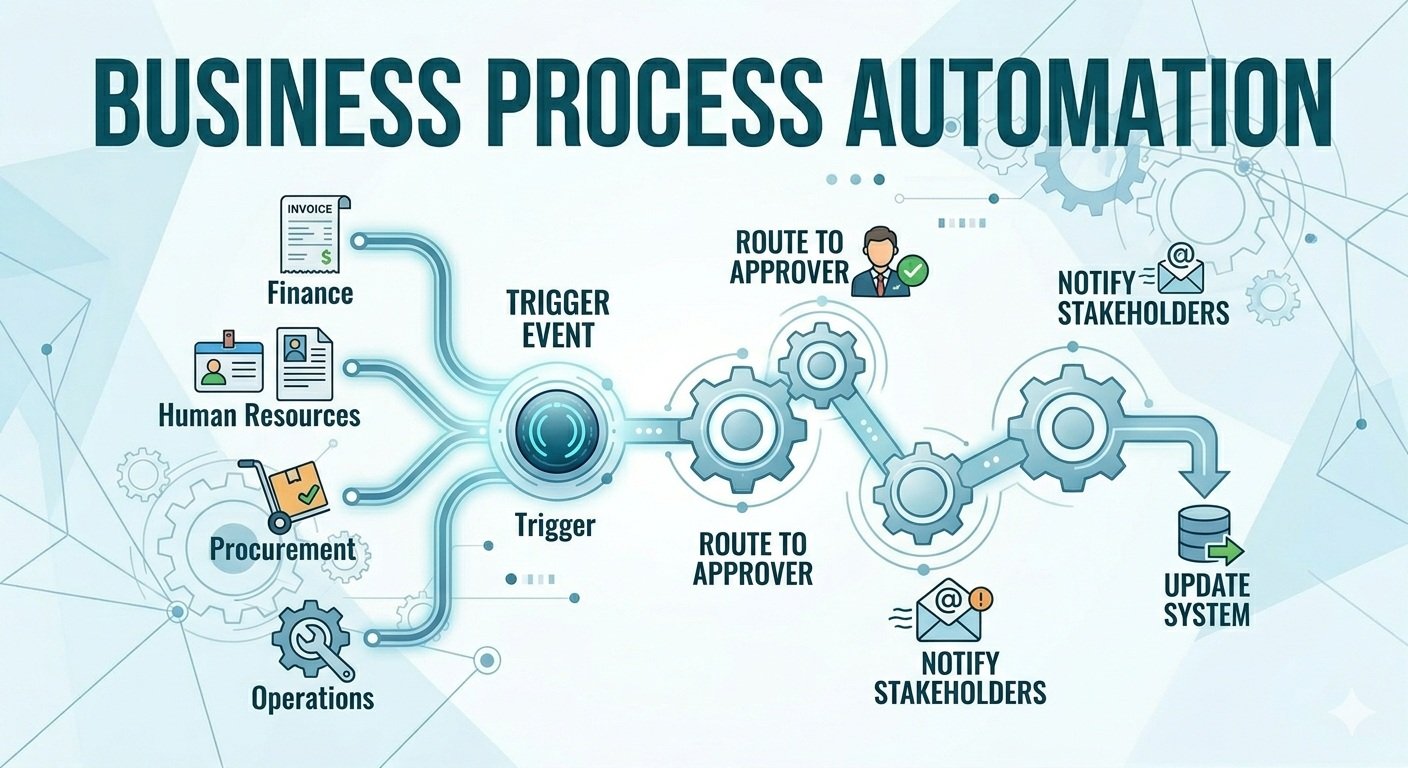
In a typical automated workflow, a trigger event initiates a series of system-driven actions. For example, when a purchase request is submitted, the system may automatically route it to the correct approver based on predefined rules, notify relevant stakeholders, and update the financial system once approval is completed. All of this happens without manual coordination between departments.
Automation is commonly used in areas such as finance, human resources, procurement, operations, and customer service. The goal is not only to reduce manual effort but also to ensure consistency in execution, where the same type of request always follows the same structured path regardless of who initiates it.
This consistency is what makes automation valuable at scale, especially in organizations where process volume is high and decision-making must remain standardized.
Why Organizations Adopt Automation
Organizations adopt Business Process Automation primarily to solve inefficiencies that naturally emerge in manual operations. As businesses grow, processes become more fragmented across teams, and communication overhead increases significantly. Tasks that were once simple and direct become dependent on multiple people, systems, and approvals.
Automation reduces this dependency on manual coordination by ensuring that processes move forward automatically based on logic rather than human follow-up. This leads to faster execution cycles, fewer delays, and reduced operational friction. It also significantly lowers the risk of human error, especially in repetitive tasks such as data entry, approval routing, and reporting.
Another key reason organizations adopt automation is cost efficiency. By reducing the time employees spend on repetitive tasks, companies can reallocate human resources toward higher-value activities such as strategy, analysis, and customer engagement. Over time, this improves overall productivity without increasing operational complexity.
At the same time, automation improves customer experience by reducing response times and ensuring more predictable service delivery.
Common Use Cases of Automation
Business Process Automation is widely applied across different departments because most business functions involve repetitive workflows that follow predictable patterns.
In finance, automation is often used to manage invoice processing, expense approvals, and payment reminders. These processes require accuracy and consistency, making them ideal for rule-based execution. Automation ensures that financial workflows move quickly while still following defined approval structures.
In human resources, automation supports employee onboarding, leave management, and payroll processing. Instead of manually coordinating between HR, IT, and department managers, systems can automatically trigger onboarding steps when a new employee is added, ensuring a smooth and standardized experience.
In operations and supply chain management, automation helps track inventory levels, process purchase orders, and manage vendor workflows. These processes often involve multiple systems and stakeholders, making automation critical for maintaining real-time accuracy.
In customer service, automation is used to route support tickets, send acknowledgment responses, and track service-level agreements. This ensures that customer issues are handled consistently and escalated when necessary.
Across all these use cases, the main value of automation lies in reducing manual coordination while improving speed and reliability.
Challenges of Business Process Automation
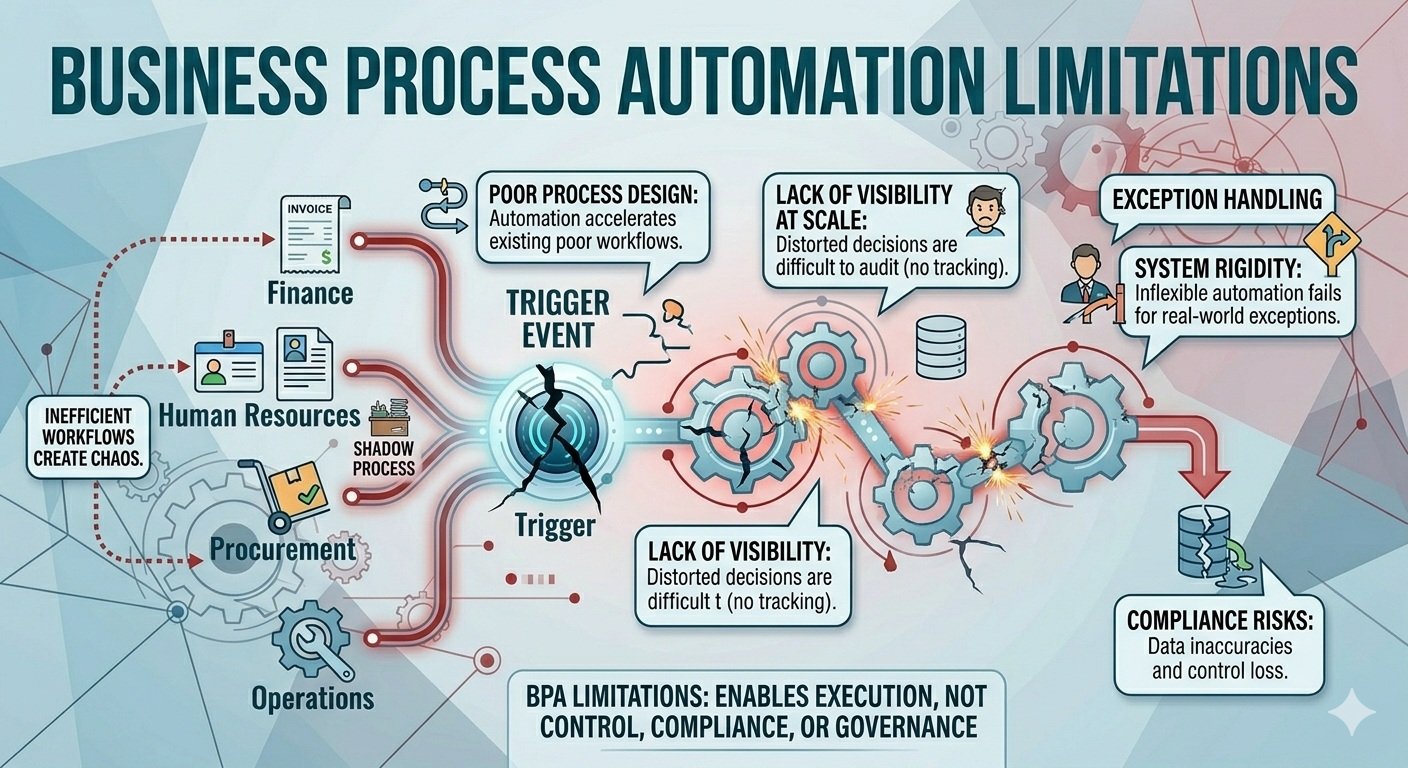
Despite its benefits, Business Process Automation is not without limitations. One of the most common challenges is that automation often accelerates existing processes without improving their quality. If a workflow is poorly designed or inconsistent, automating it simply makes inefficiency happen faster.
Another challenge is the lack of visibility into how automated processes operate at scale. Once workflows are automated, it can become difficult for organizations to understand why certain decisions were made or how exceptions were handled, especially if proper tracking and audit mechanisms are not in place.
Automation can also struggle with flexibility. While it works well for structured and predictable workflows, real-world business environments often include exceptions that do not fit neatly into predefined rules. If systems are too rigid, employees may find ways to bypass automation entirely, creating shadow processes outside the official system.
These challenges highlight an important reality. Automation alone does not guarantee control, compliance, or governance. It only ensures execution.
Why Automation Alone Is Not Enough
This is where many organizations develop a critical blind spot. While automation improves speed and reduces manual effort, it does not inherently ensure that the correct process is being followed.
Automation does not validate whether the right approval hierarchy was applied, whether policy rules were correctly enforced, or whether exceptions were properly handled and documented. It simply executes whatever logic it has been given, regardless of whether that logic reflects real governance requirements.
As a result, organizations may unintentionally scale process errors. A poorly defined approval rule or missing control can be executed thousands of times flawlessly by automation, creating systemic risk without immediate visibility.
In other words, automation increases efficiency, but it does not guarantee correctness, accountability, or compliance. Without additional structure, organizations risk turning speed into uncontrolled execution.
The Need for Governance and Enforcement
To address this gap, organizations need a governance and enforcement layer that sits above automation and ensures that processes are not only executed but also controlled.
Governance defines how processes should behave, including rules, roles, approval structures, and accountability frameworks. Enforcement ensures that these rules are actively applied during execution rather than being treated as guidelines.
With this layer in place, every workflow becomes controlled by design. Approvals follow defined structures, exceptions are automatically flagged and managed, and every action is recorded for auditability. This ensures that automation does not operate in isolation but instead functions within a controlled operational environment.
Governance and enforcement also introduce real-time visibility, allowing organizations to detect deviations as they occur rather than discovering them after problems arise. This shifts process management from reactive to proactive control.
Conclusion
Business Process Automation is a powerful foundation for improving efficiency, reducing manual effort, and enabling organizations to scale their operations. However, it is not sufficient on its own to ensure operational control or compliance.
True operational excellence requires a combination of both automation and structured governance. Automation handles execution, while governance and enforcement ensure that execution follows the correct rules, approvals, and accountability structures.
Appnicorn provides a governance and enforcement layer that strengthens automation by standardizing business processes, enforcing rules consistently, and ensuring full visibility and accountability across organizational workflows. To learn how this can work for your organization, request a free governance assessment report and identify gaps in your current process controls.