What Happens in the First 24 Hours After a Data Breach?
Nobody gets a clean alert saying “breach detected, here is exactly what happened.” It usually starts messier than that. A customer emails saying they're getting suspicious login attempts. An employee notices a folder of records that shouldn't be accessible to everyone suddenly is. A vendor quietly mentions their own system was compromised, and you realise your data was sitting inside it. Or an IT team member spots something odd in the logs late on a Friday and isn't sure yet whether it's actually serious.
In that first stretch of time, nobody knows the full picture. What separates organisations that get through this cleanly from those that turn a manageable incident into a much bigger mess almost never comes down to the breach itself. It comes down to what happens, and how it's recorded, in the confused hours right after someone first realises something is wrong.
The problem with figuring it out as you go
Without a plan already in place, those first hours tend to go the same way almost everywhere. Someone realises something's wrong and isn't sure who else needs to know. A few people start looking into it informally, on their own initiative, often duplicating each other's work or missing pieces entirely because nobody's coordinating. Decisions get made verbally, in hallway conversations or quick calls, with nothing written down about what was found or why a particular action was taken. And underneath all of it, the clock is running on things nobody's tracking yet, like how long it's actually taken to understand what happened and what needs to happen next.
This isn't a failure of effort. People in this situation are usually working hard and taking it seriously. The failure is structural: there's no defined place for this information to go as it comes in, so it scatters across memories, private messages, and half-finished notes, and that scattering is exactly what makes the incident harder to manage and nearly impossible to explain properly afterward.
What actually needs to be happening
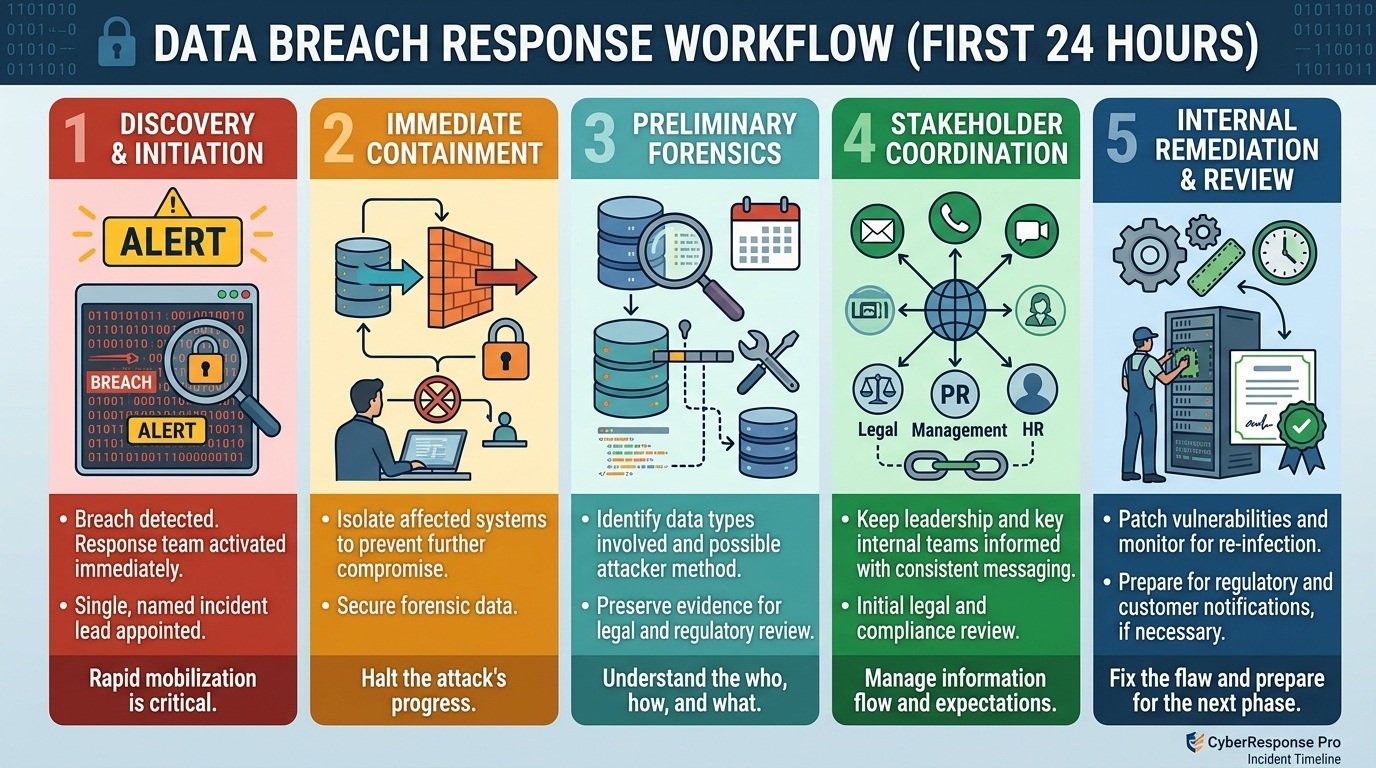
Strip away the panic and a breach response really comes down to a handful of things that need to happen consistently, and need to be written down as they happen, not reconstructed afterward from memory.
The key details need to be captured as soon as they're known: what was discovered, when, by whom, and what data or systems appear to be involved. Even an incomplete picture is worth recording immediately, because that record is what everything else gets built on, and because memory of exactly when something was noticed fades fast under stress.
An investigation needs to actually happen, with whoever's looking into it able to add findings as they go rather than holding everything in their head until they're ready to present a finished conclusion. Incidents rarely resolve in one sitting, and a half-finished investigation that lives only in someone's head is fragile in a way a written, updated record isn't.
Corrective action needs a place to be tracked too, whatever that looks like in a given case: cutting off access, resetting credentials, patching a vulnerability, notifying an affected system's vendor. Each action taken needs to be visible, not just remembered by whoever did it.
Evidence needs to be kept as it's gathered, not collected in a rush right before someone has to explain what happened. This matters more than it might seem at the time, because evidence gathered calmly during the response is far more reliable than evidence reconstructed under pressure weeks later.
And the whole thing needs a clear resolution status that actually gets updated, so anyone looking in, whether that's management, legal, or an external party, can see at a glance whether this is still active, under control, or fully closed.
Why the scattered version costs more than it looks like at first
The real cost of an unstructured response rarely shows up in that first week. It shows up later, when someone needs a clear account of what happened. A customer whose data was involved asks exactly what occurred and what was done about it. Legal counsel needs a timeline before advising on next steps. Management wants a summary before a board meeting. A regulator, if the incident is serious enough, asks for a full account of the investigation and the corrective actions taken.
In every one of those moments, “we handled it, and I think it went fine” is a very different answer from a clear, dated record showing exactly what was found, what was done, and when it was resolved. Organisations that struggle most after a breach usually aren't the ones where something went wrong. Something going wrong is close to inevitable eventually, at some scale, for almost every organisation handling personal data. The ones that struggle are the ones who can't clearly show, afterward, that they responded properly.
What a structured approach actually changes
None of this requires exotic tools or a dedicated security team the size of a large enterprise's. What it requires is a defined place where an incident gets logged the moment it's suspected, where investigation notes accumulate as they're found rather than being held in someone's head, where corrective actions get tracked as they're taken, and where the whole thing has a visible status instead of living as an assumption that “someone's on it.”
This is precisely why incident and breach management is treated as its own structured process inside a proper data protection management system, rather than something handled ad hoc through email and memory each time. The goal isn't to remove the stress of a real incident, that stress is somewhat unavoidable. The goal is to make sure that stress doesn't also cost the organisation its ability to explain, clearly and with evidence, exactly what it did about it.
This applies the moment you hold personal data, not just after something happens
It's tempting to think of breach response as something to figure out once it's actually needed. In practice, the organisations that handle it well are the ones who built the structure before anything went wrong, the same way a fire extinguisher only works because it was already on the wall, not because someone went shopping for one during the fire. Any organisation holding customer, employee, patient, tenant, or user data, whether that's a SaaS company, a healthcare provider, an e-commerce business, or a multi-branch service operator, carries this exposure already, whether or not anyone's tested how the organisation would actually respond.
Building the habit before the Friday night phone call
Most organisations never plan to have a breach. It's not a scheduled event, it arrives at an inconvenient time, discovered by someone who wasn't expecting to be the one dealing with it. What determines how that day goes isn't whether the organisation is somehow immune to incidents. It's whether there's already a clear, structured place for the response to happen the moment it's needed, instead of being invented from scratch while everyone's already under pressure.
If your organisation's current plan for a breach is “we'll figure out what to do when it happens,” that gap is worth closing now, while there's no pressure attached to closing it.