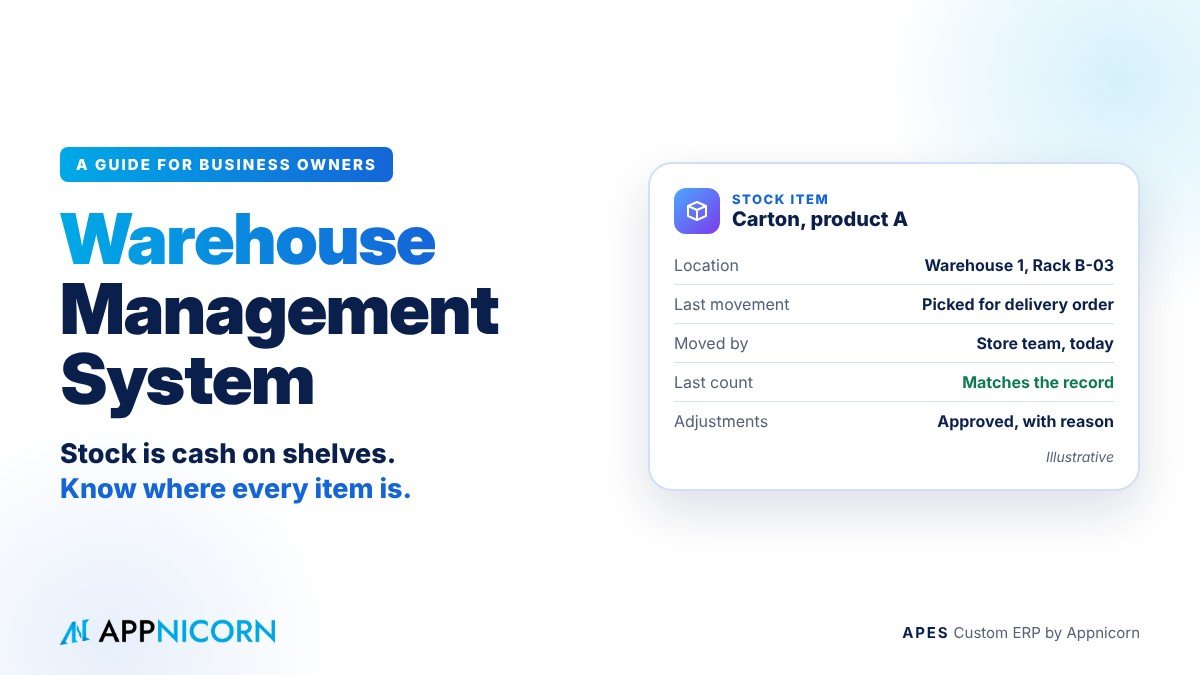
Walk into almost any growing distributor or trading company and ask a simple question: how much of this item do we have, and where is it? Very often, the answer takes a while. Someone checks a spreadsheet, someone else walks to the racks, and the two numbers do not quite agree. The system says there are forty cartons. The shelf has thirty-four. Nobody is sure where the other six went.
For a director, that gap is not a warehouse problem. It is a money problem. Stock is cash sitting on shelves. When the business cannot see it clearly, it buys too much of some items and too little of others, promises deliveries it cannot make, and quietly writes off stock that went missing months ago.
A warehouse management system exists to close that gap. This guide explains what one does, why it matters to the people who run the business rather than just the people who run the warehouse, which controls directors should insist on, and how to put one in place without disrupting your daily operations.
What a warehouse management system does
A simple stock list tells you how much of each item you have. A warehouse management system tells you much more: where each item is, how it got there, where it is going next, and who moved it.
It follows stock through every stage of its life in the warehouse. Goods are received against a purchase order, so what arrived can be compared with what was ordered. They are put away into a known location. When a customer order comes in, the system tells the team what to pick and from where. The goods are packed and dispatched against a delivery order. Stock that moves between locations or branches is transferred on record. Counts are carried out regularly and any differences are investigated. Returns are inspected and either put back into stock, repaired or written off.
At every step, the movement is recorded. The result is a single, reliable figure for each item, by location, at any moment.
Why the warehouse matters to the boardroom
It is tempting to treat the warehouse as an operational detail. In reality, it touches almost every number a director cares about.
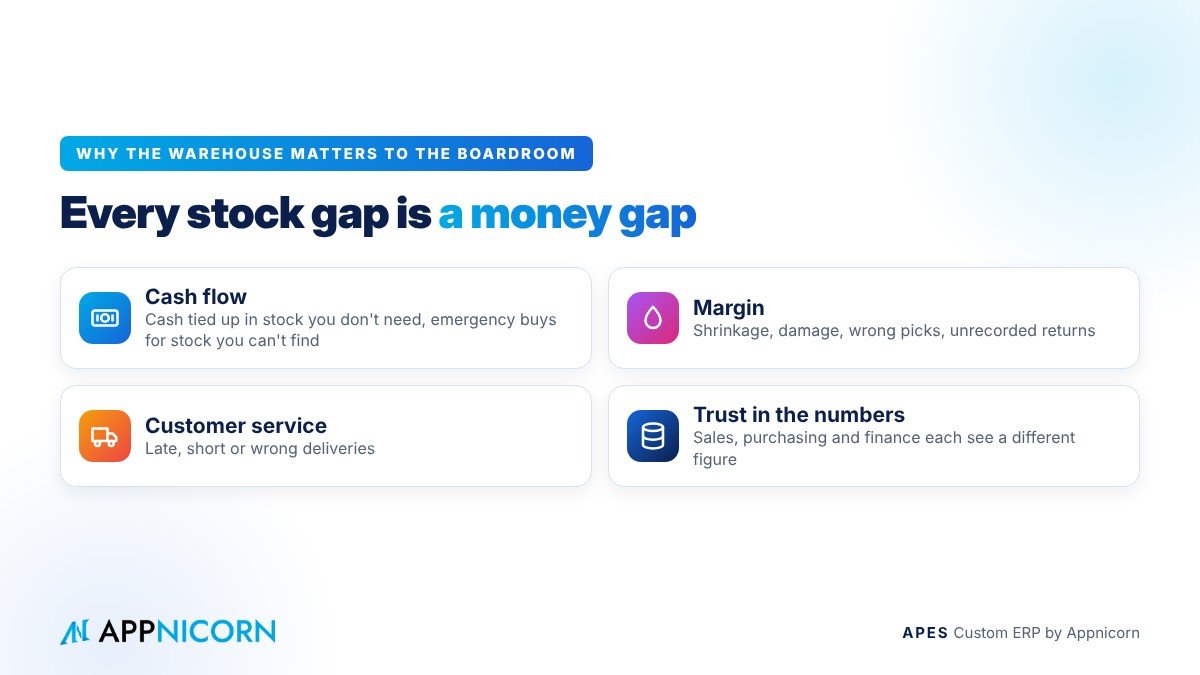
Cash flow is the first. Stock that is not needed ties up money that could be used elsewhere, while stock that cannot be found leads to emergency purchases at worse prices. Both are avoidable when the business can see exactly what it holds.
Margin is the second. Shrinkage, damage, wrong picks and unrecorded returns all reduce profit, and they are usually discovered long after they happened, at a stock take, when it is too late to find the cause.
Customer service is the third. Late deliveries, part deliveries and wrong items cost customers, and they almost always trace back to stock information that was wrong or out of date.
And the fourth is trust in the numbers. When sales, purchasing and finance each work from different stock figures, every decision about ordering, pricing and promising delivery is a guess.
Signs your warehouse has outgrown its current tools
A few signs are very common. The stock count rarely matches the records, and the difference is simply adjusted without explanation. Staff walk the racks to check availability before confirming an order. Items are hard to find because locations are not recorded, or are recorded only in someone's memory. Purchasing reorders based on a figure they do not fully trust. Write-offs and stock adjustments are made without anyone senior seeing them. Deliveries go out with wrong or missing items, and nobody can easily trace why. And the warehouse depends on one or two experienced people who know where everything is.
If several of these sound familiar, the issue is unlikely to be effort. It is that the warehouse is being run on tools that were never designed to control it.
How a warehouse system works, flow by flow
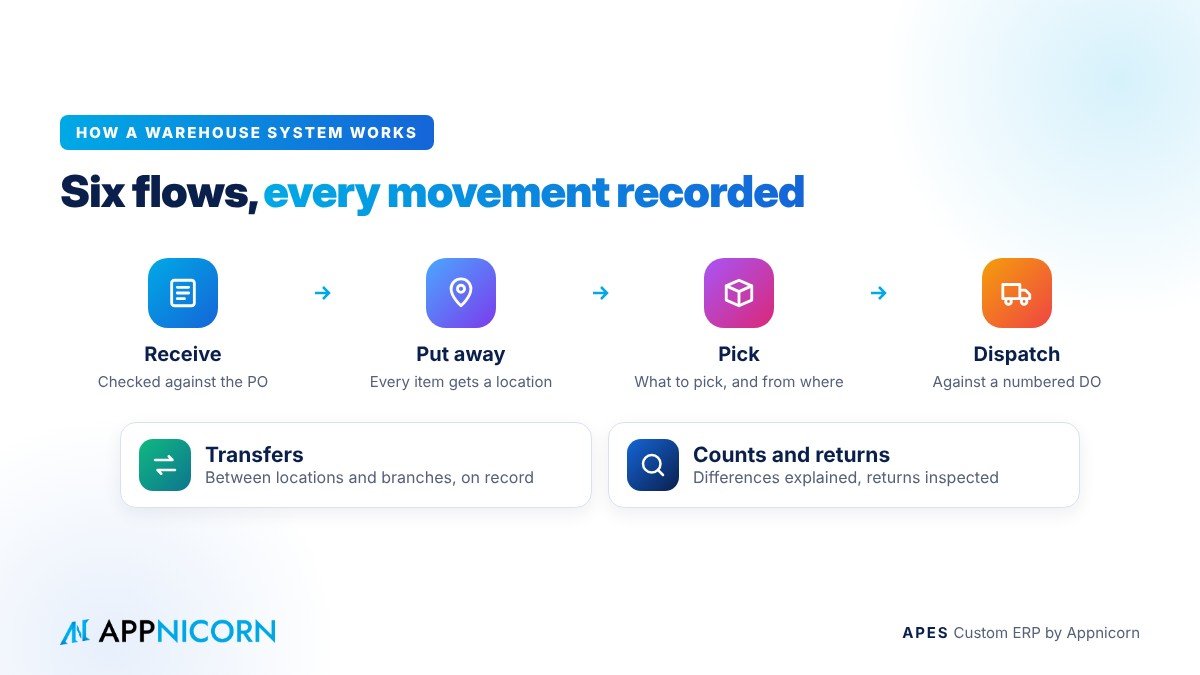
It helps to think of the warehouse as a handful of flows, each with its own record and its own checks.
Receiving is where control starts. Goods are checked against the purchase order on arrival, and any shortfall, excess or damage is recorded there and then. This protects the business from paying for goods it never received.
Put-away gives every item a home. When stock is placed in a known location, it can be found quickly and counted accurately.
Picking and dispatch turn customer orders into deliveries. The system tells the team what to pick and from where, and the delivery order records exactly what left the building and when.
Transfers move stock between locations, warehouses or branches on record, so stock never disappears in transit between two spreadsheets.
Counts, ideally done in small regular cycles rather than one large annual stock take, keep the records honest. Differences are recorded with a reason rather than silently corrected.
Returns are inspected before they go anywhere, so damaged goods are not put back on the shelf and resold.
The controls directors should insist on
A warehouse system is only as good as the controls built into it. A few matter more than the rest.
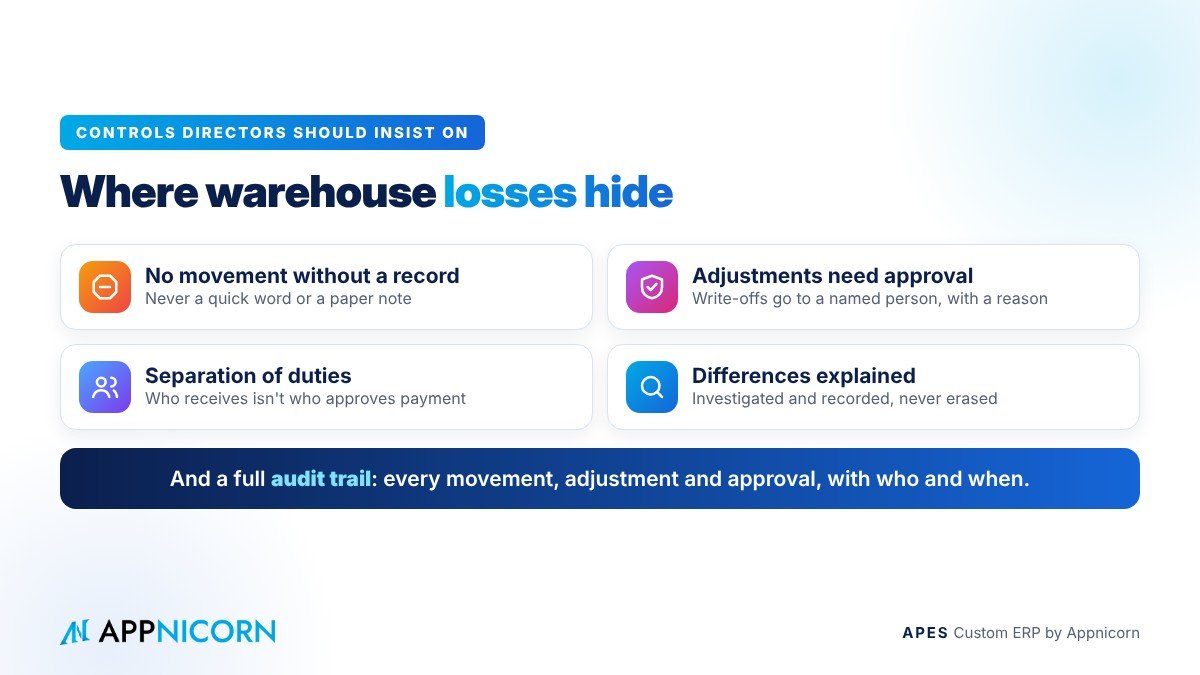
No movement without a record. Stock should only enter, move or leave through the system, never by a quick word or a note on paper. This is the single most important rule.
Adjustments need approval. Any write-off, stock correction or change to recorded quantities should go to a named person for approval, with a reason. In many businesses this is where losses hide.
Separation of duties. The person who receives goods should not be the same person who approves payment for them, and the person who counts stock should not be the only person who can adjust it.
Differences are explained, not erased. When a count does not match, the difference should be investigated and recorded, so patterns become visible over time.
A full audit trail. Every movement, adjustment and approval should be recorded with who did it and when, so any question can be answered from the record.
What management should be able to see
With these flows and controls in place, management can see the warehouse clearly without walking it. They can see stock by item and by location, goods that have been ordered but not yet received, customer orders waiting to be picked or dispatched, stock that has not moved for a long time, and every adjustment and write-off, with its reason and approver.
That visibility changes the conversation. Instead of discovering at the year-end stock take that something went wrong, managers can act while it is still small.
Why warehouses need a system built around them
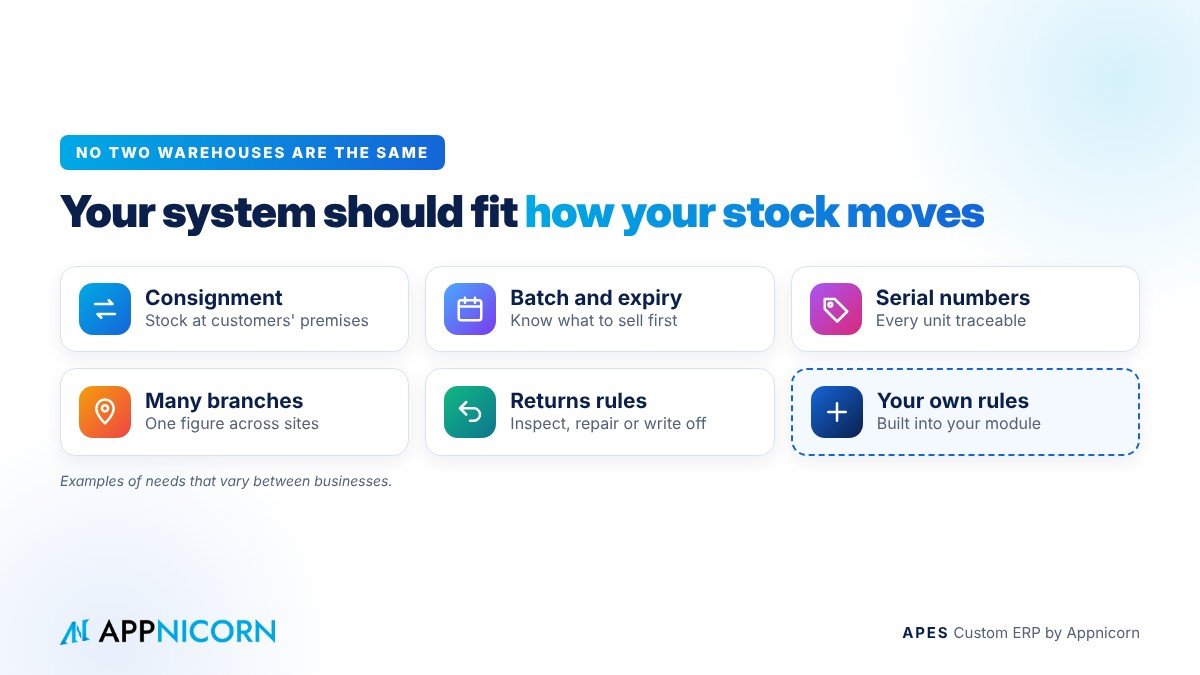
Warehouses differ far more than most software assumes. One business sells on consignment and must track stock that sits at a customer's premises but still belongs to them. Another must track batches and expiry dates. Another needs serial numbers for every unit. Some work across several branches or warehouses, some have their own way of naming locations, and many have special rules for returns, samples or demonstration units.
When a system cannot hold these realities, the warehouse team fills the gaps with spreadsheets and paper, and the reliable single figure the business wanted never appears. This is why so many companies find that a warehouse system built around their own flows and rules works far better than one that asks them to change how the warehouse runs.
The warehouse as part of a wider system
A warehouse system is most valuable when it is connected to the rest of the business. Purchasing tells the warehouse what to expect. Sales tells it what to pick. Delivery records what left. Finance knows what was received and what was dispatched, so it can pay and bill accurately.
When all of these work from the same records in one workspace, a confirmed sales order can reserve stock, a low stock level can prompt a purchase request, and a completed delivery can tell finance to invoice. That connection is what turns a warehouse system into part of an ERP.
How to put it in place without disruption
Warehouses cannot stop while a new system is introduced, so the rollout needs to be practical.
Start with clean basic information: a clear list of items, units and locations. Label the locations physically so the system and the shelves use the same names.
Choose a first flow. For many businesses that is receiving and dispatch, because those are where stock enters and leaves. For others it is counts and adjustments, because that is where losses are hiding.
Run a full count before going live, so the system starts from a figure everyone trusts. Then make the system the only way to move stock. Paper running alongside the system will quickly undermine it.
Finally, introduce regular cycle counts and review the differences each month. Over time, the gap between the records and the shelves narrows, and the business starts to trust its own numbers.
Common mistakes to avoid
Starting with poor data is the most common. If item codes, units and locations are inconsistent, the system will inherit the confusion.
Keeping paper alongside the system is the second. It creates two versions of the truth and staff will drift back to the old one.
Making it too complicated is the third. Every extra step slows the warehouse team. Build the controls that matter and keep the rest simple.
And leaving it without an owner is the fourth. Someone senior needs to own stock accuracy, review adjustments and act on what the numbers show.
APES: a warehouse system built around how your stock moves
APES (said "A-pes") is a custom ERP made by Appnicorn, a Malaysian IT company with years of experience building business systems. Every module in APES is customised to your company's unique needs, and stock and warehouse processes are among the areas where that matters most. APES already runs in production for consignment distribution, one of the more demanding ways to manage stock.
In APES, your receiving, put-away, picking, dispatch, transfers, counts and returns can each follow your own steps, with your own locations, documents and rules. Adjustments and write-offs go to the right people for approval, with deadlines and escalation so nothing waits forgotten. Documents such as delivery orders are numbered under control, and every movement and decision is kept in a tamper-evident audit trail. Because each business works in its own workspace, the warehouse sits alongside purchasing, sales, delivery and claims, all working from the same records. If your business needs a module that does not exist yet, Appnicorn designs and builds it with you.
AI works inside APES as a governed assistant. It can read and summarise documents such as supplier delivery notes and draft the next step, but it never acts beyond the rights of the person it works for, and a person always makes the decision.
Pricing depends on the process being built, so the best first step is a conversation. Show us where your business is losing money. Bring your last stock count, the differences you could not explain, and how stock moves through your warehouse today, and we will show you how it would run in APES.
Talk to Appnicorn about a warehouse system built around your business.