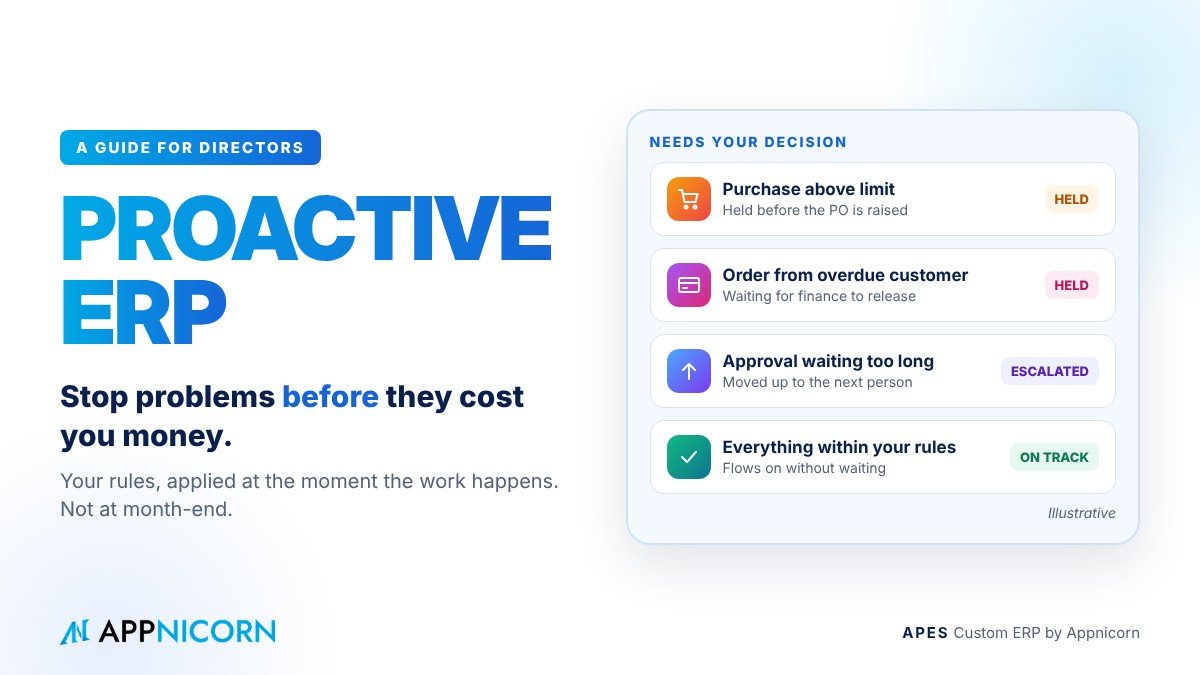
Every director knows the feeling. The month-end report lands, and there it is: a supplier paid twice, a customer who was allowed to keep ordering long after they stopped paying, a project that quietly went over budget weeks ago. The information was in the business all along. It simply reached you after the money had gone.
Most companies are run this way, and not because their managers are careless. It is because most of the tools a business relies on are built to record what happened, not to act while it is happening. Spreadsheets store numbers. Chat groups store messages. Even many business systems are, at heart, very good filing cabinets. They tell you, accurately and in detail, what went wrong last month.
A proactive ERP works differently. Instead of waiting for someone to look at a report, it applies your company's rules at the moment the work is done: before the purchase is committed, before the order is accepted, before the deadline is missed. This guide explains what that means in practice, how it works, where it pays off, and how to put it in place without burying your team in rules and alerts.
Reactive and proactive: what is the difference?
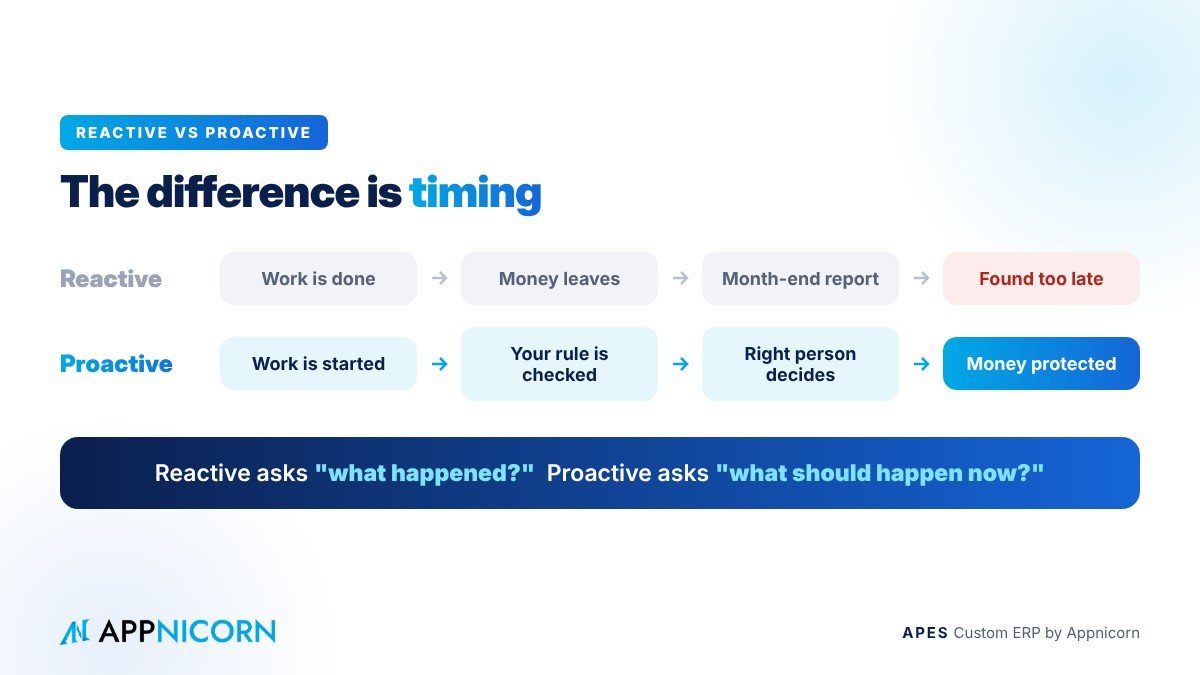
A reactive system answers the question "what happened?". It is useful, and every business needs it. But by the time the answer arrives, the decision has already been made, the goods have already shipped and the payment has already gone out. All management can do is investigate, recover what it can and promise to do better next time.
A proactive system answers a different question: "what should happen now?". It knows the rules you have set, such as spending limits, credit terms, required documents and response times, and it checks them at the point of action. If a request is within the rules, the work moves on without delay. If it is outside them, the system holds it, asks the right person to decide, and keeps a record of what was decided.
The difference is not the amount of information. It is the timing. A reactive business learns about a problem at month-end. A proactive business deals with it while there is still time to change the outcome.
Why most businesses end up running reactively
Very few companies choose to be reactive. They drift into it as they grow.
In the early years, the owner sees everything. Every purchase, every discount, every late payment crosses their desk, so problems are caught by instinct. As the business adds staff, departments and branches, that personal oversight thins out. The rules still exist, but they live in the owner's head, in an old policy file, or in the habits of a few experienced staff.
At the same time, the work spreads across separate tools. Requests arrive by WhatsApp. Approvals are a quick "ok" in a chat group. Stock is tracked in Excel, purchase orders are typed in Word, and deliveries are recorded on paper. None of these tools knows your rules, and none of them can stop anything. They can only store what people tell them.
The result is a business where control depends on someone noticing. When the right person happens to look at the right moment, problems are caught. When they do not, the problem surfaces later, usually in the accounts.
What a proactive ERP actually does
An ERP is one system that connects the main activities of a business, such as purchasing, stock, sales, delivery and claims, so that information is entered once and shared by everyone who needs it. A proactive ERP adds one important idea: the system does not just hold the work, it applies your rules to it as it moves.
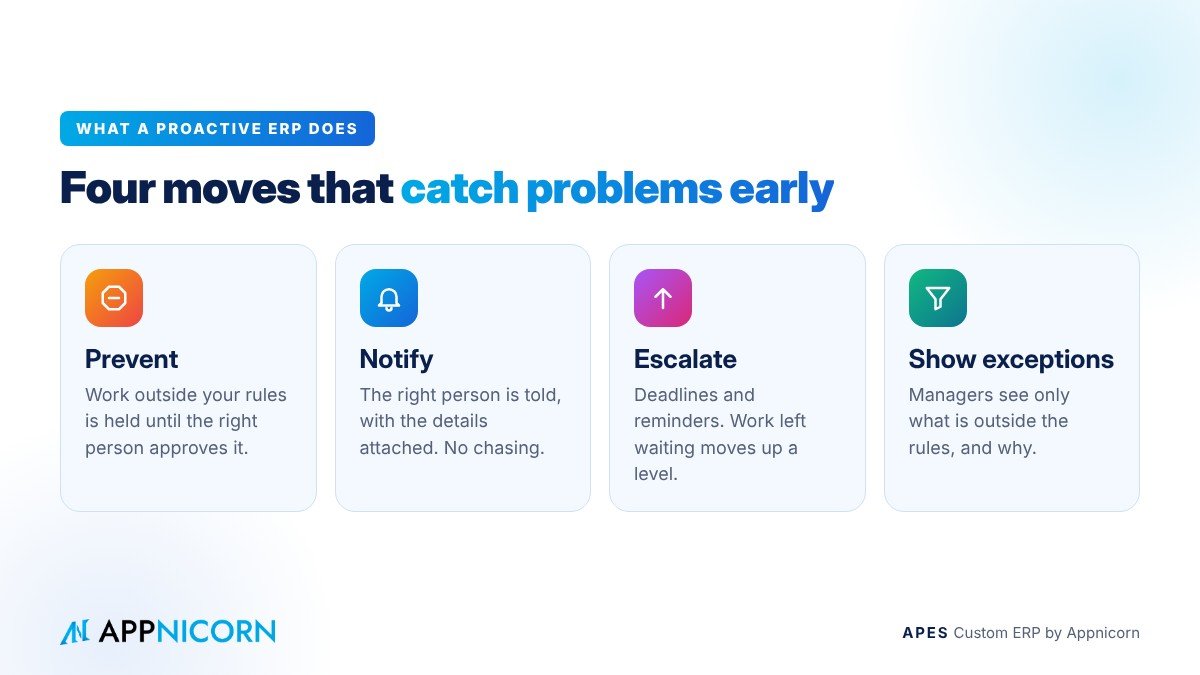
In practice, that comes down to four kinds of action.
The first is prevention. Some things should not happen without a check, and a proactive ERP makes the check unavoidable. A purchase above a set amount cannot become a purchase order until the right person has approved it. An order from a customer past their credit terms is held until finance releases it. A job cannot be closed until the required checklist is complete.
The second is notification. When something needs attention, the right person is told, inside the system, with the details attached. Nobody has to remember to forward a message or chase a colleague for an update.
The third is escalation. Work that waits too long does not simply sit there. Deadlines are attached to tasks, reminders go out as they approach, and if a request is still waiting when the deadline passes, it moves up to the next person. Stuck approvals stop being invisible.
The fourth is visibility by exception. Instead of reading every report line by line, managers see what is outside the rules: what is waiting for them, what is overdue, what was held and why. Everything that is running normally stays out of the way.
Where proactive control pays off
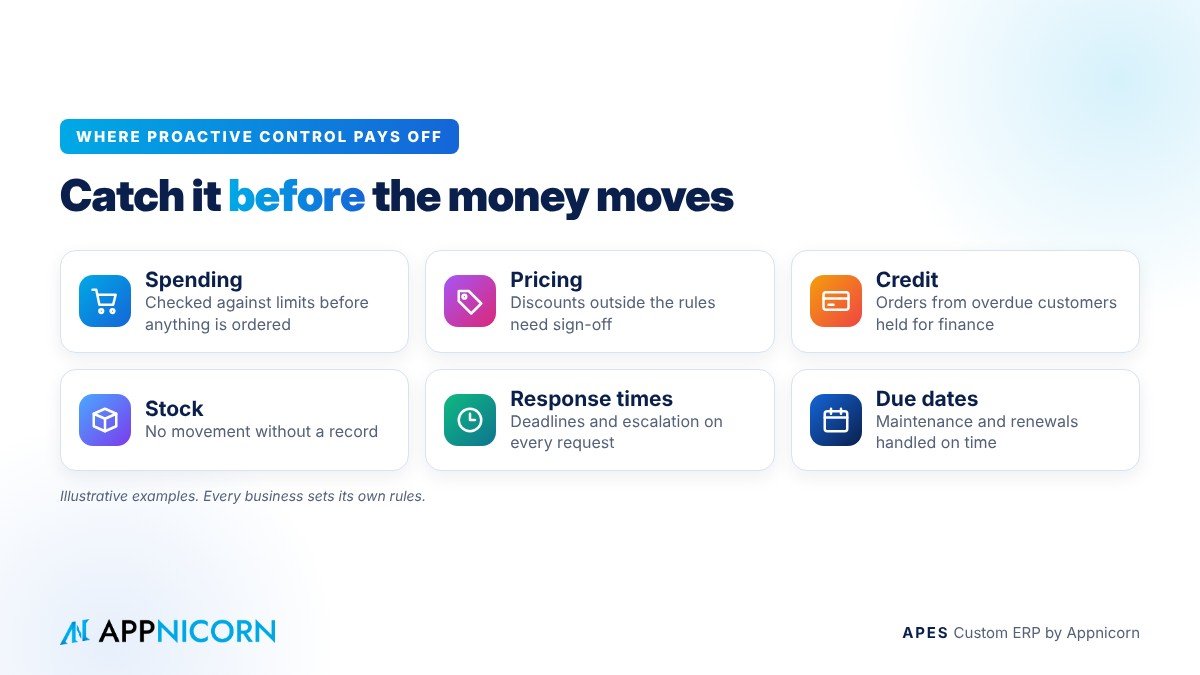
The value of a proactive ERP is easiest to see in the places where money usually leaks. The examples below are illustrative, and every business will have its own.
Spending is the most obvious one. In a reactive business, a purchase is often discovered when the supplier's invoice arrives. In a proactive one, the request is checked against your limits and the budget before anything is ordered, and only approved requests become purchase orders.
Sales pricing is another. Discounts and special prices are where profit quietly disappears. A proactive ERP holds any price or discount outside your normal rules until someone with the authority agrees to it, and records who agreed and when.
Credit control is a third. Instead of finding at month-end that a slow-paying customer received another three deliveries, the system checks the customer's status when the order is entered and holds it for finance to decide.
Stock is a fourth. When every movement needs a record before goods leave, stock stops going missing without explanation, and discrepancies are found when they happen rather than at the next count.
Response times are a fifth. Customer complaints, service jobs, internal requests and approvals all have a natural deadline. With deadlines and escalation built in, the business stops relying on someone remembering to follow up.
And finally, recurring obligations such as equipment maintenance, licence renewals and contract reviews can be tracked with due dates and owners, so they are handled on time rather than discovered when something breaks or expires.
How a proactive rule works, step by step
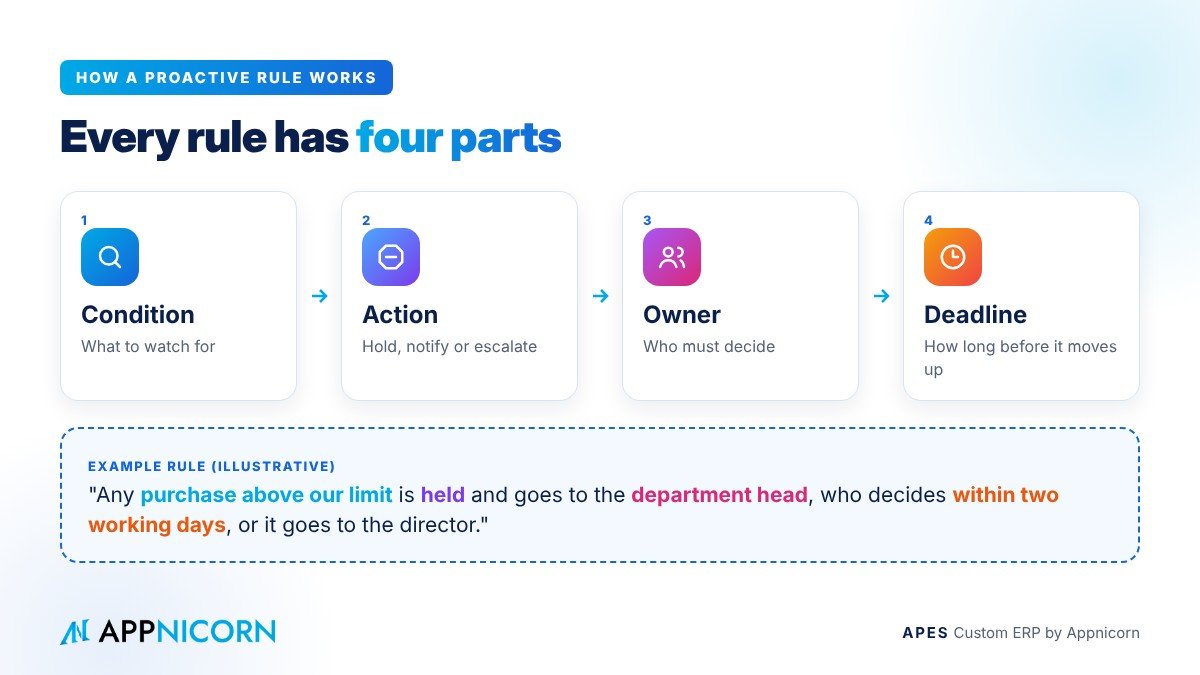
Every proactive rule, however simple or complex, has the same four parts. Understanding them makes it much easier to design your own.
The first part is the condition: what the system is watching for. For example, a purchase request above a certain amount, an order from a customer with overdue invoices, or an approval that has been waiting longer than two working days.
The second part is the action: what the system does when the condition is met. It might hold the work, send it for approval, notify someone, or escalate it.
The third part is the owner: the named person or role who must decide. A rule without an owner simply creates noise. A rule with an owner creates a decision.
The fourth part is the deadline: how long the owner has to act before the work moves on or moves up. This is what stops a held request from becoming a forgotten one.
Put together, a rule reads like a sentence your managers would recognise: "Any purchase above our limit goes to the department head, who must decide within two working days, or it goes to the director." That sentence is your policy. In a proactive ERP, it is also how the system behaves, every time, for everyone.
Proactive is not the same as predictive
It is worth being clear about what proactive means, because the word is often stretched.
A proactive ERP does not guess the future. It does not need to. Most of the problems that hurt a business are not mysteries. They are known risks that slipped through because nobody checked at the right moment: the limit that was exceeded, the customer who was already overdue, the approval that sat in someone's inbox. Applying known rules at the right time catches a very large share of them.
Artificial intelligence can help with this work, for example by reading documents, summarising requests or drafting the next step. But in a well-governed system, AI supports people rather than replacing their judgement. It can prepare a decision; a person makes it.
Why a proactive ERP has to fit your business
Proactive control only works if the rules are your rules. A system that applies someone else's idea of a sensible limit or approval chain will either block work that should flow, or let through work that should have been stopped. Staff quickly learn to work around it, and you are back to WhatsApp and spreadsheets.
This is why proactive control and a custom ERP go together. When every module is built around how your company actually works, with your approval levels, your credit terms, your documents and your exceptions, the rules can be precise. Work that is within the rules flows faster than before, because nobody needs to ask permission. Work that is outside them is caught every time.
Designing your first rules
The best way to start is not with software but with a short list of money questions. Where has the business lost money in the past year because something was found too late? Which decisions would you personally want to see before they are made? Which delays cost you customers or cash?
For each answer, write the rule as a plain sentence with the four parts: the condition, the action, the owner and the deadline. Keep the first set small. A handful of well-chosen rules on the process that costs you most will do more good than dozens of rules spread across the whole company.
Then decide how exceptions will be handled. Real business always has them: an urgent purchase, a trusted customer, a one-off price. A good rule does not forbid exceptions. It makes sure they are decided by the right person and recorded.
What changes for management
When proactive control is in place, the rhythm of management changes.
Meetings shift from "what went wrong last month?" to "what is waiting for a decision now?". Managers spend less time collecting updates and more time deciding. Directors can delegate with more confidence, because the limits they care about are applied whether or not they are in the office. And when something does go wrong, the record already shows what happened, who decided and why, so the conversation is about fixing the cause rather than reconstructing events.
There is a quieter benefit too. Staff tend to prefer clear rules. When everyone knows what needs approval, who decides and how long it should take, there is less awkward chasing, less guesswork and fewer arguments about who said what.
Common pitfalls, and how to avoid them
The first pitfall is too many alerts. If every small event sends a notification, people stop reading them. Keep rules for things that matter, and send each one to a single named owner.
The second is rules that are too rigid. If the system cannot handle a legitimate exception, staff will go around it. Build in a clear path for exceptions, with approval and a record.
The third is rules without owners or deadlines. A held request that nobody is responsible for is just a new place for work to get stuck.
The fourth is setting rules once and never looking at them again. Limits and approval chains should change as the business grows. Review them every few months, using the record of what was held, approved and escalated.
A quick self-check for directors
Ask yourself a few honest questions. When did you last discover a costly problem after it had already happened? Could you list, right now, every approval waiting on a manager in your company? Do your spending and discount limits apply when you are on leave? Would you know today if a customer past their credit terms placed a new order? If any of these answers make you uncomfortable, your business is probably running more reactively than it needs to.
APES: a custom ERP that applies your rules before it costs you
APES (said "A-pes") is a custom ERP made by Appnicorn, a Malaysian IT company with years of experience building business systems. Every module in APES is customised to your company's unique needs, whether that is purchasing, stock, sales, delivery, claims, service jobs or a process unique to your industry. If the module you need does not exist yet, Appnicorn designs and builds it with you.
APES is built for proactive control. Your approval levels and business rules are part of each module, so requests outside your limits go to the right person before anything is committed. Deadlines, reminders and escalation keep work from stalling. Every step is kept in a tamper-evident audit trail, so you always know who decided what, and when. Each business gets its own workspace, with all its modules, records and people in one place.
AI works inside APES as a governed assistant. It can read, summarise and extract information from documents and draft the next step, but it never acts beyond the rights of the person it works for, and a person always makes the decision. As we put it: AI proposes, APES authorises.
Pricing depends on the process being built, so the best first step is a conversation. Show us where your business is losing money: the purchase that went through without a check, the customer who kept ordering, the approval that sat for a week. We will show you how APES would have caught each one, and the rules that would have done it.
Talk to Appnicorn about a proactive, custom ERP for your business.