Process Control in Modern Organizations: Why Governance and Enforcement Matter More Than Ever
In many organizations today, processes exist everywhere. Purchase requests move through approvals, employees apply for leave, finance teams handle invoices, sales teams manage quotations, and operations teams coordinate activities across departments. Businesses create processes because processes bring structure. They define how work should happen.
Yet many organizations discover a frustrating reality. Having a process does not automatically mean having control. A process may look well documented. It may have flowcharts, forms, policies, and standard operating procedures. Teams may even implement a workflow or business process management system. But despite all these efforts, exceptions continue appearing, approvals become inconsistent, rules get bypassed, and different teams begin operating in different ways.
This is where process control becomes important. Process control is not simply about documenting procedures or creating workflows. It is about ensuring processes operate consistently, follow defined rules, and remain aligned with organizational objectives.
As organizations become more digital and complex, process control increasingly depends on stronger business process governance and enforcement mechanisms.
Without governance and enforcement, even well-designed processes can gradually become unreliable. This article explores what process control really means, why traditional approaches often fall short, and how governance and enforcement create sustainable process control across an organization.
What Is Process Control
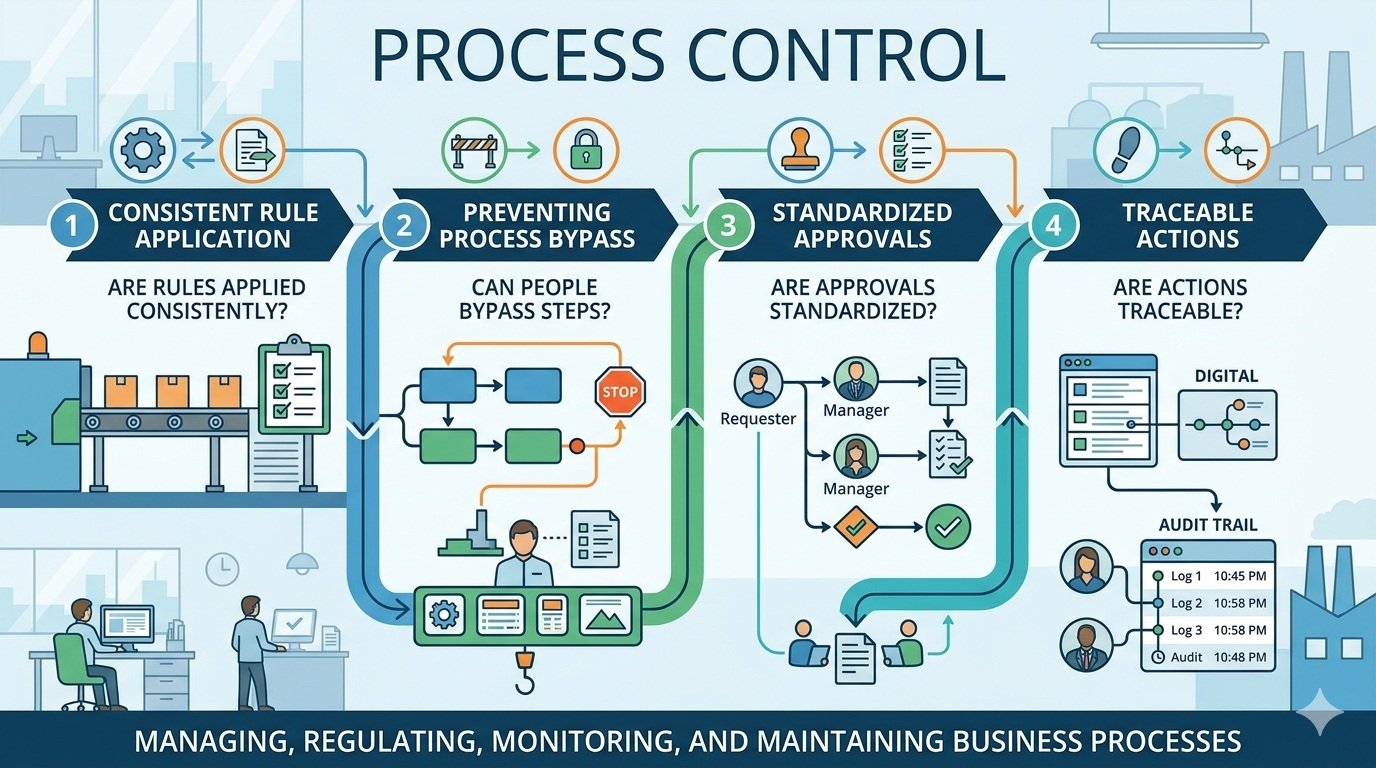
Process control refers to the ability to manage, regulate, monitor, and maintain business processes so they operate according to predefined standards and objectives. In simpler terms, process control answers questions such as are rules applied consistently, can people bypass steps, are approvals standardized, and whether actions are traceable.
In an employee leave process, process control ensures approval rules remain consistent, leave balances are validated automatically, and exceptions are logged. On the other hand, during a procurement process, process control ensures vendor policies are followed and approval chains remain standardized. It also makes sure all purchases above certain values require additional approvals.
Another great example will be the financial approval process. Process control ensures documentation requirements are enforced and audit records remain complete. The objective is not merely operational efficiency, but to maintain predictability, accountability, and compliance.
Why Processes Lose Control Over Time
Organizations often begin with strong intentions. They document workflows, create standard operating procedures, train employees, and implement software systems. Initially, everything appears organized. However, over time, several issues commonly emerge.
Human interpretation changes processes. Employees often interpret procedures differently. One manager may require three supporting documents while another asks for one. One department may apply stricter rules while another becomes more flexible. Eventually, teams start to develop different practices. Processes become inconsistent and exceptions become normal behavior.
Manual Oversight Becomes Difficult
As organizations grow, monitoring every process manually becomes unrealistic. Managers cannot continuously verify whether rules are followed and approvals occur correctly. Manual monitoring creates gaps.
Besides, business changes can happen continuously. Organizations are forced to evolve whenever there are new products, new departments forms, and new regulation changes. Processes that once worked effectively may become outdated. Without controlled governance mechanisms, modifications often happen informally. Sometimes, employees will create shortcuts to complete work faster. They might go for approval bypasses, email-based approvals, and manual overrides. Initially, these exceptions seem harmless. But overtime, they gradually redefine the process itself.
The Difference Between Process Management and Process Control
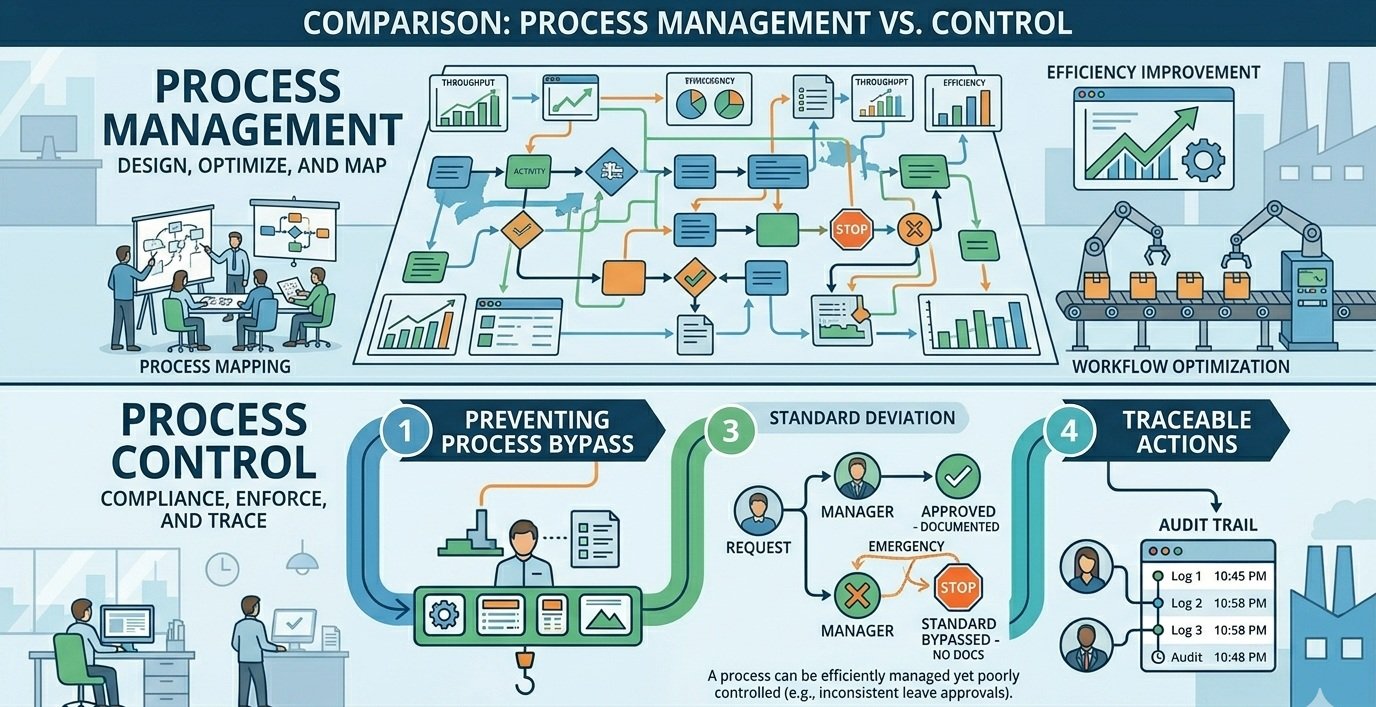
Many organizations assume process management automatically creates process control. The two concepts are related but different. Process management focuses on designing workflows, improving efficiency, mapping activities, and optimizing performance. On the other hand, process control focuses on ensuring compliance, enforcing rules, standardizing behavior, and maintaining accountability.
A process can be efficiently managed yet poorly controlled. For example, a leave approval workflow may process requests quickly. However, when different managers start to apply different approval standards, or ignore documentation requirements for certain emergency cases, the control is lost.
Why Traditional BPM Alone May Not Be Enough
Many organizations adopt Business Process Management (BPM) or workflow automation solutions with the expectation that implementing a system will automatically create complete process control. BPM platforms undoubtedly provide significant value and have become an important component of digital transformation initiatives. They help organizations visualize workflows, automate repetitive activities, optimize operational efficiency, and monitor process performance. These capabilities can reduce manual effort, shorten processing times, and create better visibility across business operations. As a result, many businesses experience noticeable improvements after implementing BPM solutions.
However, while BPM systems are highly effective at managing how work flows through an organization, they often focus more heavily on process execution than process governance. In other words, they can help move work from one stage to another efficiently, but they do not always ensure that the underlying rules, standards, and controls are consistently applied across the organization. A workflow may appear organized and automated on the surface, yet the process can still be vulnerable to inconsistency if governance mechanisms are weak or missing.
One common challenge is that process rules may still remain heavily dependent on individual users. Even within an automated workflow, certain decisions often rely on managers or employees interpreting policies correctly and applying them consistently. This creates room for variation because different individuals may make different decisions under similar circumstances. For example, a manager reviewing an expense request might approve spending that exceeds company policy simply because the system allows flexibility or because the manager interprets the situation differently. In this case, the process itself continues moving forward, but the intended control over policy enforcement becomes weaker.
Another challenge emerges in the handling of exceptions. Most organizations require flexibility because not every situation can fit perfectly into predefined rules. Exceptions are a normal part of business operations, especially when dealing with urgent requests, special cases, or changing business conditions. However, when governance structures are not clearly defined, exceptions can gradually become difficult to manage. Different departments may begin applying different standards for similar situations, documentation requirements may become inconsistent, and accountability can slowly weaken over time. Instead of remaining controlled deviations from standard processes, exceptions can eventually become informal practices that alter the process itself.
Organizations may also begin experiencing uncertainty around process ownership. Questions such as who owns a process, who has the authority to approve changes, who defines standards, and who monitors compliance can become increasingly difficult to answer. When these responsibilities are not clearly established, ownership often becomes fragmented across teams and departments. One group may believe another group is responsible for maintaining the process, while decision-making authority becomes distributed without clear accountability. Over time, this can create confusion, inconsistencies, and operational risk.
BPM remains an important and valuable approach for improving operational efficiency, but efficient process execution alone does not necessarily guarantee strong process control. Organizations increasingly need an additional layer that focuses on governance and enforcement to ensure that processes not only move efficiently but also operate consistently, comply with business rules, and remain aligned with organizational objectives.
Understanding Business Process Governance
Business process governance provides the structured framework that ensures business processes are executed consistently, transparently, and in alignment with organizational objectives. It defines how work should be performed by establishing clear rules, responsibilities, and control mechanisms that reduce ambiguity and prevent inconsistent interpretations of procedures across teams and departments. Without governance, processes tend to drift into fragmented practices where different groups apply their own variations, leading to inefficiency and lack of standardization.
At its core, governance sets policies such as approval thresholds, documentation requirements, and escalation rules to guide process execution in a standardized way. It also clearly defines roles and responsibilities by identifying process owners, approvers, administrators, and reviewers, ensuring accountability is properly assigned and maintained throughout the process lifecycle. In addition, governance introduces accountability mechanisms and performance monitoring frameworks that make it possible to track decisions, measure compliance, and identify process weaknesses using data-driven insights.
Overall, governance transforms business processes from disconnected activities into structured, measurable systems that support consistency, accountability, and continuous improvement across the organization.
Why Governance Alone Is Still Not Enough
Business process governance plays an important role in creating structure and consistency across an organization. Governance establishes the rules, policies, and standards that define how processes should operate. It helps organizations clarify responsibilities, create accountability, and align processes with business objectives. However, while governance provides direction, rules by themselves do not guarantee that processes will actually be executed as intended. Defining standards is only one part of achieving effective process control. The greater challenge often lies in ensuring those standards are applied consistently during day-to-day operations.
Many organizations already have extensive governance structures in place. They create policies that define acceptable practices, develop standard operating procedures (SOPs) to guide employees, maintain documentation for various workflows, and establish governance committees responsible for oversight and decision-making. On paper, these organizations may appear highly organized and well controlled. The expectation is often that if enough documentation and policies exist, process consistency will naturally follow. However, despite these efforts, operational issues frequently continue to appear.
The reason is that documented rules still rely heavily on human behavior. Policies and procedures often assume that individuals will remember requirements, interpret them correctly, and consistently apply them in every situation. In reality, people operate under changing circumstances, competing priorities, and time pressures. Employees may forget certain requirements, especially when processes become more complex or involve numerous exceptions. Different individuals may also interpret the same rule differently, leading to inconsistent decision-making across departments or teams.
Human behavior naturally introduces variation into processes. Some individuals may intentionally make exceptions because they believe special circumstances justify a different approach. Others may create shortcuts to complete work more quickly, especially when they perceive certain steps as unnecessary obstacles. Over time, these shortcuts can gradually become accepted practices rather than isolated exceptions. As a result, the process that exists in documentation may begin to differ significantly from the process that actually occurs in daily operations.
This creates a significant limitation for governance alone. Governance can define what should happen, but it cannot automatically ensure that it does happen. Without mechanisms that actively apply and monitor rules during process execution, organizations become heavily dependent on manual discipline and human consistency. The effectiveness of the process increasingly relies on individuals remembering policies and choosing to follow them correctly every time. As organizations grow larger and processes become more complex, maintaining this level of consistency through manual effort alone becomes increasingly difficult.
For this reason, governance by itself is often insufficient to achieve sustainable process control. Organizations increasingly require enforcement mechanisms that move beyond documented intentions and actively ensure that governance rules are applied consistently in practice. Governance creates the framework, but enforcement helps transform that framework into reliable operational behavior.
The Missing Layer: Process Enforcement
Process enforcement addresses the critical gap between defining governance rules and ensuring they are consistently followed in real-world execution. While governance establishes policies, standards, and procedures, enforcement ensures these rules are automatically applied within workflows and systems, reducing reliance on human memory, interpretation, or discipline. Instead of expecting individuals to consistently remember and apply rules correctly, enforcement embeds them directly into process execution to create built-in compliance and operational consistency.
This is achieved through mechanisms such as automated approval validation, mandatory documentation checks, exception tracking, and role-based access controls. For example, purchase approvals can be automatically routed based on predefined thresholds, required documents can be enforced before a process continues, and any deviations from standard rules can be logged and made auditable. These controls ensure that processes remain aligned with governance standards while reducing errors, inconsistencies, and unauthorized actions.
Ultimately, process enforcement transforms process control from a reactive approach—where issues are identified after they occur—into a proactive system that prevents many failures before they happen. This leads to stronger consistency, improved accountability, better security, and more reliable business operations overall.
How Process Governance and Enforcement Strengthen Process Control
Process control is strengthened when governance, enforcement, and monitoring work together as a unified system. Governance defines what should happen by setting rules, policies, approval structures, and ownership responsibilities across business processes. However, governance alone is not enough to ensure consistent execution, which is where process enforcement becomes essential. Enforcement ensures that these rules are applied in real time through system-driven mechanisms such as automated validations, access controls, and rule-based routing, reducing reliance on human memory or interpretation.
Process control sits above both governance and enforcement by monitoring whether processes are functioning correctly over time. It uses compliance reports, audit trails, and performance indicators to identify deviations and ensure continuous improvement. A practical example can be seen in employee leave management, where manual processes often lead to inconsistent approvals, missing documentation, and policy violations. When governance and enforcement are applied, approval rules, documentation requirements, and leave limits are automatically enforced, resulting in consistent, transparent, and auditable outcomes.
Overall, combining governance with enforcement transforms process control from a manual, error-prone activity into a structured, automated, and reliable system that improves consistency, accountability, and operational efficiency across the organization.
Benefits of Strong Process Control
Strong process control delivers significant value by ensuring that business operations remain consistent, predictable, and aligned with organizational objectives. When governance and enforcement are effectively embedded into processes, organizations experience fewer deviations from standard procedures and greater uniformity in how work is executed across teams and departments. This consistency reduces operational risk, as processes are less likely to be influenced by individual interpretation or ad-hoc decision-making. It also improves compliance, since rules are not only defined but actively applied throughout execution. Over time, this leads to more reliable audit outcomes, better transparency, and stronger confidence in operational integrity. In addition, strong process control enhances efficiency by reducing the need for manual intervention, exception handling, and corrective actions, allowing teams to focus on higher-value activities rather than repeatedly fixing process breakdowns. Ultimately, organizations benefit from improved decision-making because the data generated from controlled processes is more accurate, structured, and trustworthy.
Signs Your Organization May Have Weak Process Control
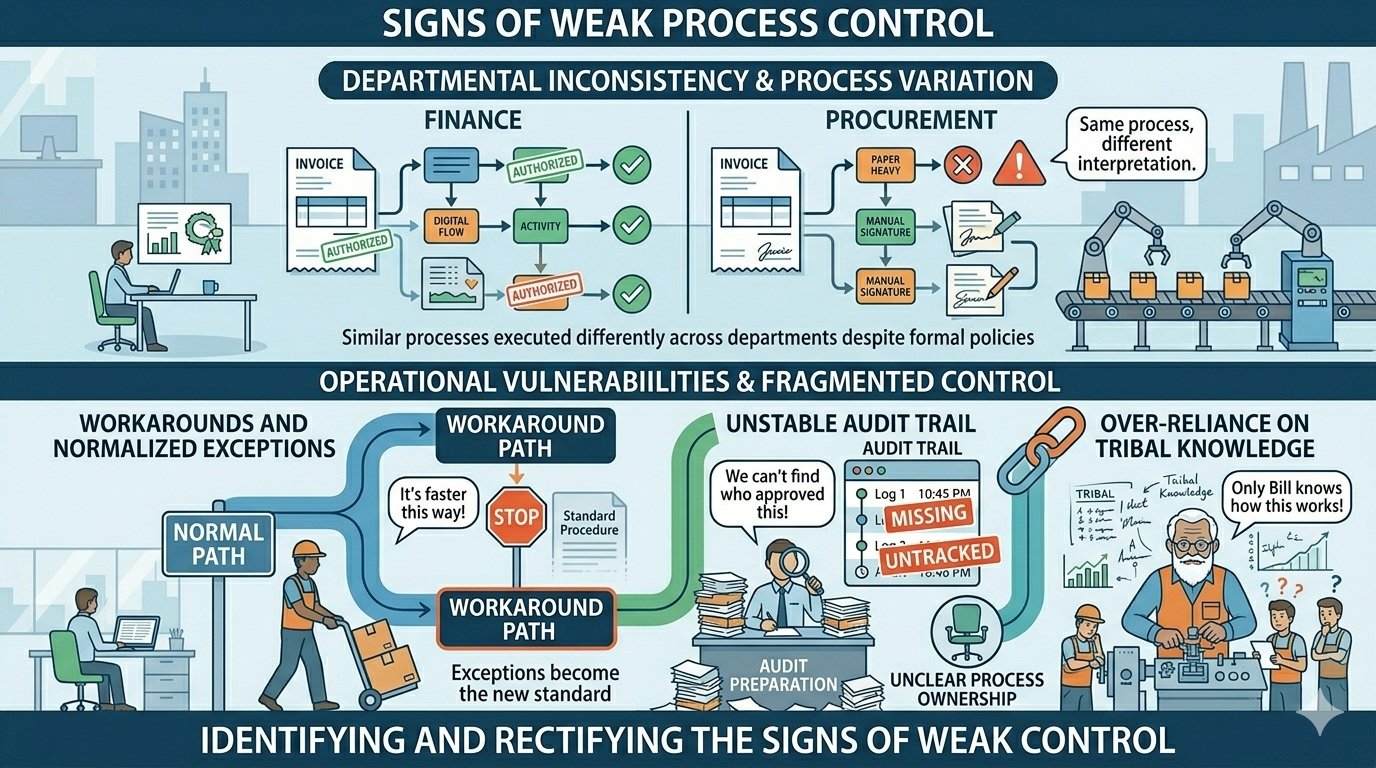
Organizations with weak process control often show subtle but persistent signs of inconsistency in their operations. One common indicator is that similar processes are executed differently across departments, even when formal policies exist. This variation suggests that rules are being interpreted individually rather than enforced consistently. Another sign is the frequent reliance on informal practices or workarounds, where employees bypass standard procedures to complete tasks more quickly or conveniently. Over time, these exceptions may become normalized rather than treated as deviations. Difficulty in audit preparation is also a strong indicator of weak control, as organizations struggle to trace decisions, approvals, or exceptions back to clear rules and accountable individuals. Additionally, when process ownership is unclear or fragmented, it becomes difficult to determine who is responsible for maintaining standards or addressing process issues. In many cases, organizations also notice that they depend heavily on specific individuals or “tribal knowledge” to ensure processes run correctly, which creates operational vulnerability if those individuals are unavailable or leave the organization.
The Future of Process Control
The future of process control is increasingly moving toward automation, real-time enforcement, and intelligent governance systems. As organizations continue to grow in complexity and operate in faster-paced environments, traditional approaches that rely heavily on documentation and manual oversight are becoming less effective. Instead, process control is evolving into a system-driven capability where rules are embedded directly into operational workflows and enforced automatically during execution. This shift reduces dependency on human memory and interpretation while improving consistency at scale. Emerging technologies such as artificial intelligence and advanced analytics are also enhancing process control by identifying anomalies, predicting risks, and suggesting improvements based on real-time data. As a result, organizations will increasingly adopt continuous, always-on control systems where governance, enforcement, and monitoring operate seamlessly together. This evolution will enable businesses to maintain stronger compliance, faster decision-making, and higher operational resilience in dynamic environments.
Conclusion
Process control is not achieved through documentation alone, nor through governance policies or workflow automation in isolation. It is the result of a structured combination of governance, enforcement, and monitoring working together as an integrated system. Governance defines the rules and expectations that shape how processes should function, while enforcement ensures those rules are consistently applied during execution. Process control then monitors outcomes to ensure that processes continue operating correctly and efficiently over time. When these elements are aligned, organizations move beyond fragmented and inconsistent workflows toward stable, reliable, and accountable operational systems. In contrast, when any of these layers is missing, process behavior becomes increasingly dependent on individual interpretation and manual discipline, leading to variability and operational risk. Strong process control ultimately enables organizations to operate with greater consistency, transparency, and confidence, forming the foundation for scalable and sustainable business operations.